
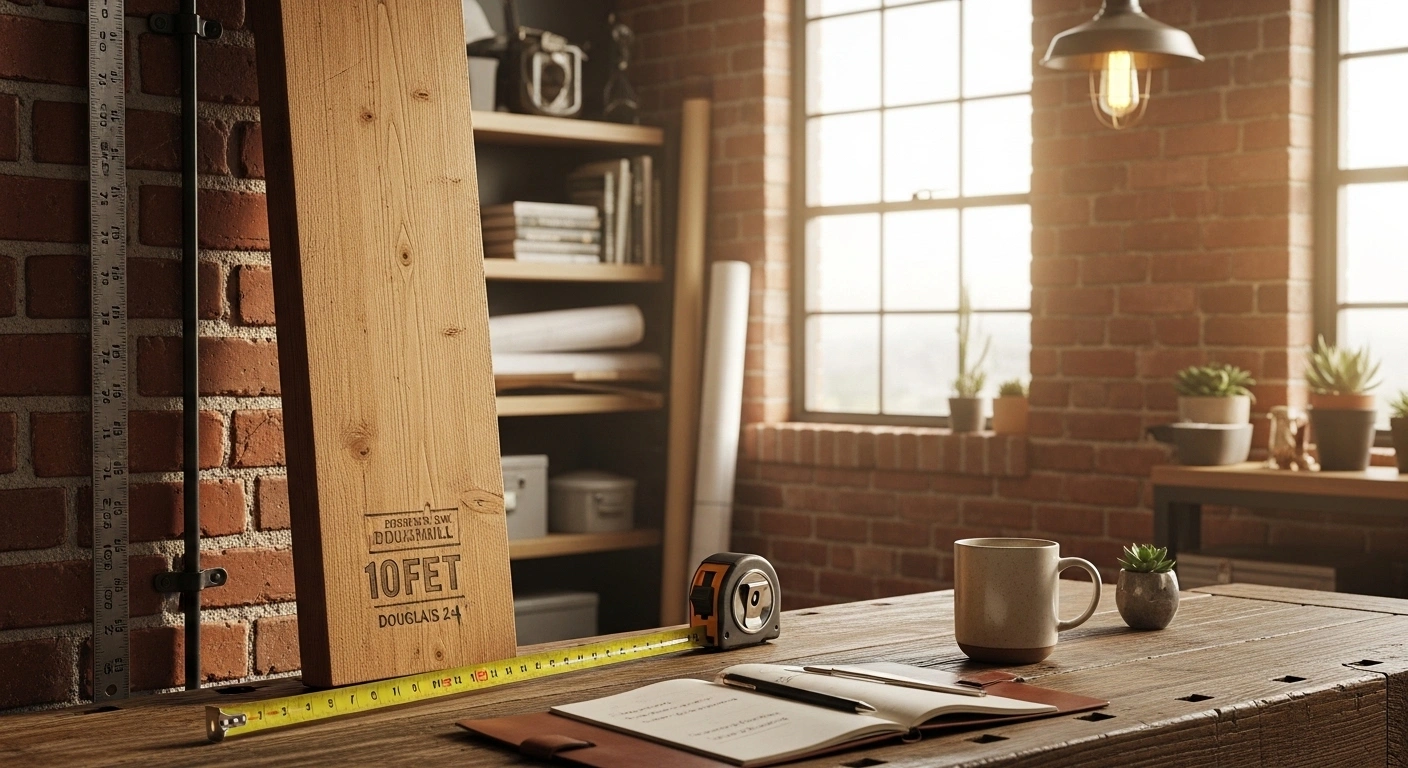

Ten feet equals 120 inches, 3.048 meters, or 3.33 yards. Visually, 10 feet matches a regulation basketball rim’s height, the width of a single-car garage door, the length of a small U-Haul truck, or two average adult men lying head to toe on the floor. Most single-car garages are 10 feet wide, and step ladders marketed as “10-foot” reach the top of a 9-foot ceiling with room to work.
You’re trying to picture a room, a rug, or a fence panel, and the number 10 feet just refuses to land. The problem: 10 feet reads short outdoors and long indoors, so a raw conversion won’t help you plan. After running dozens of size comparisons for BusinessComputingWorld readers over the past year, here’s how to make 10 feet click for whatever you’re actually deciding.
The foot as a unit was standardized at exactly 0.3048 meters by international agreement in 1959, which is why 10 feet lands on a precise 3.048 meters rather than a rounded figure. That agreement, known as the International Yard and Pound Agreement, aligned US and Commonwealth measurements and remains the definition used by the National Institute of Standards and Technology today. In practical terms, 10 feet corresponds to a common design threshold in American housing. The International Residential Code sets 7 feet as the minimum ceiling height for habitable rooms, while 9 to 10 feet is the range architects call a “premium” ceiling. A basketball rim has stayed at 10 feet since James Naismith nailed peach baskets to a Springfield gym balcony in December 1891. That single decision — never revised across 130-plus years of professional and amateur play — is why 10 feet feels instantly readable to millions of people who have never picked up a tape measure.
How Long Is 10 Feet in Inches, Meters, and Yards?
Ten feet is exactly 120 inches, 3.048 meters, or 3.33 yards. On the metric side, that’s 304.8 centimeters or 3,048 millimeters. As a fraction of a mile, 10 feet is about 0.00189 — a rounding error over any commute distance.
The precision matters if you’re ordering fabric, lumber, or fencing. A “10-foot” 2×4 board is cut to 120 inches with a small tolerance, not 3 meters. Metric-priced materials use the 3.048-meter figure, so a 3-meter panel is slightly shorter than 10 feet, not slightly longer.
| Unit | Equivalent of 10 feet | Where you’ll see it |
|---|---|---|
| Inches | 120 | Craft, sewing, small parts |
| Yards | 3.33 | Landscaping, fabric bolts |
| Meters | 3.048 | Metric plans, international specs |
| Centimeters | 304.8 | Furniture dimensions |
| Millimeters | 3,048 | Precision engineering |
| Miles | 0.00189 | Long-distance context |
Rounding 10 feet down to 3 meters shaves almost two inches off your run. That gap shows up as visible mismatch in cabinetry, curtains, or flooring seams. For rough framing, the gap disappears into trim. For finish carpentry, tile layout, or wallpaper alignment, it never does.
For the smaller reference frame you’ll need in daily life, our breakdown of how long an inch really is covers coin, paperclip, and hand-span comparisons that scale up cleanly to 10 feet. Ten feet also lines up with a few familiar household measures. A residential doorway is 30 to 36 inches wide, so 10 feet is roughly four doorways side by side. A standard queen bed is 60 inches wide, meaning 10 feet is exactly two queens laid side by side across a wall.
10 Real Things That Are Almost Exactly 10 Feet Long
Ten objects match the 10-foot mark and appear in most people’s daily lives, which is why the length feels intuitive once you tie it to physical references. A regulation basketball hoop stands 10 feet from floor to rim, a standard preserved in the NBA rulebook since the league adopted Naismith’s original height. U-Haul’s smallest moving truck measures 10 feet in cargo length. A “10-foot” 2×4 lumber board is a stock length at every major American home center, cut to 120 inches with roughly 1/8 inch of tolerance. Standard single-car garage doors are 10 feet wide by 7 feet tall per most builder specifications. Adult male American alligators average 8 to 11.2 feet in length, placing many wild adults right at the 10-foot line. Recreational sit-in kayaks in the “beginner” class measure 9.5 to 10.5 feet. A Christmas tree marketed as “10-foot” typically arrives between 9.8 and 10.2 feet after netting is removed.
Two adults of average American male height (5 feet 9 inches) lying head to toe measure just under 11 feet — close enough that “two guys on the floor” is a useful visual shortcut for 10 feet.
Three standard shopping carts lined up nose to tail also cover about 10 feet, since a typical cart runs 38 to 42 inches long. That’s the trick photographers use when they need to visualize distance in a parking lot without a tape.
For a smaller-scale companion reference, our guide to how long 10 inches is shows the same 12:1 ratio in miniature — useful when you’re switching between room-scale and desk-scale planning.
Why Does 10 Feet Feel Different in a Room, a Yard, or a Hallway?
Ten feet feels short outdoors and generous indoors. Your eye judges distance relative to the boundaries around you, so a 10-foot span across an open lawn reads as “a few strides.” The same 10 feet inside a small bedroom reads as “wall to wall.” The number never changes. Your perception of it does.
Spatial scale sensitivity — how a fixed length reads across different environments — is a documented effect in architectural design. Ten feet inside a hallway feels tight because your peripheral vision picks up walls on both sides, compressing your sense of forward space. In a 10-foot-wide living room, the same distance reads as “cozy but usable” because you perceive depth from your seat, not lateral distance. Outdoors, 10 feet reads as short because the eye has no near boundary, and distant objects dominate perception. A standard US parking spot is 9 feet wide by 18 feet deep, per Institute of Transportation Engineers design guidance. Ten feet of vertical clearance meets the “premium ceiling” bar defined in the International Residential Code code family. Understanding scale sensitivity matters most when planning: 10 feet of open space in a small apartment feels spacious, while 10 feet in a garden feels like the neighbor’s fence is close enough to touch.
Here’s the sensitivity matrix I use to explain this to clients:
| Context | How 10 feet reads | Best real-world use |
|---|---|---|
| Interior hallway | Very tight — pressure on both sides | Corridor, closet reach-in |
| Small bedroom width | Cramped as full room | Studio nook, single-bed setup |
| Standard living room depth | Comfortable sofa-to-TV distance | Media zone, conversation area |
| Kitchen island run | Generous prep zone | Two-cook workflow |
| Backyard patio side | Small — one dining set fills it | Bistro table, grill area |
| Open lawn or driveway | Very short — five strides | Passing gap, mower turnaround |
| Vertical ceiling | Premium — feels airy | Great room, loft |
For readers comparing room footprints, our reference on how big 500 square feet is shows how a 10-foot wall lands inside a small apartment.
How to Walk Out 10 Feet Without a Tape Measure
Four adult male steps or roughly four and a half female steps cover 10 feet, but personal stride varies more than most guides admit. The reliable method is to calibrate your own step length once, then reuse it. Two calibration methods work: the 10-step count on a marked line, or the tile-count method on a known floor.
Population averages give you a starting point. According to CDC gait data and biomechanics research, the average adult male has a step length of about 2.5 feet at a comfortable walking pace. The average adult female steps about 2.2 feet. Height shifts these numbers: taller people step longer, and a brisk pace stretches stride by 10 to 15 percent.
Calibrate your stride in under two minutes:
- Find a hallway or sidewalk with a known 10-foot mark — a garage door width works.
- Walk the distance at a normal pace, counting each foot-fall.
- Divide 10 by your count. That’s your step length in feet.
- Repeat twice more and average the three counts.
Most people land between 2.1 and 2.7 feet per step. If you’re 5 feet 6 inches, expect about 2.3 feet per step. At 6 feet 2 inches, expect 2.6 or slightly more. Once you know your number, converting distance becomes easy. To pace out 10 feet from now on, just divide 10 by your step length and count that many footfalls.
Two common calibration errors ruin the result. Walking too slowly artificially shortens your stride. Walking heel-to-toe like a tightrope walker also gives a false short reading. Use your natural pace — the one you’d use walking to a mailbox.
How to Sketch 10 Feet Accurately on Paper for Room Planning
Ten feet on paper looks convincing only when you use a consistent scale. The two standard architectural scales for residential plans are 1/4 inch equals 1 foot and 1/2 inch equals 1 foot. At 1/4-inch scale, 10 feet is exactly 2.5 inches on paper. At 1/2-inch scale, 10 feet is 5 inches. Pick one and hold it through the whole drawing.
Graph paper simplifies the math. Standard quad-ruled paper has 4 squares per inch, so each square equals 3 inches at 1/4-inch scale. Ten feet then covers 10 squares. Engineering graph paper with 5 squares per inch reads a bit differently: each square becomes 2.4 inches at 1/4-inch scale, which is awkward for precise drafting. Stick to quad-ruled for room sketches.
The scale trap most homeowners fall into: switching scales mid-drawing. If your 10-foot living room wall is 2.5 inches on paper but your 6-foot couch is drawn 3 inches wide because “it felt right,” the plan lies to you. The couch appears smaller than the wall, when in reality the couch takes up 60 percent of the wall.
Draw the room’s outer walls first at true scale. Sketch the doorways and windows next. Add furniture last, with each piece’s real dimensions scaled from your measurements. If you’re planning square footage as well, our overview of what a square foot actually looks like helps you place scaled area rugs and mats into the drawing.
A digital shortcut works too. Free tools like Roomstyler, Planner 5D, or SketchUp Free let you type “10 feet” directly and place the wall to scale. The manual-paper method is faster for a single wall or fence run.
What TV Size Works Best from 10 Feet Away?
At 10 feet from your screen, a 75-inch 4K TV hits the THX cinematic reference of a 36-degree horizontal viewing angle. A 65-inch TV at 10 feet matches the more conservative SMPTE 30-degree standard. For pure home-theater immersion, an 85-inch screen at 10 feet approaches the 40-degree upper THX comfort threshold.
TV size at 10 feet is set by viewing angle, not personal preference. THX certification specifies a 36-degree horizontal field of view as the standard for cinematic viewing. The formula is direct: multiply viewing distance in inches by 0.84 to get the ideal 4K diagonal. At 10 feet (120 inches), that math yields about 100 inches for a fully immersive front-projection setup and roughly 75 inches for the 36-degree angle on a 16:9 TV. SMPTE, the professional broadcast standards body, uses 30 degrees as its minimum acceptable viewing angle, which lands at 65 inches for a 10-foot distance. RTINGS, an independent testing lab, recommends 40 degrees for modern 4K content, pointing to about 85 inches at 10 feet. Below 55 inches at 10 feet, most viewers report a small-screen feeling. Above 85 inches at 10 feet, eye strain starts to rise in typical rooms with mixed lighting.
Resolution changes the near limit, not the far limit. A 4K screen lets you sit closer without visible pixels, but the viewing-angle math for the “best” size stays the same. A 1080p 75-inch TV at 10 feet still hits the 36-degree angle, but text and fine detail will look softer than 4K at the same distance.
The room-lighting factor gets overlooked. In a bright living room with windows on two walls, drop one size below the calculated ideal — glare washes out a screen too large for the wall. In a controlled home-theater room, go up one size.
Buying at 10 Feet: Rugs, Sofas, Curtains, and Shelves That Actually Fit
A 10-foot wall or run changes what you can buy. Rugs, sofas, curtain rods, and shelving all have standard sizes that either work well or fight the 10-foot dimension. Getting this right saves a return trip and awkward gaps you notice every day.
For area rugs, an 8×10 rug is the standard sold at Home Depot, IKEA, and Wayfair for a room where the longest wall is 10 feet. That 8-foot rug width leaves one foot of exposed floor on each side of a 10-foot wall. If you want the rug to touch the baseboards, go with a 9×12 and let the rug run under low-profile furniture legs. A 10×14 rug will bunch against baseboards on a 10-foot wall — skip it for rooms this size.
Sofas at 10 feet work best in the 84 to 96-inch range. That leaves 12 to 36 inches of breathing space on the wall for end tables or floor lamps. A 108-inch sofa on a 10-foot wall pins itself corner to corner — visually heavy and hard to style.
Curtain rods for a 10-foot window run should extend 4 to 6 inches past the window casing on each side. That means an actual rod length of 130 to 132 inches — one of the reasons most extra-wide rod tracks are sold in 120-inch and 144-inch lengths.
For shelving, a 10-foot wall handles two 5-foot shelving units without a gap, or one wall-length 10-foot shelf if you can get plywood or MDF ripped to size. If you’re comparing furniture footprints, our guide to how big an Alaskan king bed is shows how oversized furniture reshapes a 10-foot wall.
10 Feet Compared to Other Common Measurements
Ten feet sits in a specific band between everyday human-scale references and larger architectural ones. Placing 10 feet alongside neighboring measurements helps you triangulate distances you don’t have a direct comparison for.
| Comparison | Distance | Relationship to 10 feet |
|---|---|---|
| 3 meters | 9.84 feet | About 2 inches shorter |
| Small sedan length | 14-15 feet | 1.5× longer |
| Twin bed length | 6.25 feet | 62% of 10 feet |
| 20-foot shipping container | 20 feet | Exactly 2× longer |
| 10 meters | 32.8 feet | 3.28× longer |
| Two full-size sedans | ~30 feet | 3× longer |
| One story of a house | 10 feet | Same |
| Half a school bus | 20 feet | Reaches 10 feet at midpoint |
For the metric-scale comparison, our companion piece on how long 10 meters is walks through city buses, diving platforms, and telephone poles at that mark. And if you’re jumping up in scale, how long 20 feet is shows shipping containers, moving trucks, and giraffe-height comparisons.
The most useful mental anchor: 10 feet is the width of one parking spot plus one foot of curb, or the height of one residential story. If you can visualize either, you can visualize 10 feet in any direction.
Common Mistakes People Make When Estimating 10 Feet
The biggest misconception about 10 feet: assuming every ceiling in an American home is 10 feet high. Most residential ceilings are 8 feet, with 9-foot ceilings common in newer construction and 10-foot ceilings marketed as a premium feature. When someone says “the ceiling is about 10 feet,” they usually mean 8. Always measure before ordering a 10-foot curtain drop or a tall bookcase.
Second common error: confusing a “10-foot” ladder with 10 feet of vertical reach. A 10-foot step ladder tops out around 10 feet at the very top step, but working reach — the height where you can safely stand and use both hands — is closer to 8 feet.
Pacing errors are also frequent. Four steps looks like 10 feet on paper, but if your normal stride is 2.3 feet, four steps is only 9.2 feet. Over a longer distance the error compounds, and a “20-foot” fence panel becomes 18.4 feet in practice. Calibrate once.
Depth perception at 10 feet is easily miscalled outdoors. Ten feet of grass looks like nothing until you place a chair on it. Then the same 10 feet feels like a real gap. If you’re planning a lawn layout, always place a physical marker at your intended distance before ordering plants or pavers. A visual reference on 1000-square-foot rooms helps calibrate when you’re planning larger indoor-outdoor transitions.
Finally, people underestimate how far 10 feet feels underwater. In a swimming pool, 10 feet of depth reads as significant because you can’t stand — the same 10 feet on land is one truck length.
FAQ
How many steps is 10 feet?
Four steps for an average adult male at a natural walking pace, or four and a half steps for an average adult female. If your height falls outside the 5-foot-6 to 6-foot range, calibrate your own stride length for accuracy.
How many meters is 10 feet?
Ten feet equals exactly 3.048 meters, based on the 1959 international agreement that defined one foot as 0.3048 meters. Rounding to 3 meters loses almost two inches over a 10-foot run.
Is 10 feet the same as 3 meters?
No, but the difference is small. Ten feet is 3.048 meters, so a 3-meter object is about 1.9 inches shorter than a 10-foot object. The gap becomes visible in trim, tile, and cabinetry work.
How big is a 10 by 10 foot room?
A 10×10 room is exactly 100 square feet — small for a bedroom, adequate for a home office, and generous for a walk-in closet. It fits a queen bed plus one nightstand or a large desk plus a filing cabinet with walking clearance.
Is a 10-foot ceiling considered tall?
Yes, in residential construction. Standard American ceilings are 8 feet, 9-foot ceilings appear in newer builds, and 10-foot ceilings are marketed as a premium feature in single-family homes. Great rooms and lofts often go higher.
Are American alligators really 10 feet long?
Adult male American alligators average 8 to 11.2 feet in length, per National Geographic species data, placing many wild adults right at the 10-foot line. Females are typically smaller at 6 to 9 feet.
What size TV do I need for a 10-foot viewing distance?
A 65-inch 4K TV meets the SMPTE 30-degree comfort standard at 10 feet. A 75-inch 4K TV meets the THX 36-degree cinematic reference. Choose 65 for mixed-use rooms and 75 or larger for dedicated media rooms.
Next Steps for Visualizing 10 Feet
Measure one 10-foot span in your own home before your next furniture decision, whether it’s your longest wall, your driveway width, or your hallway length. Mark it with painter’s tape at both ends, then live with the visual for a day. That single reference point calibrates every future estimate you make.
If you’re planning a room, sketch the 10-foot wall at 1/4-inch scale on graph paper and place scaled furniture cutouts before buying anything. If you’re picking a TV, measure the actual distance from where you’ll sit — then apply the 0.84 THX multiplier to pick a size that hits the cinematic angle.
Pace off 10 feet using your calibrated stride at least once this week. That skill compounds. Once you can walk out 10, 20, and 50 feet without a tape, you’ll never buy the wrong-size rug or bookshelf again.
Ten feet is a length that rewards a single moment of physical calibration with years of reliable estimation. Spend the two minutes today.
