
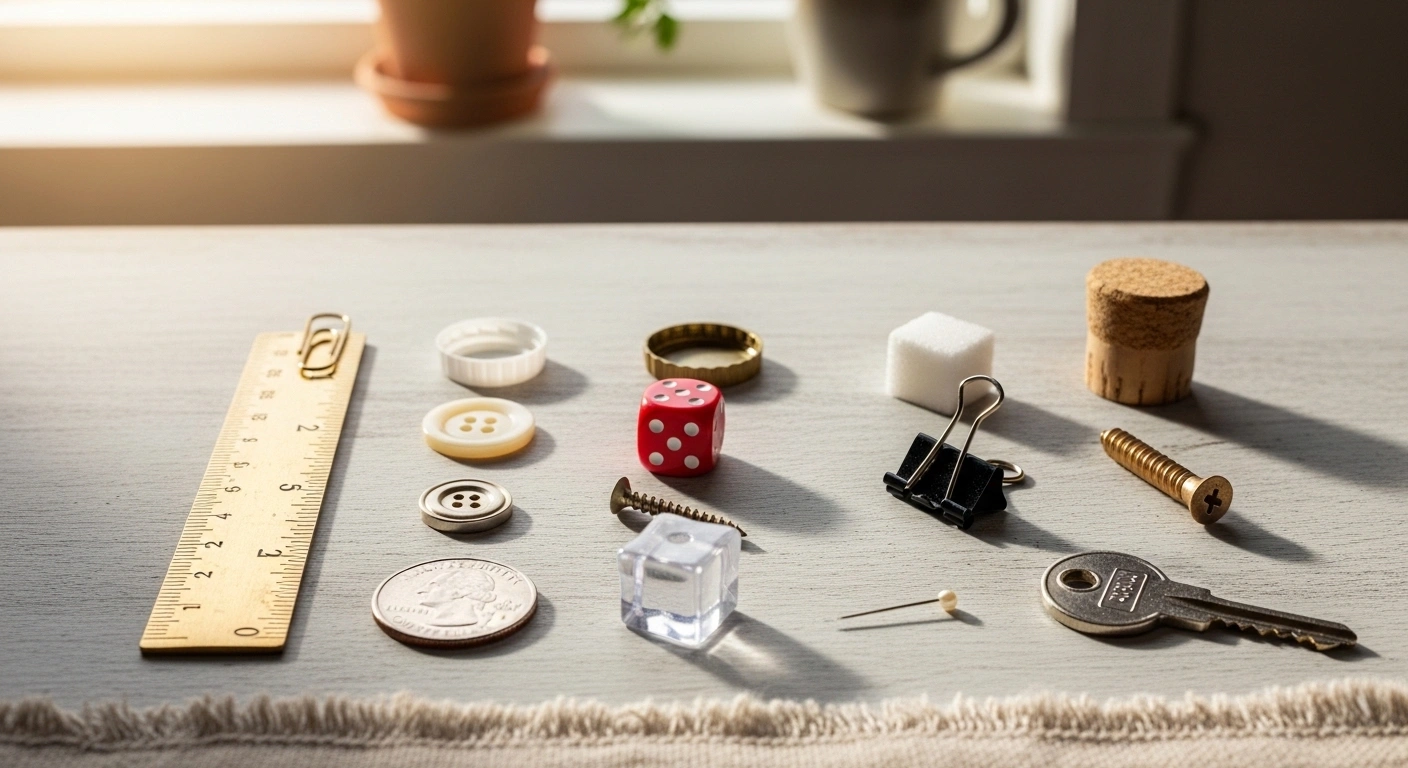

How long is an inch? An inch equals exactly 2.54 centimeters (25.4 millimeters) — one-twelfth of a foot. Common reference objects get you close: a small paperclip, an adult thumb at the knuckle, or a U.S. quarter across.
You’re staring at a spec that says “1 inch” and can’t picture it. Every ruler you own is buried somewhere.
What settles it fast is a mental library of everyday objects already within arm’s reach. That library is what BusinessComputingWorld has built across dozens of size guides.
The international inch has been fixed at exactly 25.4 millimeters since the 1959 International Yard and Pound Agreement, when representatives from the United States, United Kingdom, Canada, Australia, New Zealand, and South Africa aligned their measurement standards. That agreement defined the international yard as 0.9144 meter, which locks the inch (1/36 of a yard) at 25.4 mm and the foot at 0.3048 meter exactly. The National Institute of Standards and Technology (NIST) has maintained this definition ever since, most recently reinforcing it by deprecating the older U.S. survey foot on December 31, 2022. In practical terms, one inch equals 2.54 centimeters, 25.4 millimeters, 0.0254 meters, or 0.0833 feet. On a standard 12-inch ruler, an inch is the distance between any two consecutive whole-number marks. On a computer screen at 96 DPI one inch spans 96 pixels; at 300 DPI print resolution, it spans 300 pixels.
What Exactly Is an Inch? The Precise Definition
An inch is a unit of length in the imperial and U.S. customary systems. Its exact modern value is 25.4 millimeters, or 2.54 centimeters.
One inch equals one-twelfth of a foot and one thirty-sixth of a yard. The symbol is either “in” or a double prime mark (″).
That fixed 25.4 mm number is not an estimate. It came from a 1959 international agreement between six English-speaking countries. All six signed off on the same yard length.
Before that, an American inch and a British inch were microscopically different. That gap mattered to engineers. Unifying the definition was the fix.
Every measurement standards body now traces the inch back to the meter. The meter itself is defined by the speed of light.
The International Bureau of Weights and Measures sets the exact number. That gives the inch scientific-grade precision without needing its own physical object.
Here is why that matters. Any tape measure, caliper, or ruler you use is legally traceable to the same 25.4 mm root. You are working with the same inch as a Boeing engineer or a London jeweler.
12 Everyday Objects That Are Almost Exactly 1 Inch Long
Knowing how long an inch is without a ruler comes down to memorizing a few reference objects. These twelve items sit within reach in most homes. Each gives you a close reference. None are perfect. Use them for quick estimates, not precision cuts.
| Object | Measurement | Accuracy |
|---|---|---|
| Small (#1) paperclip length | 1.0 inch | Very close |
| U.S. quarter diameter | 0.955 inch | Slightly under |
| Adult thumb at knuckle (width) | 0.9–1.1 inch | Varies |
| Standard bottle cap diameter | 1.0 inch | Very close |
| Mini sticky note (one side) | 1.0 inch | Exact |
| USB-A plug (visible metal shell) | 1.0 inch | Very close |
| Index fingertip to first joint | ~1.0 inch | Adult average |
| Standard die (face plus a nudge) | 0.625 inch face | Under |
| Pink pencil-tip eraser (long side) | 0.85–1.0 inch | Close |
| Large shirt button diameter | 0.75–1.0 inch | Close |
| Peanut in the shell (length) | ~1.0 inch | Very close |
| Standard SIM card long edge | 0.98 inch | Very close |
Three of these deserve a closer look because they are the ones most people already carry.
The paperclip is the workhorse. A standard #1 paperclip is designed to be almost exactly one inch.
Brands like Officemate, ACCO, and Staples stay consistent to that spec. Lay one flat and you have a portable inch.
The U.S. quarter is your pocket ruler. Its diameter is 0.955 inch, per U.S. Mint specifications — about 0.045 inch shy of a full inch.
That gap is roughly the thickness of a business card. For anything outside precision work, that gap disappears in the noise.
The adult thumb is the original inch. The word itself traces to the Latin uncia, meaning one-twelfth. The practical origin was the width of a grown man’s thumb.
Most adult thumbs measure between 0.9 and 1.1 inches at the knuckle. Calibrate yours once against a ruler and it becomes a lifetime tool.
For a longer reference, our guide to 3-inch object comparisons applies the same library approach at triple the scale.
How to Measure an Inch Without a Ruler (No-Tool Methods)
When you need to measure how long an inch is and no ruler is available, three methods deliver reliable results. Each takes under thirty seconds and uses only what you have on you.
Each method is accurate enough for shopping, DIY estimates, and quick sanity checks on product specs.
Method 1: The Thumb Knuckle
Your thumb’s first joint — from the tip to the first crease — is the closest built-in inch you own. Ancient measurement systems used exactly this reference. That is why the Latin word uncia survives in both “inch” and “ounce.”
Take a ruler and measure yours once. Write down the result in inches.
From that point forward, you have a calibrated inch that goes wherever you go.
Method 2: The Standard Currency Trick
Coins already in your pocket give reliable inch estimates:
- U.S. quarter: 0.955 inch across
- U.S. penny: 0.75 inch across (three-quarters)
- U.K. £1 coin: 0.91 inch across
- Canadian toonie: 1.03 inch across (slightly over)
For anything close to one inch, a U.S. quarter (rounded up) or a Canadian toonie (rounded down) gets you within 5 percent. That margin is well inside the tolerance for most shopping decisions.
Method 3: The Business Card Method
Standard U.S. business cards measure 3.5 by 2 inches. That means the short edge is 2 inches.
Fold or eyeball it in half. What you have left is a very close 1-inch estimate.
The method works because business cards are one of the most standardized objects globally. Both the ISO 216 spec and U.S. corporate norms produce the same familiar 3.5 × 2 rectangle.
For a full breakdown of common two-inch object references, the same visualization logic applies at double the scale.
The 3-Zone Precision Rule: When “About an Inch” Is Enough
Not every situation asking “how long is an inch” needs a perfect answer. Sometimes an eyeball estimate is fine. Sometimes it isn’t.
The 3-Zone Precision Rule sorts common tasks by required accuracy. That way you know when a quarter in your pocket is enough — and when it isn’t.
| Zone | Tolerance | When to Use | Best Reference |
|---|---|---|---|
| Zone A — Precision | ±1/64 inch (0.015″) | Jewelry, machining, medical, tech specs | Steel ruler or digital caliper |
| Zone B — Everyday | ±0.1 to 0.2 inch | Shopping, hanging art, garden spacing, sewing | Paperclip or U.S. quarter |
| Zone C — Rough | ±0.3 inch or more | Storage estimates, packing, casual sizing | Thumb knuckle or bottle cap |
Zone A covers anything where a fraction of an inch changes the outcome.
If a printed circuit board component is off by 1/32 inch, it will not seat. If a wedding band is measured with a thumb, it will not fit.
In this zone, the only reliable answer to “how long is an inch” comes from a calibrated tool.
Zone B is where most home tasks live. You are picking a picture frame, sizing a jewelry gift, or checking whether a phone fits a pocket.
A U.S. quarter (0.955 inch) or a small paperclip (about 1 inch) gets you close enough. The 4-5 percent margin never bites you.
Zone C is the fastest and least accurate. Rough packaging, book-spine thickness, “will this fit in the drawer” — that zone.
A thumb knuckle or bottle cap works fine here. Anyone insisting an eyeball estimate should hit 1/16 of an inch is over-engineering.
Here is what most guides miss. Bad measurements happen because people match a rough object to a precision job. Match the tool to the zone, and the failure rate collapses.
For readers working in metric, the same logic applies to millimeter-scale references at a finer resolution.
How Long Is an Inch in cm, mm, and Feet? (Complete Conversion Chart)
When shopping internationally, converting how long an inch is into other units matters. One inch equals exactly 2.54 centimeters — a number set by international agreement in 1959 and unchanged since.
Here is the full conversion table for every unit you’re likely to encounter on a spec sheet.
| From 1 Inch | Equals | Notes |
|---|---|---|
| Centimeters | 2.54 cm | Exact |
| Millimeters | 25.4 mm | Exact |
| Meters | 0.0254 m | Exact |
| Feet | 0.0833 ft (1/12) | Exact |
| Yards | 0.0278 yd (1/36) | Exact |
| Miles | 0.0000158 mi | Rounded |
| Pixels @ 96 DPI (screen) | 96 px | Standard web |
| Pixels @ 300 DPI (print) | 300 px | Print standard |
| Points (typography) | 72 pt | Standard |
| Picas (typography) | 6 pica | Standard |
The formula is straightforward. To convert inches to centimeters, multiply by 2.54. To convert centimeters to inches, divide by 2.54.
A shortcut most people miss: 4 inches is very close to 10 cm (10.16 cm, actually).
That 10-cm approximation is close enough for clothing sizes, luggage dimensions, and most product listings. For longer-scale precision on the ten-inch mark, the same 2.54 multiplier applies.
For finer-grained metric visualization, our guide to what 2 centimeters looks like covers the sub-inch range.
Why Is an Inch 2.54 Centimeters? A Short History
The reason how long an inch is comes out to exactly 2.54 centimeters is deliberate, not accidental. Six countries met in 1959 and agreed on the number.
That ended decades of tiny inconsistencies between the American inch and the British inch. The International Yard and Pound Agreement is why every ruler you buy today reads the same.
The Roman Roots
The word inch comes from the Latin uncia, meaning “one-twelfth.” That etymology explains both “inch” (one-twelfth of a foot) and “ounce” (one-twelfth of a Roman pound).
The connection sits inside modern English hidden in plain sight.
The Barleycorn Era
Medieval English law defined the inch physically. Under a 1324 statute during the reign of King Edward II, three round barleycorns end-to-end equaled one inch.
That definition even survives today. U.K. and U.S. shoe sizes still count in barleycorns, each size representing one-third of an inch.
The 1959 Fix
Before 1959, the U.S. defined an inch as 25.4000508 mm. The U.K. defined it as 25.399977 mm.
The difference is tiny — about 0.0002 mm — but for aerospace tolerances and international trade, tiny was not good enough.
In July 1959, the U.S. Federal Register published the refinement that formally locked the international inch at 25.4 mm exactly. NIST continues to maintain this definition today alongside the deprecation of the older survey foot.
The 2023 Update
NIST officially deprecated the U.S. survey foot on December 31, 2022. That is one of the more recent moves affecting American measurements.
Starting January 1, 2023, “foot” in surveying, mapping, and engineering means only the international foot (0.3048 m). The U.K.’s National Physical Laboratory maintains the equivalent standards on the British side.
The change does not affect the length of an inch. It does end the tiny 1-part-in-500,000 discrepancy that used to trip up geospatial software.
Where the Inch Still Matters in 2026
Understanding how long an inch is still matters in more industries than you’d expect. That is true even as the metric system dominates globally.
Three countries have not officially adopted metric — the United States, Myanmar, and Liberia. The inch persists well beyond those national borders.
Here is where it still leads:
- Screen dimensions: TVs, laptops, monitors, and phones are advertised in inches globally. A “6.1-inch iPhone” reads the same in Berlin, Tokyo, and Toronto.
- Server racks: The 19-inch rack (defined by the EIA-310 standard) is the global default for data center hardware. Every major cloud provider — AWS, Azure, Google Cloud — buys and installs equipment measured in inches.
- Automotive wheels: Tire and rim sizes almost always list in inches, even from Japanese and German manufacturers.
- Construction: U.S. lumber, plumbing, and framing use inch-based dimensions exclusively.
- Firearms: Bore diameters worldwide use both inch (caliber) and metric measurements — a .308 rifle is 0.308 inch, or 7.62 mm.
- Furniture and home goods: Anything sold in North America uses inches. A “12-inch square” pillow or a full square foot of tile are default retail specs.
For what a full twelve-inch foot looks like in the real world, sizing scales cleanly by twelve from every inch reference above.
Common Mistakes When Visualizing an Inch
When people misjudge how long an inch is, three mistakes account for most of the trouble. Fixing each one takes ten seconds.
Skip these fixes, and you will consistently overshoot or undershoot when estimating small measurements.
Mistake 1: Using a Thumb Without Calibrating
Adult thumbs range from about 0.85 inch to 1.15 inch at the knuckle. That is a 35 percent spread.
Someone with slim fingers using their thumb as an “inch” reference will consistently underestimate. Someone with broad hands will overestimate.
The fix takes thirty seconds: put your thumb next to a ruler once and remember the offset. From then on, you have a personal calibration factor.
Add or subtract a few percent based on what your thumb actually measures.
Mistake 2: Confusing Inch and Centimeter
International product listings mix units freely. A “5.5 display” could mean 5.5 inches (14 cm) or 5.5 cm (2.16 inches).
The consequences vary from mildly annoying (a compact phone) to project-ruining (a mistakenly small TV).
Fix number two: check the unit twice before ordering.
If a listing shows suspiciously small display or dimension numbers, it may be in centimeters. Cross-reference against the manufacturer’s official page.
Mistake 3: Trusting a Ruler with a Damaged Zero-Edge
Most people never check the zero edge of their ruler. Wood and plastic rulers wear down over years of use.
A ruler with 1/32 inch shaved off its leading edge will bias every measurement short.
The last fix: measure a known object and compare against your ruler. A U.S. dollar bill is exactly 6.14 inches. A standard American letter-size sheet is 8.5 by 11 inches.
If the numbers are off, replace the ruler or use a different reference.
For scaled-up examples, our guide to eight-inch everyday objects uses the same test-against-known-standards logic.
Frequently Asked Questions
How long is an inch in centimeters and millimeters?
One inch equals exactly 2.54 centimeters, or 25.4 millimeters. That conversion has been fixed by international agreement since 1959. It applies in every English-speaking country and every industry standard worldwide.
Is a U.S. quarter exactly one inch across?
Not quite. A U.S. quarter measures 0.955 inch in diameter — about 4.5 percent under a full inch. For most everyday estimating, that gap is small enough to ignore. Precision work needs an actual measurement.
How can I measure an inch without a ruler?
Three quick methods work almost anywhere. Use the width of your thumb at the knuckle. Use a U.S. quarter or Canadian toonie in your pocket. Fold a standard business card in half — the short edge is exactly 2 inches, so half is 1 inch.
Why is an inch 2.54 centimeters exactly?
The 2.54 cm figure was locked in by the 1959 International Yard and Pound Agreement. Six countries agreed to define the yard as exactly 0.9144 meter, which makes the inch exactly 25.4 mm. Before 1959, U.S. and U.K. inches differed by roughly 0.0002 mm.
Is a thumb really one inch wide?
Roughly, yes — but variance matters. Adult thumbs range from about 0.85 inch to 1.15 inch at the knuckle. The word “inch” itself comes from a Latin root that referenced the human thumb. Calibrate your own once against a ruler for reliable use.
What is one inch on a ruler?
On a standard 12-inch ruler, one inch is the distance between any two consecutive whole numbers. Between them, the smaller marks divide the inch into halves, quarters, eighths, and sometimes sixteenths. Metric rulers use centimeters, where 1 inch spans slightly over 2.5 cm.
How many pixels is one inch on a screen?
That depends on screen resolution. At the standard 96 DPI used by most websites, one inch equals 96 pixels. At 300 DPI print resolution, one inch equals 300 pixels. Modern high-density displays can pack over 400 pixels into one inch.
Locking In the Inch Reference
You now know how long an inch is: 2.54 cm, 25.4 mm, or the width of a paperclip. Take three concrete steps to lock in the reference.
Calibrate your thumb. Grab any ruler and measure your thumb width at the knuckle. Note whether you run slightly over or under a full inch.
That personal calibration is a lifetime tool you always carry.
Save the conversions. Add 1 inch = 2.54 cm and 1 inch = 25.4 mm to your phone’s notes. International shopping just got easier.
Match tool to zone. For any measurement, ask which zone you are in.
Zone A needs a caliper. Zone B needs a paperclip or quarter. Zone C needs a thumb.
Skip that step and the rest of the guide will not save you.
The inch is old, human-scaled, and — since 1959 — precisely defined by science. You can trust it.
What you cannot trust is a rough reference deployed for a precision job. Get the zone right first, and everything downstream falls into place.
