
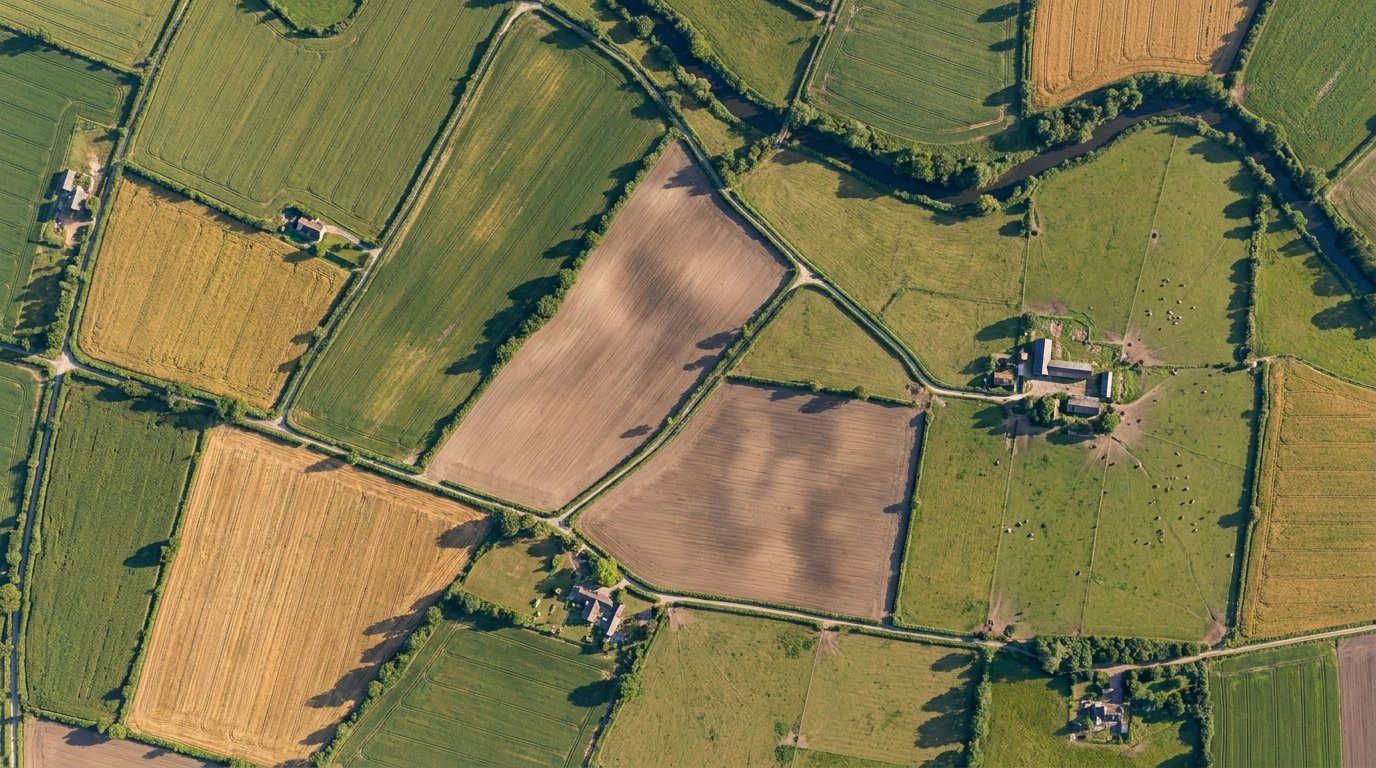

700 acres equals 30,492,000 square feet, 1.09375 square miles, or approximately 283.3 hectares. As a perfect square, each side measures about 5,520 feet — just over one mile. That’s roughly 530 American football fields side by side, 83% of New York City’s Central Park, and enough land to support 70 megawatts of utility-scale solar generation at standard panel densities.
You’ve encountered “700 acres” in a land listing, a survey report, or a farm appraisal and the number means nothing without a frame of reference. Most people read it, nod, and move on — which is exactly how they end up misjudging a property’s scale, miscalculating fencing costs, or underestimating what a 700-acre operation actually requires to run. This guide converts the number into something you can see, walk, and make decisions with, backed by USDA data and standard survey mathematics.
What Does 700 Acres Equal in Every Unit?
700 acres equals 30,492,000 square feet, 1.09375 square miles, 283.28 hectares, and 2.83 square kilometers. These four conversions serve every context — U.S. real estate, international land transactions, agricultural planning, and renewable energy development all measure land in different units.
| Unit | Value |
|---|---|
| Square feet | 30,492,000 ft² |
| Square miles | 1.09375 mi² |
| Hectares | 283.28 ha |
| Square kilometers | 2.83 km² |
| Square meters | 2,832,800 m² |
| Square yards | 3,388,000 yd² |
| City blocks (avg. 2.5 acres) | 280 blocks |
The square miles figure is the most useful mental anchor. 700 acres is just over one full square mile — specifically 109.375% of one. This is the key threshold that separates 700 acres from smaller acreage numbers like 500 or 600: it crosses into “more than a square mile” territory, which has specific implications for survey systems, land use planning, and equipment logistics.
A full square mile in the U.S. Public Land Survey System is called a section (640 acres). A 700-acre parcel is a section plus 60 acres — picture a standard one-mile grid square with a small additional strip along one side.
Understanding how to anchor area measurements to familiar objects applies at every scale. The same way that how big 17 inches looks in real life clicks once you hold a specific object, 700 acres clicks once you match it to a known landmark.
How Big Is 700 Acres Compared to Famous Landmarks?
700 acres sits in a specific size range — larger than any single theme park in the U.S. and comparable to major urban green spaces. Here’s how it maps against places you already know.
Central Park, New York City: Central Park covers 843 acres. A 700-acre parcel represents about 83% of Central Park — large enough to contain nearly the entire park except the northernmost section.
Monaco: The Principality of Monaco covers approximately 499–514 acres, according to Monaco’s official statistical office. At 700 acres, your parcel is about 36% larger than the entire country — enough land to fit Monaco inside it with 186 acres left over.
Glastonbury Festival site, UK: The Glastonbury Festival site is typically described as 800–900 acres for the full working farm (Worthy Farm). The festival itself occupies a smaller perimeter. A 700-acre parcel is comparable in scale to the active festival grounds.
Walt Disney World Magic Kingdom park: The Magic Kingdom theme park covers approximately 107 acres. You could fit 6.5 Magic Kingdom parks inside 700 acres, with room for parking.
| Famous Place | Acreage | 700 Acres vs. That Place |
|---|---|---|
| Monaco (whole country) | ~514 acres | 700 acres is 36% larger |
| Central Park, NYC | 843 acres | 700 acres = 83% of it |
| Glastonbury Festival area | ~700–800 acres | Roughly equivalent |
| Magic Kingdom (Walt Disney World) | ~107 acres | Fits 6.5 times inside |
| U.S. township section (1 sq mile) | 640 acres | 700 acres exceeds by 60 acres |
| Average U.S. city block | ~2.5 acres | 700 acres = 280 city blocks |
How Many Football Fields Fit in 700 Acres?
700 acres contains approximately 529 American football fields laid side by side. A standard NFL field including both end zones measures 360 feet × 160 feet, totaling 57,600 square feet. Dividing 30,492,000 by 57,600 gives 529.4 fields.
For soccer: a FIFA-regulation pitch runs approximately 105 × 68 meters (about 76,824 square feet). At that dimension, 700 acres holds roughly 397 full soccer pitches.
For basketball: a regulation NBA court is 4,700 square feet. You could fit 6,488 basketball courts inside 700 acres — a figure that’s more useful as scale perspective than practical planning.
Here’s the football field comparison in practice: a standard NFL stadium holds about 65,000–80,000 spectators and sits on roughly 10–15 acres including the stadium structure. The playing field alone — that 57,600-square-foot rectangle — would need to be laid out 529 times to cover 700 acres. If you stood at one end zone and walked to the other end, you’d walk 120 yards. Do that 529 times and you’ve covered the full area.
How Long Does It Take to Walk Across 700 Acres?
700 acres arranged as a perfect square measures 5,520 feet per side — just over one mile (5,280 feet). Walking that side at a comfortable 3.5 mph takes approximately 18 minutes per side.
The full perimeter of a square 700-acre parcel is roughly 22,080 feet, or 4.18 miles. A continuous boundary walk at 3 mph on flat ground takes about 84 minutes.
Actual walk times depend heavily on parcel shape and terrain:
- Square cropland on flat terrain: ~80–85 minutes for the full perimeter
- Elongated strip parcel (1/4 mile wide × 4.4 miles long): Walking the long axis alone takes nearly 75 minutes at a normal pace — before you even turn around
- Mixed terrain (woods, hills, wet areas): Add 50–80% to flat estimates
- Full field inspection with stops: Budget 3–4 hours for a thorough walk of 700 acres in varied terrain
According to USDA’s Farms and Land in Farms 2023 Summary, the average U.S. farm size in 2023 was 464 acres. A 700-acre operation is 51% above the national average — large enough that a farmer cannot effectively manage field conditions by visual inspection alone without a vehicle or drone.
The 700-Acre Use-Case Threshold Framework
Here’s the original framework no other guide offers: a decision matrix matching 700 acres to specific operational thresholds where this size creates advantages or constraints you won’t find at 500 or 600 acres.
This is the 700-Acre Threshold Matrix, built on USDA land classification data and National Renewable Energy Laboratory solar land use research:
| Use Case | 700-Acre Threshold | What Changes vs. Smaller Parcels |
|---|---|---|
| Row crop farming | Strong commercial scale — top 20% of U.S. farms | GPS auto-steer, large combine payoff; single operator feasible at harvest |
| Cattle ranching (beef) | 140–350 head range (varies by region) | Approaches minimum scale for feedlot-to-market vertical integration |
| Solar farm (utility-scale) | ~70–117 MW capacity at 6–10 acres/MW | Crosses into utility-scale category; attracts major energy developers |
| Wind energy | Viable for 3–6 turbines at standard spacing | Minimum viable for small commercial wind project |
| Residential development | 700–2,800+ units depending on zoning | Large enough for a master-planned community with amenities |
| Conservation land trust | Meaningful wildlife corridor | Exceeds 500-acre threshold for forest-interior species viability |
| Regional airport | Adequate for regional commercial service | Most regional airports need 600–1,000 acres; 700 fits mid-range |
| Golf resort (36-hole) | Can fit two regulation 18-hole courses | 18-hole course needs 100–200 acres; 700 supports full resort footprint |
The solar figure deserves its own explanation. According to the Great Plains Institute’s land use research on utility-scale solar, a conservative estimate is 10 acres per megawatt of solar generation. At 700 acres, that’s approximately 70 MW of capacity — well past the 5 MW threshold that defines utility-scale solar under most state energy regulations. This makes 700 acres genuinely attractive to major energy developers in a way that smaller parcels are not.
The real question for any 700-acre evaluation is which of these use cases matches your soil, location, access, and financial goals. The number alone doesn’t decide — but 700 acres clears the threshold for options that simply aren’t viable at 200 or 300 acres.
What 700 Acres Costs: Regional Price Data
Land price is where 700 acres becomes a financial decision, not just a measurement question. According to USDA NASS Land Values 2024 Summary, U.S. average cropland value reached $5,570 per acre in 2024, up 4.7% from 2023. Pastureland averaged $1,830 per acre nationally.
At those averages, 700 acres translates to:
- 700 acres of cropland: ~$3,899,000 at national average
- 700 acres of pastureland: ~$1,281,000 at national average
Regional variation is extreme. The same 700 acres in different states differs by a factor of 10 or more:
| Region | Avg. Cropland $/Acre (2024) | 700-Acre Cropland Cost |
|---|---|---|
| Iowa / Illinois (Corn Belt) | ~$10,000–$13,000/acre | $7M–$9.1M |
| Kansas / Nebraska (Northern Plains) | ~$3,500–$4,500/acre | $2.45M–$3.15M |
| Texas (Southern Plains) | ~$2,200–$2,800/acre | $1.54M–$1.96M |
| Montana (Mountain) | ~$890–$1,100/acre | $623K–$770K |
| California (Pacific) | ~$9,000–$15,000+/acre | $6.3M–$10.5M+ |
These ranges are estimates based on USDA regional averages. Actual transaction prices depend on soil quality, water rights, drainage infrastructure, access roads, and improvements. A formal appraisal from a state-licensed or MAI-credentialed appraiser is the only way to establish defensible value for a specific parcel.
700 Acres in Metric: What the Hectare Number Means
700 acres converts to 283.28 hectares or 2.83 square kilometers. The hectare is the standard land measurement in most countries outside the U.S. — in European agriculture, Latin American ranching, and international conservation reporting, you’ll work in hectares.
Context for 283 hectares:
- The EU Common Agricultural Policy classifies farms above 100 hectares as large farms. At 283 hectares, a 700-acre property exceeds that threshold by nearly three times.
- A standard FIFA soccer pitch is 0.714 hectares. So 283 hectares equals approximately 397 soccer pitches — matching the acreage calculation.
- At 2.83 km², your parcel is larger than Vatican City (0.44 km²) and comparable to several small European island territories.
The fast mental conversion: multiply acres by 0.4 to get approximate hectares. So 700 × 0.4 = 280 hectares — off by only 3.28 from the exact figure. Good enough for quick estimates in any international land negotiation.
This unit fluency matters the same way knowing how big 19 inches is in centimeters matters when spec-ing international hardware — the number is useless if you can’t translate it to the system your counterpart is using.
The Shape Problem at 700 Acres: Why Square Footage Isn’t the Whole Story
700 acres is large enough that parcel shape stops being an abstract concern and becomes a serious operational factor.
A square 700-acre parcel measures 5,520 × 5,520 feet. Perimeter fencing: approximately 22,080 linear feet (4.18 miles). A single access road from one side serves the whole parcel. Equipment passes are long and efficient.
An elongated 700-acre strip, say 1,320 feet wide (a quarter-mile) by 23,100 feet long (4.375 miles): same 700 acres, but perimeter fencing jumps to roughly 49,200 linear feet — more than double the square version. Equipment turns constantly. Multiple access roads are likely required. Irrigation systems, if needed, become far more complex to configure.
The cost difference between these two configurations at standard fencing rates runs to $100,000–$200,000+ in material alone, before labor.
There’s also the issue of the internal road network. A square 700-acre farm can be accessed from a single road with interior field lanes covering roughly 1–2 miles. An elongated strip covering 4+ miles requires either multiple road connections or driving the full length to reach the far end — a 10-minute tractor ride just to start working the back forty.
Ask for the GIS parcel map and legal description before any evaluation. The number “700 acres” without dimensions is like knowing a warehouse has 50,000 square feet without knowing if it’s a square building or a long narrow structure — the area is identical, but only one configuration works for what you actually need.
Just as what 11 inches looks like changes completely depending on the object’s shape, 700 acres looks and functions completely differently depending on how that area is configured.
700 Acres for Farming: What the Scale Actually Means in Practice
A 700-acre grain operation is a serious commercial farm. Based on USDA NASS 2023 national average corn yield of 177.3 bushels per acre, a fully planted 700-acre corn operation could produce approximately 124,110 bushels in a strong season. At a representative cash corn price of $4.50/bushel, that’s roughly $558,495 in gross revenue before input costs.
But here’s what most land guides skip entirely: at 700 acres, the economics of farm equipment change fundamentally. A single modern GPS-guided combine with a 40-foot corn head can harvest approximately 300–400 acres per day under good conditions. A 700-acre corn harvest therefore takes 2–3 days with one machine — feasible for a single operator during a good weather window. Below 500 acres, that same logic holds. Above 700 acres, most farmers add a second machine or hire custom harvesting to manage weather risk during the narrow harvest window.
That equipment tipping point is real. Farm machinery dealers structure lease arrangements, and crop insurance underwriters structure premium tiers, partly around the 500–700 acre range. At 700 acres, you’re operating at a scale where those structural differences in financing and risk management start to matter.
A 700-acre cattle ranch, applying standard Midwestern stocking rates of one cow-calf pair per 1.5–3 acres of improved pasture, supports 233–467 head — a commercial herd large enough to sell directly to feedlots rather than through auction markets, capturing better pricing at scale.
Frequently Asked Questions About How Big 700 Acres Is
What is 700 acres in square miles? 700 acres equals exactly 1.09375 square miles. There are 640 acres in one square mile, so 700 ÷ 640 = 1.09375. This means 700 acres is just over one full square mile — about 9.375% larger than a single square-mile section.
How many football fields is 700 acres? Approximately 529 American football fields (including end zones) fit in 700 acres. Each standard NFL field measures 57,600 square feet. Dividing 30,492,000 square feet (700 acres) by 57,600 gives 529.4 fields.
How long does it take to walk around 700 acres? The perimeter of a square 700-acre parcel is approximately 22,080 feet, or 4.18 miles. At 3 mph on flat ground, a full boundary walk takes about 84 minutes. On varied terrain — woods, hills, wet areas — budget 2.5–4 hours for a complete inspection walk.
Is 700 acres a large farm? Yes, significantly. According to USDA’s Farms and Land in Farms 2023 Summary, the average U.S. farm size in 2023 was 464 acres. A 700-acre farm is 51% above that average. Fewer than 20% of U.S. farms exceed 500 acres; 700 acres places an operation in the upper tier of farm sizes nationally.
What is 700 acres in hectares? 700 acres equals 283.28 hectares. The exact conversion is 1 acre = 0.404686 hectares, so 700 × 0.404686 = 283.28 ha.
How does 700 acres compare to Central Park? Central Park in New York City covers 843 acres. A 700-acre parcel is about 83% the size of Central Park — large enough to contain everything from the south end through the Great Lawn, the Reservoir, and the North Woods, stopping short of the final northern section.
How many homes can 700 acres hold? At average U.S. residential lot sizes of approximately 12,632 square feet per lot (home, yard, and driveway), roughly 2,414 homes with yards could fit on 700 acres. At suburban townhome densities of 4–8 units per acre, a developer could build 2,800 to 5,600 units, depending on local zoning, setbacks, and infrastructure.
What does 700 acres of farmland cost? Using USDA NASS 2024 national average cropland values of $5,570 per acre, 700 acres of average cropland costs approximately $3.9 million. Prices range from under $700,000 for dry rangeland in Montana or Wyoming to $7M–$9M+ for prime Corn Belt cropland in Iowa or Illinois. These figures are national averages, not appraisals.
Next Steps If You’re Evaluating 700 Acres
The measurement itself is just the starting point. Three concrete steps that turn “700 acres” from a number into an actionable decision:
1. Request the GIS parcel map with boundary dimensions. Shape matters as much as total area. A 700-acre square and a 700-acre strip have the same acreage and radically different operating costs. Get the actual dimensions before you build any budget estimates.
2. Run a soil capability analysis. The USDA Natural Resources Conservation Service provides free soil survey data through Web Soil Survey at websoilsurvey.nrcs.usda.gov. Knowing how many of the 700 acres are Class I–II cropland vs. wetland, timber, or rough ground determines productive capacity and drives every financial projection that follows.
3. Match the acreage to the Threshold Matrix. Use the 700-Acre Threshold Matrix above to identify which use cases this specific parcel supports. Location, terrain, soil, and proximity to infrastructure determine which cells in that matrix are actually open to you — the raw acreage just tells you you’re in the right ballpark.
Seven hundred acres is genuinely large. It exceeds a full square mile, crosses the threshold for utility-scale solar development, supports a commercial-scale grain or cattle operation, and can anchor a mid-size residential development or conservation project. Getting value from that scale starts with knowing exactly what you’re working with — shape, soil, and access — not just the number.
