
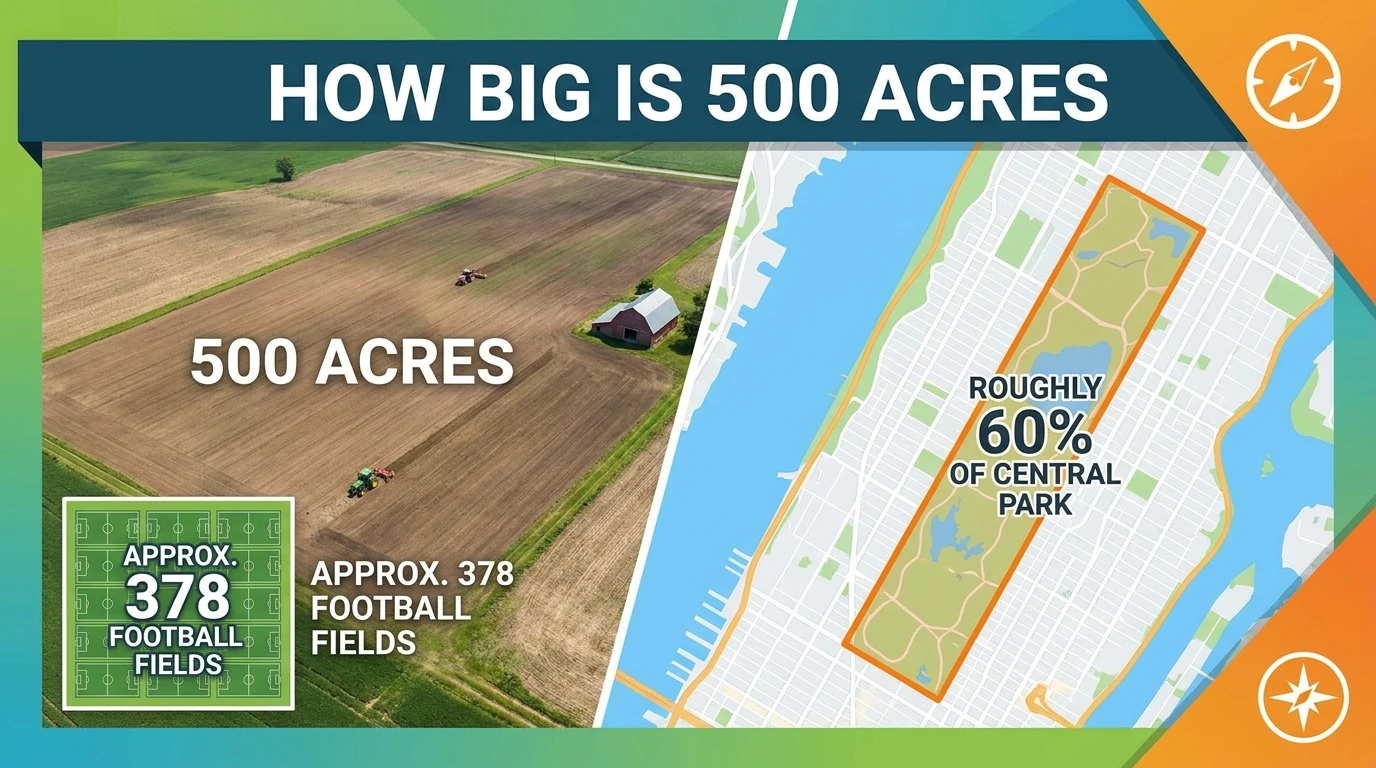

500 acres equals 21,780,000 square feet, 0.78125 square miles, or approximately 202 hectares. If you arranged it as a perfect square, each side would measure about 4,667 feet — just under a mile. That’s roughly the same total land area as the country of Monaco, or about 378 American football fields placed side by side.
You’ve come across “500 acres” — maybe in a real estate listing, a land survey, a farm appraisal, or a zoning document — and the number tells you nothing. Raw acreage is notoriously hard to picture without a frame of reference, and most guides just throw football fields at you without explaining what you’d actually do with the information. This guide gives you concrete, layered comparisons across every context where 500 acres actually matters: property decisions, farming operations, outdoor recreation, and professional land use planning. These are the kind of anchor points that make the number stick.
What Does 500 Acres Equal in Every Unit?
500 acres equals 21,780,000 square feet, 0.78 square miles, roughly 202 hectares, and just over 2 square kilometers. These four conversions cover every context you’ll encounter, whether you’re reading a U.S. real estate listing or an international land-use report.
Here’s the full conversion table:
| Unit | Value |
|---|---|
| Square feet | 21,780,000 ft² |
| Square miles | 0.78125 mi² |
| Hectares | 202.34 ha |
| Square kilometers | 2.02 km² |
| Square meters | 2,023,430 m² |
| Square yards | 2,420,000 yd² |
| City blocks (avg. 2.5 acres each) | 200 blocks |
The square mile figure is the most useful for quick orientation. 500 acres is just under four-fifths of a square mile — so if you’re looking at a map, you’re looking at an area slightly smaller than a single grid square in most U.S. township surveys, which divide land into 640-acre square-mile sections.
If you’re working with smaller measurements daily — for example, understanding how big 20 inches looks in practice when shopping for equipment — scaling up to acreage uses the same principle: anchor the number to something familiar first.
How Big Is 500 Acres Compared to Famous Places?
The fastest way to anchor 500 acres is to match it against a landmark you already know.
Monaco: The entire sovereign nation of Monaco covers approximately 499–514 acres depending on land reclamation at time of measurement, according to Monaco’s official statistical office. So 500 acres is essentially the same footprint as an entire country — home to roughly 38,000 residents, a Formula 1 circuit, a casino district, and a royal palace, all within your 500-acre boundary.
Central Park, New York City: Central Park covers 843 acres. Your 500-acre plot is about 59% of Central Park’s total area — large enough to hold the entire Reservoir, the Great Lawn, the Ramble, and still have room left over.
Disneyland (Anaheim, California): The original Disneyland Resort covers approximately 500 acres, making it one of the cleanest real-world comparisons available. The entire park — from Main Street USA to Tomorrowland, including two theme parks, three hotels, and Downtown Disney — sits on almost exactly 500 acres.
Walt Disney World comparison: Disney World in Florida is about 25,000 acres. You could fit exactly 50 Disneylands — 50 of your 500-acre plots — inside it. That scale difference is worth sitting with for a moment.
| Famous Place | Acreage | Compared to 500 Acres |
|---|---|---|
| Monaco (whole country) | ~499 acres | Essentially identical |
| Disneyland Resort (CA) | ~500 acres | Equal |
| Central Park, NYC | 843 acres | 500 acres = 59% of it |
| Universal Studios Orlando | ~400 acres | 500 acres is 25% larger |
| Walt Disney World (FL) | ~25,000 acres | Would fit 50× inside |
| Average U.S. city block | ~2.5 acres | 200 city blocks |
How Many Football Fields Is 500 Acres?
A standard American football field, including both end zones, measures 360 feet long by 160 feet wide — 57,600 square feet total. Dividing 21,780,000 by 57,600 gives you 378 football fields.
Picture that for a second. Lay 378 football fields edge to edge and you’d need to drive for several minutes to cross from one sideline to the other.
A FIFA-regulation soccer field runs approximately 105 meters by 68 meters (344 × 223 feet), which is about 76,824 square feet. At that size, 500 acres holds approximately 284 full soccer pitches.
If tennis is your reference: a single court is 2,808 square feet. You could fit 7,756 tennis courts into 500 acres — not that you’d want to, but it illustrates the scale.
Just as understanding how big 18 inches actually is requires connecting the number to familiar objects, acreage clicks when you stack it against things you’ve physically walked through.
How Long Would It Take to Walk Across 500 Acres?
This is the question most guides skip — and it’s one of the most practically useful things to know.
If 500 acres were arranged as a perfect square (4,667 feet per side), walking at a brisk 3.5 mph pace would take you about 15–16 minutes to cross one side. A full perimeter walk at the same pace would take roughly one hour.
But land is never perfectly square. Real-world timing depends on shape and terrain:
- Narrow, elongated parcel (e.g., 500 feet wide by 1.76 miles long): Walking the long axis would take about 30–35 minutes at normal pace, and over an hour on hilly or wooded ground.
- Square parcel on flat terrain: About 15 minutes side to side, ~55 minutes for the full perimeter.
- Irregular terrain (hills, forest, wetlands): Add 40–60% to any estimate.
According to research published by the USDA National Agricultural Statistics Service, the average U.S. farm in 2022 was approximately 463 acres — meaning 500 acres is slightly above the national average farm size. A farmer walking field boundaries on a typical 500-acre operation can expect a 1–2 hour perimeter inspection walk depending on field geometry.
The 500-Acre Decision Framework: Which Use Fits Which Size?
Here’s what no other guide provides: a practical decision matrix for what you can actually do with 500 acres, matched by land type and operational scale.
This is the 500-Acre Use-Case Framework, built on standard land-use classifications from USDA agricultural guidelines:
| Land Use | Viable at 500 Acres? | Notes |
|---|---|---|
| Row crop farming (corn, soy, wheat) | Yes — optimal range | USDA classifies 500+ as “large commercial” |
| Cattle ranching (beef) | Yes, at ~100–150 head | Requires supplemental feed in dry climates |
| Specialty crop farming (vineyards, orchards) | Yes — high-value use | 500 acres = significant commercial vineyard |
| Wind farm (utility-scale) | Marginal — better at 1,000+ | Can support ~5–8 turbines |
| Solar farm (utility-scale) | Yes | ~50–75 MW capacity at standard density |
| Residential subdivision | Yes — mid-size development | ~500–1,700 homes depending on density |
| Nature reserve / conservation | Yes — meaningful wildlife corridor | Above minimum viable habitat for many species |
| Private hunting/recreation land | Yes — premium size | Large enough for diverse habitat zones |
| Airport (regional) | Marginal | Small regional airports typically need 600+ acres |
The key threshold: 500 acres crosses from “large hobby farm” territory into what the USDA formally classifies as large commercial agricultural operations. Below 500 acres, most crop operations are mid-size. At 500 and above, you’re in a different category for financing, equipment scale, and regulatory treatment.
What 500 Acres Looks Like for Farmers, Buyers, and Planners
For the Farmer or Rancher
A 500-acre farm is a serious, full-time commercial operation. In the U.S. Corn Belt, 500 acres of row crops can produce roughly 400,000 to 500,000 bushels of corn in a strong year, based on national average yields of 177 bushels per acre reported by the USDA’s 2023 crop production summary. That’s a seven-figure gross revenue operation.
For livestock: at standard stocking rates of one cow-calf pair per 2–5 acres (varying by region and grass quality), 500 acres supports 100 to 250 head of cattle — a mid-to-large commercial ranch in most U.S. states.
Here’s the reality most land buyers miss: 500 acres of raw, unimproved land is operationally very different from 500 acres of developed farmland with irrigation, drainage tiles, fencing, and grain storage. The number is the same; the productivity isn’t.
For the Land Buyer or Investor
If you’re evaluating a 500-acre property purchase, the per-acre price varies enormously by location. According to USDA Land Values 2023 Summary, average U.S. cropland values ranged from roughly $750 per acre in Montana’s dryland regions to over $13,000 per acre in Iowa’s prime corn belt. At those extremes, 500 acres ranges from $375,000 to over $6.5 million.
The shape of the parcel matters as much as the number. A 500-acre square is far more manageable than a 500-acre strip one-quarter mile wide and 3.1 miles long — both are 500 acres, but equipment efficiency, fencing costs, and access roads differ dramatically.
For the Planner or Developer
At urban densities of 4–6 units per acre (typical suburban single-family zoning), 500 acres holds 2,000 to 3,000 housing units — a mid-size residential community. At lower-density rural residential of 1 unit per acre, you’re looking at 500 individual parcels.
Understanding exact dimensions matters here. Just as professionals need to know what 7 inches looks like before specifying hardware clearances, land planners need to feel 500 acres before laying out roads and utilities.
How Big Is 500 Acres in Metric? (For International Readers)
500 acres converts to 202.34 hectares or 2.02 square kilometers. The hectare is the standard land area unit in most countries outside the U.S., and 202 hectares is a substantial land holding in any system.
For context:
- The European Union defines “large farm” threshold at approximately 100+ hectares under Common Agricultural Policy statistics. At 202 hectares, a 500-acre property is solidly in the large farm category by EU standards too.
- A standard FIFA soccer pitch is 0.714 hectares. So 202 hectares = approximately 283 soccer pitches (same result as the acreage math — the units agree).
- In square kilometers: 2.02 km² is slightly larger than the total area of Vatican City (0.44 km²) and noticeably smaller than the island of Nauru, the world’s smallest republic at approximately 21 km².
If you frequently convert between metric and imperial — the way you might need to know what 12 inches translates to in centimeters for product specs — the key conversion to memorize is: 1 acre = 0.4047 hectares, so multiply acres by 0.4 for a fast estimate.
The Misconception About 500 Acres Being “Square”
Here’s what most people get wrong: they picture 500 acres as a square, because the square version is easiest to calculate. In reality, most land parcels of this size are irregular — bounded by roads, rivers, ridgelines, or county survey lines.
The square-version dimensions (4,667 × 4,667 feet) give you a mental baseline. But the same 500 acres configured as a narrow strip would look radically different on a map — and function completely differently in practice.
A real-world example: many large farms in the U.S. Great Plains are “section fractions” — rectangular parcels derived from the original township-and-range survey system, where a full section is 640 acres (1 square mile). A 500-acre parcel in that system might be a three-quarter section, configured roughly 4,800 feet by 4,356 feet — not square, but close.
Understanding this distinction matters when you’re walking property boundaries, planning access roads, or estimating fencing material. A perfectly square 500-acre parcel requires about 18,668 linear feet (3.54 miles) of perimeter fencing. An elongated 500-acre rectangle of the same area can require significantly more. Just as understanding what 16 inches actually measures helps you buy the right laptop bag, knowing actual parcel dimensions — not just total acreage — determines whether your land-use plans are feasible.
500 Acres for Hunting, Recreation, and Conservation
500 acres hits a meaningful threshold for outdoor recreation uses that smaller parcels can’t match.
Hunting: Wildlife managers generally consider 500+ acres sufficient for a self-contained white-tailed deer management program. Below that, deer regularly cross property boundaries, limiting your control over the herd. At 500 acres, you can establish food plots, timber management zones, and stand locations without running out of space.
Nature trails: A 500-acre property can support 5–15 miles of walking or riding trails, depending on routing efficiency, without significant repetition. Most visitors would need multiple visits to cover the whole network — which is exactly the kind of experience destination properties aim for.
Conservation biology: According to the Society for Conservation Biology, minimum viable habitat patches for many forest-interior bird species start around 100–250 acres. At 500 acres, you cross the threshold into habitat that can support a meaningful diversity of interior-dependent species — those that need to be far from forest edges to successfully nest.
The practical question for anyone evaluating 500 acres for recreation is not “is this enough?” but “what’s the terrain?” Five hundred acres of dense hardwood forest in Kentucky feels enormous. Five hundred acres of flat, open Nebraska grassland you can see across in minutes feels much smaller.
[IMAGE: Aerial photo of wooded 500-acre hunting property with creek and open fields | Alt: 500 acres wooded hunting land aerial view showing scale]
Frequently Asked Questions About How Big 500 Acres Is
How many houses fit on 500 acres?
At average U.S. single-family lot sizes of about 12,632 square feet (per U.S. Census Bureau residential land data), you could fit approximately 1,724 homes with yards on 500 acres. At urban townhome densities (1,500–2,500 sq ft per unit including shared infrastructure), you’d fit 2,000–4,000+ units. The number depends entirely on the zoning density and whether you account for roads, utilities, and open space.
Is 500 acres considered a large farm?
Yes. The USDA Economic Research Service classifies farms into size categories, with “large family farms” starting at 500 to 999 acres in gross sales terms. In acreage terms specifically, 500 acres places you in the upper quarter of U.S. farm sizes — fewer than 25% of U.S. farms exceed 500 acres, based on 2022 Census of Agriculture data.
How far is it around 500 acres?
A perfectly square 500-acre parcel has a perimeter of approximately 18,668 feet, or 3.54 miles. Walking the boundary at a comfortable 3 mph pace takes roughly 70 minutes on flat ground. On rugged terrain, plan for 2+ hours.
What is 500 acres in square miles?
500 acres equals 0.78125 square miles exactly. There are 640 acres in one square mile, so 500 ÷ 640 = 0.78125.
How does 500 acres compare to a square mile?
A square mile is 640 acres. 500 acres is approximately 78% of a full square mile — picture a square mile with a roughly 140-acre corner removed.
Can you farm 500 acres alone?
With modern GPS-guided equipment, a single operator can manage planting and harvesting on 500 acres of row crops — but it’s a genuine physical and logistical challenge during time-sensitive windows like planting season and harvest. Most operations of this size use 1–3 people. Specialty crops (vegetables, orchards) require substantially more labor per acre.
What does 500 acres cost?
Land prices vary enormously. USDA 2023 data shows average U.S. cropland at roughly $4,080 per acre. At that average, 500 acres would cost approximately $2.04 million. Irrigated farmland in California or Iowa can exceed $15,000 per acre, while raw rangeland in Nevada or Wyoming may trade below $500 per acre.
How big is 500 acres in meters?
500 acres equals 2,023,430 square meters. As a square, each side would measure approximately 1,422 meters — just under 1.5 kilometers per side.
What to Do Next If You’re Evaluating 500 Acres
If you’re actively looking at a 500-acre property — whether for farming, hunting, development, or investment — these are the three things that matter more than the acreage number alone:
1. Get the legal description and a plat map. The exact shape, boundary dimensions, and any easements or encumbrances tell you far more than “500 acres” alone. A surveyor or title company can provide this. Don’t make an offer without it.
2. Walk the boundary yourself. Aerial photos and satellite imagery are useful starting points, but there’s no substitute for physically walking the land. You’ll identify drainage issues, access problems, timber quality, and neighbor relations that no map shows.
3. Match the acreage to your actual use case. Use the 500-Acre Decision Framework above. An operation viable at 500 acres of prime Iowa cropland is a completely different business from 500 acres of Texas Hill Country cedar. The number only means something in context.
Five hundred acres is large enough to matter — for a farm, a conservation project, a development, or a hunting property. Whether it’s enough depends entirely on what you’re trying to do with it.
