
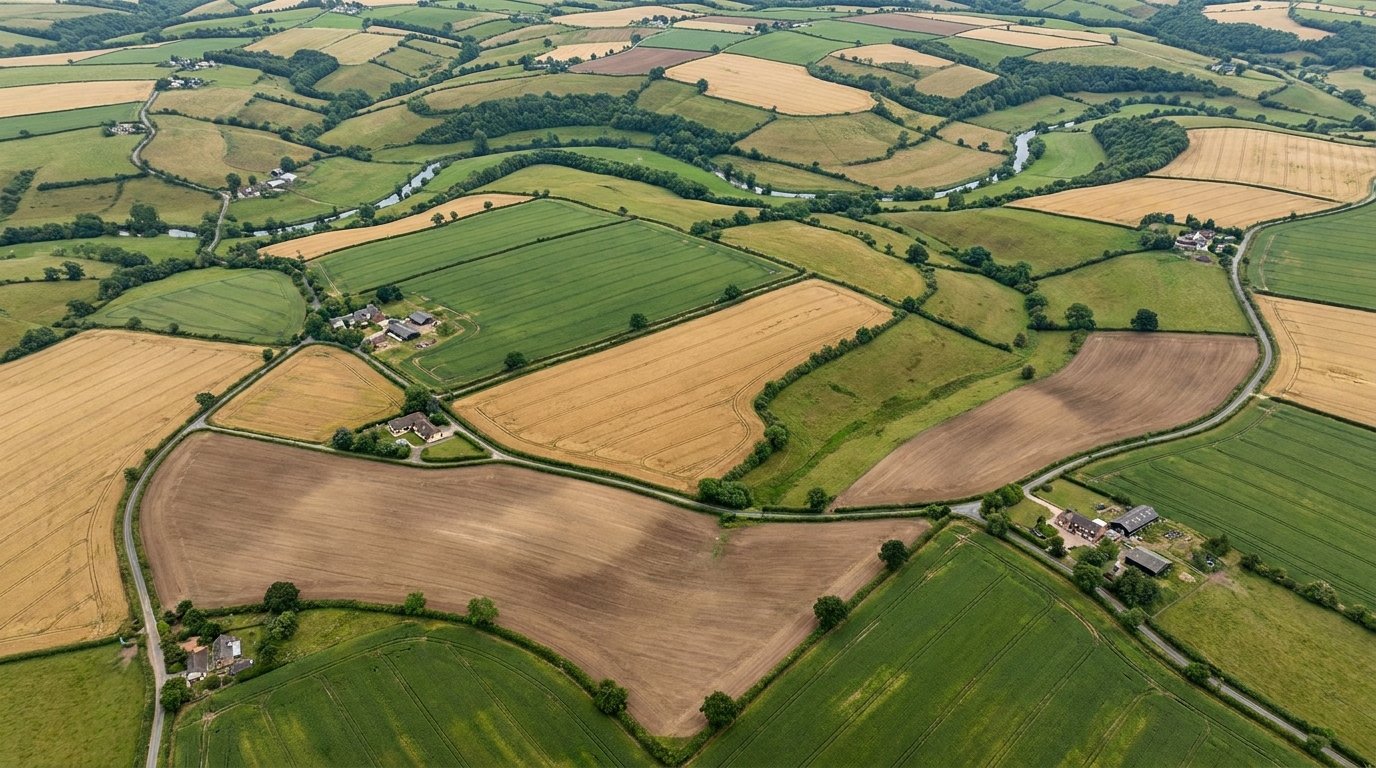

600 acres equals 26,136,000 square feet, 0.9375 square miles, or approximately 242.8 hectares. Arranged as a perfect square, each side measures about 5,112 feet — just under one mile. That’s roughly 1.17 times the size of Monaco, about 71% of New York City’s Central Park, and large enough to hold 453 American football fields laid side by side.
You’ve seen “600 acres” in a real estate listing, a farm appraisal, or a land survey — and the number tells you nothing useful without context. Most people picture it as “big” and stop there, which causes real problems when you’re trying to plan a farm operation, evaluate a property purchase, or figure out how long it’ll take to inspect the boundary. This guide translates 600 acres into every unit, landmark, and practical scenario that actually matters, drawing on USDA agricultural data and standard survey mathematics.
What Does 600 Acres Equal in Every Unit?
600 acres equals 26,136,000 square feet, 0.9375 square miles, 242.8 hectares, and just over 2.4 square kilometers. These four conversions cover every context you’ll encounter — U.S. real estate listings, international land reports, and agricultural planning documents all use different units for the same measurement.
| Unit | Value |
|---|---|
| Square feet | 26,136,000 ft² |
| Square miles | 0.9375 mi² |
| Hectares | 242.81 ha |
| Square kilometers | 2.43 km² |
| Square meters | 2,428,116 m² |
| Square yards | 2,904,000 yd² |
| City blocks (avg. 2.5 acres) | 240 blocks |
The square miles figure is the most useful mental anchor. 600 acres is just under a full square mile — specifically 93.75% of one. If you’ve ever looked at a U.S. township-and-range survey map, a full section equals 640 acres (one square mile). A 600-acre parcel is a section with just 40 acres trimmed off one corner.
Understanding area conversions at this scale uses the same mental approach as understanding smaller measurements. Just as how big 9 inches looks in everyday objects requires anchoring a number to something physical, acreage only clicks when you match it against something you’ve actually seen.
How Big Is 600 Acres Compared to Famous Places?
600 acres sits in a unique size range — larger than any single theme park in the U.S. and bigger than an entire sovereign nation. Here’s how it stacks up against landmarks you already know.
Monaco: The Principality of Monaco covers approximately 499–514 acres, according to Monaco’s official statistical office. At 600 acres, your parcel is about 17% larger than the entire country of Monaco — a place that contains a Formula 1 circuit, a royal palace, a casino district, and 38,000 residents.
Central Park, New York City: Central Park spans 843 acres. A 600-acre plot represents roughly 71% of Central Park — large enough to contain the entire north end of the park including the Harlem Meer, the Great Hill, and the North Woods, with room to spare.
Walt Disney World Resort (Magic Kingdom park only): The Magic Kingdom theme park at Walt Disney World covers approximately 107 acres. You could fit about 5.6 Magic Kingdom parks inside 600 acres. The entire Walt Disney World property is around 25,000 acres, so 600 acres is only about 2.4% of it.
Queen Elizabeth Olympic Park, London: The Olympic Park in London covers roughly 560 acres. At 600 acres, your parcel is slightly larger than the full Olympic Park site used for the 2012 London Olympics.
| Famous Place | Acreage | 600 Acres vs. That Place |
|---|---|---|
| Monaco (whole country) | ~514 acres | 600 acres is 17% larger |
| Queen Elizabeth Olympic Park, London | ~560 acres | 600 acres is slightly larger |
| Central Park, NYC | 843 acres | 600 acres = 71% of it |
| Magic Kingdom (Walt Disney World) | ~107 acres | Fits 5.6 times inside 600 acres |
| U.S. township section (standard) | 640 acres | 600 acres = 93.75% of one section |
| Average U.S. city block | ~2.5 acres | 600 acres = 240 city blocks |
How Many Football Fields Is 600 Acres?
600 acres contains approximately 453 American football fields side by side. A standard NFL field including both end zones measures 360 feet × 160 feet, giving a total of 57,600 square feet. Dividing 26,136,000 by 57,600 yields 453.75 fields.
A FIFA-regulation soccer pitch runs approximately 105 meters × 68 meters (about 76,824 square feet). At that dimension, 600 acres holds roughly 340 full soccer pitches.
For tennis: a standard court is 2,808 square feet. You could fit 9,308 tennis courts into 600 acres — a number that’s mathematically accurate but practically useful only as a scale demonstration.
The football field comparison sticks because most people have walked the length of one. Picture walking from one end zone to the other. Now picture doing that 453 times, laid side by side. That’s 600 acres.
How Long Does It Take to Walk Across 600 Acres?
600 acres arranged as a perfect square measures 5,112 feet per side, which is approximately 0.97 miles — just under a mile. Walking that distance at a brisk 3.5 mph pace takes about 16–17 minutes per side.
The full perimeter of a square 600-acre parcel is roughly 20,448 feet, or 3.87 miles. A continuous boundary walk at 3 mph on flat terrain takes about 77 minutes.
Real-world walk times vary significantly:
- Flat, square cropland parcel: ~75–80 minutes for the full perimeter
- Elongated strip parcel (e.g., 600 feet wide × 1.82 miles long): Walking the long axis alone takes about 30 minutes at normal pace
- Wooded or hilly terrain: Add 40–70% to flat-ground estimates
- Mixed terrain with fencing, streams, and brush: Budget 2–3 hours for a full perimeter inspection
According to USDA’s Farms and Land in Farms 2023 Summary, the average U.S. farm size in 2023 was 464 acres — meaning 600 acres is about 29% above the national average. A farmer walking a 600-acre field boundary for the first time should plan for a half-day, not a quick stroll.
The 600-Acre Use-Case Decision Framework
Here’s what no other guide provides: a practical matrix for what you can do with 600 acres, matched against operational viability. This is the 600-Acre Fit Matrix, built on USDA Economic Research Service land classification data.
| Land Use | Viable at 600 Acres? | Key Requirement |
|---|---|---|
| Row crop farming (corn, soybeans, wheat) | Yes — strong commercial scale | Equipment access, soil quality |
| Cattle ranching (beef, stocker) | Yes — 120–300 head range | Water infrastructure, fencing |
| Sheep or goat grazing | Yes — 600–1,200 animals at standard rates | Predator management |
| Commercial timber production | Yes — meaningful yield | 30–60 year rotation cycle |
| Solar farm (utility-scale) | Yes — ~60–90 MW capacity | Grid interconnection, flat terrain |
| Wind energy | Marginal — better at 1,000+ acres | Wind resource assessment required |
| Residential subdivision (suburban) | Yes — 600–2,400 units at typical densities | Zoning, infrastructure |
| Small regional airport | Yes — most need 500–700 acres minimum | FAA clearance, approach path |
| Golf course (18-hole) | Yes — standard 18-hole needs 100–200 acres | Multiple courses or buffer land remaining |
| Conservation / wildlife refuge | Yes — viable habitat patch | Interior-dependent species need 500+ acres |
The critical threshold for 600 acres: you cross from “very large hobby farm” into what USDA classifies as large commercial agricultural scale. Fewer than 20% of U.S. farms exceed 500 acres, placing a 600-acre operation in the top tier of farm sizes nationally.
Here’s why that threshold matters practically: lenders, equipment dealers, and commodity buyers all treat operations above 500 acres differently. Financing terms, equipment lease structures, and elevator contracts often shift at this scale. If you’re evaluating 600 acres for any agricultural purpose, you’re operating at a scale where professional appraisers, agronomists, and ag lenders are standard — not optional.
What 600 Acres Costs: Real Numbers by Region
Land price is where 600 acres goes from an abstract number to a financial reality. According to USDA NASS Land Values 2024 Summary, U.S. average cropland value was $5,570 per acre in 2024, up 4.7% from the previous year. Pastureland averaged $1,830 per acre in 2024.
At those national averages:
- 600 acres of cropland: $3,342,000 (at $5,570/acre national average)
- 600 acres of pastureland: $1,098,000 (at $1,830/acre national average)
But regional variation is massive. The same 600 acres in different states can differ by a factor of 10 or more:
| Region | Avg. Cropland $/Acre (2024) | 600-Acre Cropland Cost (Estimate) |
|---|---|---|
| Iowa / Illinois (Corn Belt) | ~$10,000–$13,000 | $6M–$7.8M |
| Kansas / Nebraska (Northern Plains) | ~$3,500–$4,500 | $2.1M–$2.7M |
| Texas (Southern Plains) | ~$2,200–$2,800 | $1.32M–$1.68M |
| Montana / Wyoming (Mountain) | ~$890–$1,100 | $534K–$660K |
| California (Pacific) | ~$9,000–$15,000+ | $5.4M–$9M+ |
These are estimates based on USDA regional averages, not appraisals. Actual prices depend on soil type, water rights, drainage, improvements, and access. Always commission a formal appraisal from a certified general appraiser (MAI designation or state-licensed equivalent) before any transaction above $500,000.
Just as understanding what 15 inches looks like across different objects changes how you shop for the right item, understanding regional land price ranges changes how you negotiate and finance a 600-acre purchase.
600 Acres for Farming: What the Numbers Actually Mean
A 600-acre grain farm in the U.S. Corn Belt is a genuine commercial operation. Based on USDA National Agricultural Statistics Service (NASS) national average corn yield of 177.3 bushels per acre reported in 2023, a 600-acre corn operation could produce roughly 106,380 bushels in a strong year. At $4.50/bushel (a representative mid-2024 cash price), that’s approximately $478,700 in gross revenue before inputs.
For cattle: standard stocking rates in the Midwest run about one cow-calf pair per 1.5–3 acres of improved pasture. On 600 acres of managed pasture, that supports 200–400 head — a sizeable commercial herd.
Here’s what most land guides skip: the difference between 600 acres of ground and 600 productive acres is enormous. A 600-acre parcel with 200 acres of wetlands, 150 acres of timber, and 250 acres of cropland is a completely different asset from 600 acres of tiled, drained Class II soils in Iowa. The acreage number is the same; the productive capacity and market value are not.
The first question for any 600-acre evaluation isn’t “how big is it?” — it’s “how many of those 600 acres are actually farmable?”
600 Acres in Metric: Hectares, Square Kilometers, and What They Mean
600 acres converts to 242.81 hectares or 2.43 square kilometers. Outside the United States, land is measured in hectares in most countries, and 242 hectares is a substantial holding in any agricultural system.
For reference:
- The European Union’s Common Agricultural Policy (CAP) classifies farms above 100 hectares as large. At 242 hectares, a 600-acre property sits well within the large farm category by EU standards.
- A standard FIFA soccer pitch is 0.714 hectares. So 242 hectares equals approximately 340 soccer pitches — matching the acreage calculation exactly.
- In terms of square kilometers: 2.43 km² is roughly five times the area of Vatican City (0.44 km²) and about the size of a mid-size commercial airport footprint.
The conversion that sticks in practice: 1 acre ≈ 0.4 hectares. So for quick mental math, divide acres by 2.5 to get a close hectare estimate. 600 ÷ 2.5 = 240 hectares — off by only 2.81 from the exact figure.
This kind of unit fluency matters if you’re dealing with international buyers, European investors, or any government reporting that uses metric. Understanding how 20 inches converts across metric and imperial systems uses the same mental framework — multiply or divide by a fixed factor, check your result against a known reference.
The Shape Problem: Why Two 600-Acre Parcels Are Nothing Alike
Most people picture 600 acres as a near-square. That mental image is almost always wrong.
A square 600-acre parcel measures 5,112 × 5,112 feet (roughly 0.97 × 0.97 miles). But real-world parcels of this size take wildly different shapes, and shape determines almost everything about practical use.
Consider two actual configurations, both exactly 600 acres:
Configuration A — Near-Square: 5,000 feet wide × 5,227 feet long. Equipment makes efficient passes. Fencing cost: approximately 20,454 linear feet of perimeter. Access from a single road serves the entire parcel.
Configuration B — Elongated Strip: 1,320 feet wide (a quarter mile) × 19,800 feet long (3.75 miles). Same 600 acres. Fencing cost jumps to roughly 42,240 linear feet — more than double. Equipment must make hundreds of short passes instead of long efficient runs. Multiple road access points likely required.
The practical consequence: a 600-acre strip parcel can cost $40,000–$80,000 more to fence, requires dramatically more fuel per acre for fieldwork, and may be nearly unusable for certain livestock operations.
Before evaluating any 600-acre property, request the legal description, survey plat, and GIS-based parcel map. The number “600 acres” without a shape is like knowing a room has 500 square feet without knowing if it’s a workable rectangle or a long narrow hallway. The area is identical; the usability is not.
Just as what 13 inches looks like varies completely depending on object shape, the same land area takes on entirely different character depending on how it’s configured on the ground.
Frequently Asked Questions About How Big 600 Acres Is
What is 600 acres in square miles?
600 acres equals exactly 0.9375 square miles. There are 640 acres in one square mile, so 600 ÷ 640 = 0.9375. This means 600 acres is just shy of a full square mile — about 93.75% of one.
How many football fields fit in 600 acres?
Approximately 453 American football fields (including end zones) fit in 600 acres. Each standard NFL field is 57,600 square feet. Dividing 26,136,000 square feet (600 acres) by 57,600 gives 453.75 fields.
How many houses can fit on 600 acres?
At average U.S. residential lot sizes of about 12,632 square feet per lot (including home, yard, and driveway), approximately 2,069 homes with yards could fit on 600 acres. At higher-density urban zoning of 4–8 units per acre, a developer could build 2,400 to 4,800 units. Actual numbers depend entirely on local zoning, setbacks, roads, and utilities.
Is 600 acres considered a large farm?
Yes. According to USDA’s Farms and Land in Farms 2023 Summary, the average U.S. farm in 2023 was 464 acres. At 600 acres, a farm exceeds the national average by about 29%. Fewer than 20% of all U.S. farms operate at 500 acres or more, placing a 600-acre operation in the upper fifth of farms by size.
How long does it take to walk around 600 acres?
The perimeter of a square 600-acre parcel is approximately 20,448 feet, or 3.87 miles. At a comfortable 3 mph walking pace on flat ground, a full boundary walk takes about 77 minutes. Add terrain difficulty, fencing, and waterways, and a realistic field inspection takes 2–3 hours.
What is 600 acres in hectares?
600 acres equals 242.81 hectares. The exact conversion factor is 1 acre = 0.404686 hectares, so 600 × 0.404686 = 242.81 ha.
How does 600 acres compare to Central Park?
Central Park in New York City covers 843 acres. A 600-acre parcel is about 71% the size of Central Park — large enough to contain the entire northern half of the park with room to spare.
What does 600 acres cost?
Price varies enormously by location. Based on USDA NASS 2024 data, U.S. average cropland value was $5,570 per acre, putting 600 acres of average cropland at roughly $3.34 million. Prime Corn Belt cropland can exceed $10,000 per acre ($6M+ for 600 acres), while rangeland in Montana or Wyoming may trade below $1,000 per acre ($600,000 or less).
What to Do Next If You’re Evaluating 600 Acres
The number alone doesn’t make a decision. Three concrete steps to move from “how big is 600 acres” to an informed position:
1. Get a parcel map with dimensions, not just acreage. Request the GIS parcel data or survey plat showing actual boundary dimensions. Shape determines fencing costs, equipment efficiency, access requirements, and usability far more than raw acreage.
2. Determine productive acres vs. total acres. Ask for a soil survey report (available free via USDA’s Web Soil Survey at websoilsurvey.nrcs.usda.gov) and a land classification breakdown. Knowing that “600 acres” includes 80 acres of wetlands, 100 acres of timber, and 420 acres of tillable ground changes the entire financial picture.
3. Walk the boundary before any commitment. Aerial photos and satellite imagery are useful starting points, but a physical boundary walk reveals drainage issues, neighbor access conflicts, timber quality, and infrastructure gaps that no map shows. Budget half a day for a 600-acre parcel on flat ground, a full day for mixed or hilly terrain.
600 acres is large enough to matter financially — whether you’re farming it, conserving it, developing it, or simply trying to understand a land transaction. The number earns its context when you’ve matched it against a shape, a soil type, and a realistic use case.
