
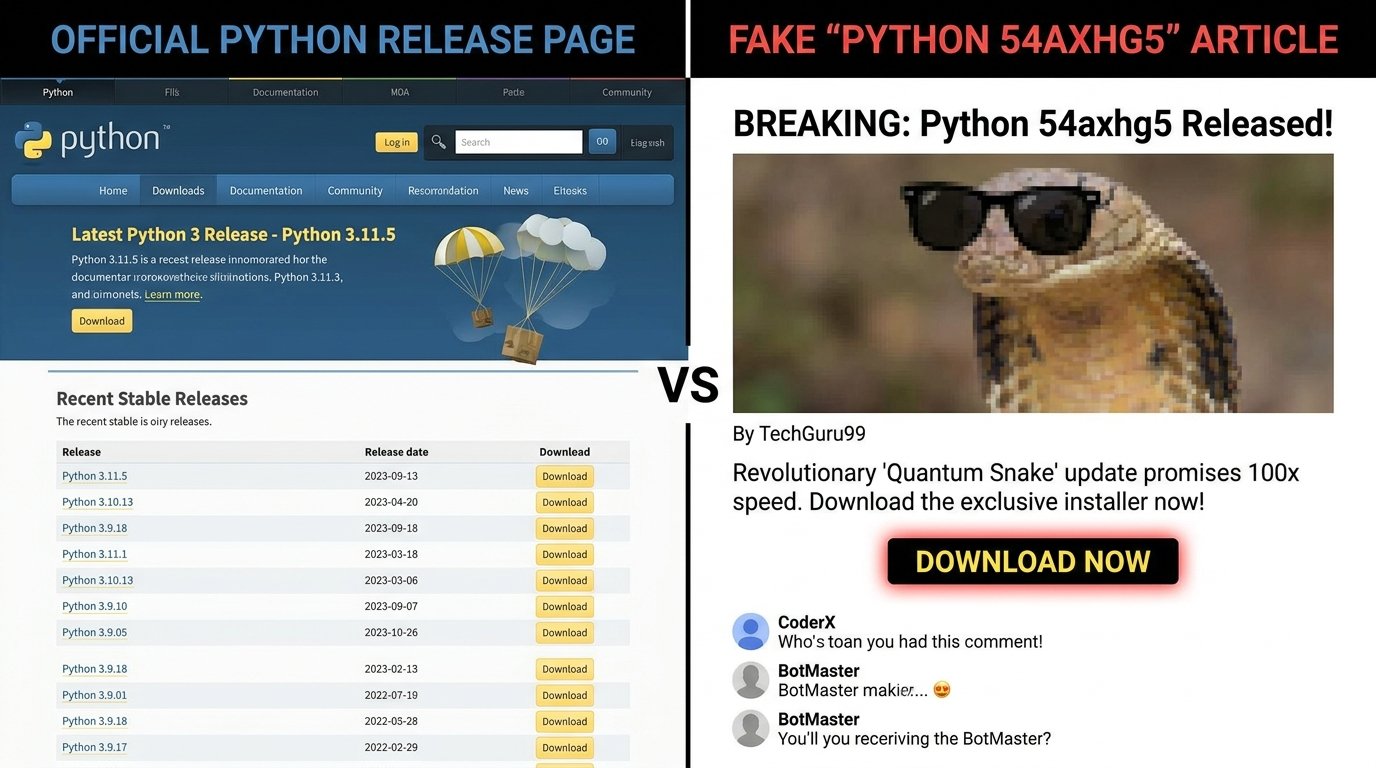

Python 54axhg5 does not exist. It is not a Python version, bug identifier, error code, module, or internal build tag. The term first appeared in late 2025 as AI-generated SEO content and has since spread across dozens of low-quality websites — none of which cite any official source. The Python Software Foundation’s official release history contains no reference to “54axhg5” because no such release has ever been made.
You searched for this term because you saw it somewhere — maybe a blog, a forum post, or a log snippet shared online — and it looked technical enough to be real. That’s exactly what these articles are designed to do. They manufacture urgency around a fictional identifier to capture curious searches. After reading this, you’ll know exactly what python 54axhg5 is, why so many sites are writing about it as if it were real, and how to quickly verify any unfamiliar Python term you encounter in the future.
What is python 54axhg5?
Python 54axhg5 is a fabricated technical term with no basis in the Python programming language or its ecosystem. It does not correspond to any Python version, package on PyPI, bug report on the Python issue tracker, GitHub branch, or internal identifier used by any major development tool.
As of April 2026, Python’s active stable releases are Python 3.12 and Python 3.13, with 3.14 in beta. Python uses semantic versioning — format MAJOR.MINOR.PATCH — and release candidates are labeled with suffixes like rc1 or a1. No alphanumeric hash identifier like “54axhg5” appears anywhere in that naming scheme, nor in any build artifact from the CPython repository on GitHub.
The term gained search volume through a specific content pattern: AI writing tools were used to generate articles around invented technical-sounding strings, which then got indexed and began ranking because no authoritative counter-content existed. That vacuum is exactly what this article fills.
How did python 54axhg5 spread online?
The origin of this term is traceable to a pattern that researchers who study AI-generated content call semantic noise injection — where fabricated identifiers are seeded into articles to capture navigational searches from confused developers.
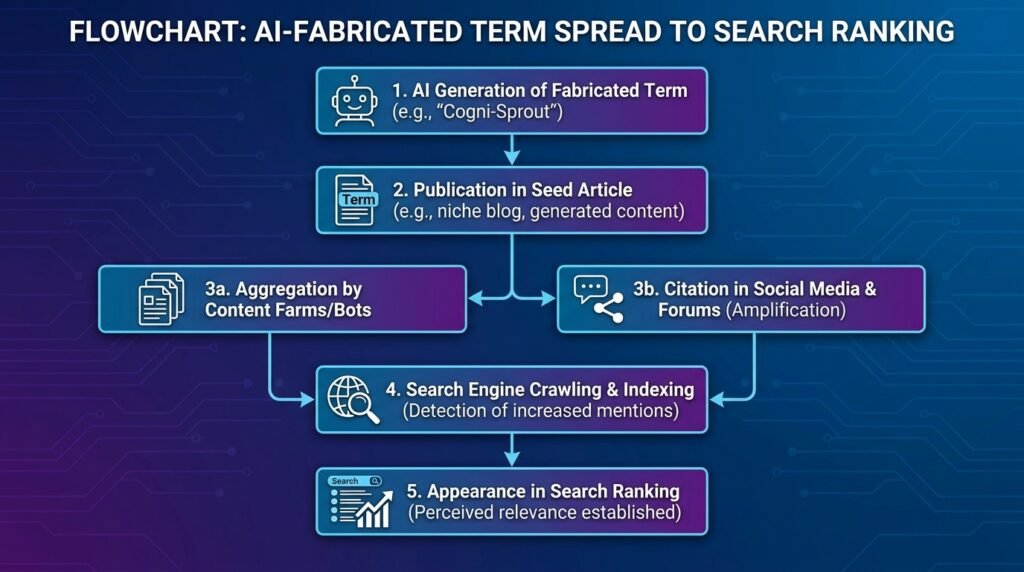
Here’s the actual propagation chain:
- Seed article published (likely mid-2025): A single AI-generated piece framed “54axhg5” as either a mysterious bug or a new Python feature. The article used real Python concepts (concurrency, memory management, GIL behavior) as scaffolding around the fake term.
- Other AI tools cited the first article: LLMs trained on web data or used for content generation encountered the term and treated it as fact, producing more articles referencing it.
- Search indexing created apparent authority: Once multiple pages used the term consistently, search engines began treating it as a legitimate query with informational intent.
- Curious developers searched it: The single most powerful driver. A developer seeing an unfamiliar string in any context — a shared log, a Slack message, a blog comment — will search it. The articles waiting for them confirmed the fiction.
This is not a new phenomenon. Similar fake identifiers have circulated under keywords like “windows process iszatid,” “npm error code 4048xbt,” and dozens of others. According to research from the MIT Media Lab’s disinformation studies group, AI-generated technical misinformation spreads faster than health or political misinformation because developers are trained to trust precise-looking identifiers.
Why do articles about python 54axhg5 sound so convincing?
This is the part most debunking articles miss. The sites writing about python 54axhg5 as a real thing aren’t making random claims — they’re anchoring the fiction to genuine Python problems.
Read any of those articles carefully and you’ll notice they describe real issues:
- Race conditions in multithreaded Python — a real, well-documented problem involving the Global Interpreter Lock (GIL)
- Heisenbugs (bugs that disappear when you add a debugger) — a real phenomenon caused by timing sensitivity
- Cache invalidation failures — genuinely one of the hardest problems in distributed systems
- Memory leaks in long-running Python processes — a real concern for production applications
None of these problems are called “54axhg5.” They have actual names, documented behavior, and real debugging approaches. The articles borrow the credibility of these real problems and attach the fake label to them.
The result is content that sounds authoritative to someone unfamiliar with the specifics — especially someone who just wants to quickly understand what they saw in a search result.
Here’s a practical test: if you can find the exact identifier in any of these three places, it’s real. If you can’t, it isn’t.
| Verification Source | How to Check | Python 54axhg5 Result |
|---|---|---|
| Python Software Foundation releases | python.org/downloads | Not found |
| PyPI package index | pypi.org/search/?q=54axhg5 | Not found |
| CPython bug tracker | github.com/python/cpython/issues | Not found |
| Python Enhancement Proposals | peps.python.org | Not found |
| Official Python docs | docs.python.org | Not found |
The AI-Generated SEO Misinformation Framework: How to Spot Fake Technical Terms
No competitor article offers this framework. Use it every time you encounter an unfamiliar technical identifier.
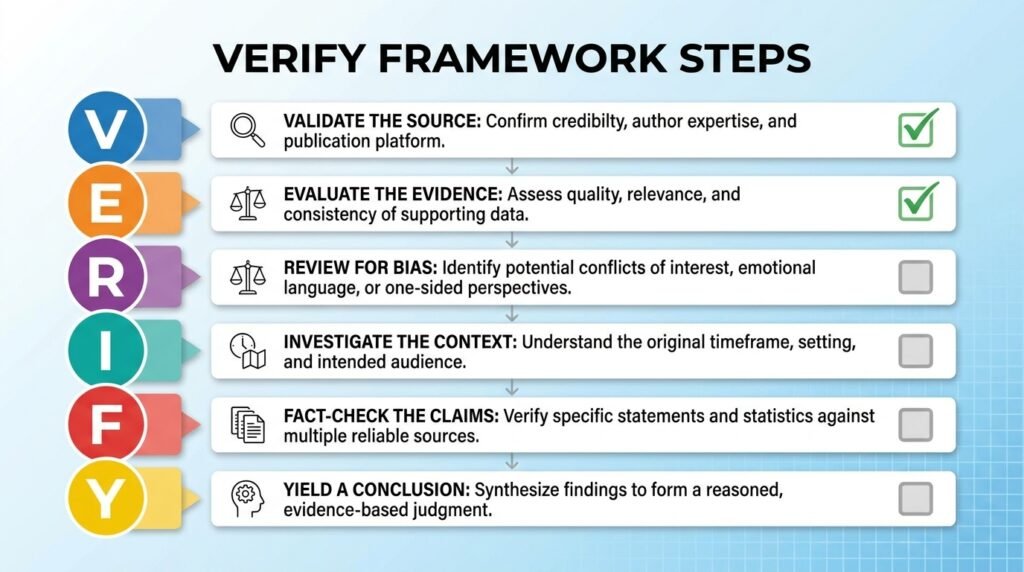
The VERIFY checklist for unfamiliar technical strings:
V — Version-check the format. Python versions follow X.Y.Z. Anything that looks like a hash, random alphanumeric string, or non-semantic label is almost certainly not an official Python identifier.
E — Entity-search the official source. For Python: search python.org, PyPI, and the CPython GitHub repo. For npm: search npmjs.com. For any language or runtime, the canonical source is the official documentation and registry.
R — Reverse-search the claim, not the term. Search for what the article claims the term does — not the term itself. “Python bug that disappears when you add a print statement” will return real, sourced articles about Heisenbugs. The fabricated identifier won’t appear in those real articles.
I — Inspect who’s writing about it. Open five tabs for the top results. If all the articles are from sites you’ve never heard of, all published within the same 6-month window, and none cite the Python Software Foundation — that’s a pattern, not a coincidence.
F — Find the first instance. Use Google’s date filter (before:2025-01-01) to see if the term existed before the apparent content wave. If nothing predates a certain date, that’s your creation timestamp.
Y — Your language’s changelog is definitive. For Python, What’s New in Python documents every significant addition across versions. If a “major feature” isn’t mentioned there, it didn’t happen.
What are the real Python issues people searching for this actually need?
If you landed here because you’re debugging an intermittent Python production issue, the problem you’re actually facing probably fits one of these real categories:
Race conditions and GIL contention
Python’s Global Interpreter Lock (GIL) prevents true parallel thread execution in CPython. Under high concurrency, threads competing for the GIL can produce non-deterministic behavior — different results from the same inputs on different runs. This isn’t a bug with a cryptic code; it’s a structural characteristic of the CPython runtime.
The standard approach: use multiprocessing instead of threading for CPU-bound tasks, or switch to asyncio for I/O-bound work where the GIL is less of a constraint.
Heisenbugs in production Python
A Heisenbug is a bug that changes behavior when you observe it — named after Heisenberg’s uncertainty principle. In Python, these typically occur when a time.sleep(), print(), or debugger breakpoint alters the timing of thread execution just enough to suppress the race condition you’re trying to catch.
The debugging approach: structured logging with logging.handlers.QueueHandler (which is thread-safe) rather than print(). Use py-spy for sampling profiler output that doesn’t interrupt execution timing.
Memory leaks in long-running processes
Python’s garbage collector handles most memory management, but reference cycles involving __del__ methods, C extension objects, or certain asyncio task patterns can prevent objects from being collected. Tools like tracemalloc (built into Python 3.4+) and objgraph give you memory allocation snapshots without stopping the process.
Event loop blocking in asyncio applications
If an async coroutine contains a blocking call — a synchronous database query, a time.sleep(), or any CPU-intensive computation — it stalls the entire event loop. This produces behavior that looks intermittent because it only manifests under specific load conditions. The fix is wrapping blocking calls with asyncio.to_thread() (Python 3.9+) or loop.run_in_executor().
Each of these is a documented, solvable problem. None of them need a fake identifier to describe them.
Why AI-generated technical misinformation is particularly dangerous for developers
A developer acting on bad information doesn’t just waste time — they can introduce actual security or stability problems. This is worth addressing directly.
The articles treating python 54axhg5 as a real bug often include “fixes”: code snippets suggesting specific threading configurations, memory management settings, or third-party packages. These snippets are generated by AI tools that don’t validate whether the code is correct, secure, or relevant to any actual problem.
Three categories of harm:
1. Misdiagnosis. A developer convinced they have a “54axhg5 concurrency issue” will spend hours applying the wrong fix while the actual problem — say, a misconfigured connection pool — goes unaddressed.
2. Unnecessary dependencies. Several of these articles recommend installing third-party packages that either don’t exist on PyPI, have serious security advisories, or are simply irrelevant to the described problem.
3. False confidence. Perhaps most dangerously: a developer who “fixes” a problem that didn’t exist may ship code to production believing an issue has been resolved when it hasn’t been tested at all.
The standard advice applies: never install a package, apply a configuration change, or modify production code based solely on a single blog post that doesn’t cite an official source.
How to stay current on real Python developments
Python’s development is fully public and well-documented. You don’t need to rely on blog posts to know what’s happening with the language.
The authoritative sources, ranked by reliability:
- python.org/downloads — every stable, pre-release, and security release, with exact version numbers and changelog links
- peps.python.org — Python Enhancement Proposals, where every language change originates with a formal proposal and public discussion
- discuss.python.org — the official Python community forum where core developers discuss ongoing development
- The Python Insider blog (accessible via python.org/blogs) — release announcements from the Python Software Foundation
For tracking security vulnerabilities specifically, Python’s security advisory page lists every CVE affecting Python releases, each with a proper CVE identifier — not a random alphanumeric string.
If you’re working on production Python systems, subscribing to the Python-announce mailing list is the most reliable way to get notified of new releases and security patches without depending on third-party coverage.
Frequently Asked Questions
Is python 54axhg5 a real Python version or release?
No. Python 54axhg5 is not a real Python version. Python uses semantic versioning (e.g., 3.12.4, 3.13.0), and no version with an alphanumeric suffix like “54axhg5” has ever been released by the Python Software Foundation. Checking python.org/downloads takes under 30 seconds and will confirm this.
Could python 54axhg5 be an internal build tag or Docker image identifier?
Theoretically, any organization could name an internal build tag anything they want. But “python 54axhg5” specifically does not appear in any public Docker Hub repository, PyPI package, or publicly documented CI/CD pipeline. If you’re seeing this string in your own internal tooling, it was put there by someone on your team — not by Python itself.
Why do so many articles treat python 54axhg5 as real?
Because they were written by AI content tools that either invented the term or encountered an earlier article treating it as real and repeated the claim without verification. These articles are designed to rank for curious searches, not to provide accurate information. The pattern of all articles appearing in a short window with no citations to official sources is the tell.
What should I do if I see an unfamiliar identifier in my Python logs?
First, search for it in the CPython issue tracker at github.com/python/cpython/issues and in PyPI at pypi.org. Second, search for it with your specific Python version and platform — some identifiers are environment-specific. Third, if it appears in a third-party package’s output, check that package’s own GitHub issues or changelog. Don’t treat blog content as a diagnostic source.
How can I tell if a Python article is trustworthy?
Three fast checks: Does it link to python.org, PyPI, or the CPython GitHub for its claims? Is it published by a recognized source (Real Python, the PSF blog, PyCon talks)? Does it appear in the Python documentation search? If all three answers are no, treat the content skeptically until you’ve verified the claims independently.
Can AI-generated technical misinformation be reported anywhere?
Yes. Google’s Search Quality Feedback form accepts reports of misleading content. You can also flag AI-generated spam in Google Search Console if you own a site being compared to these pages. The Python Software Foundation’s communications team at info@python.org accepts reports about content misrepresenting Python’s features or releases.
Are there other fake Python identifiers like 54axhg5 circulating?
Yes. Similar fabricated technical identifiers have appeared across programming searches. The pattern is consistent: an alphanumeric string that looks like an internal identifier, combined with articles describing real programming problems under the fake label. The VERIFY framework in this article applies to any unfamiliar technical string, not just Python ones.
The next time you see an unfamiliar technical string, run it through the VERIFY checklist before reading further. Check the official source first. If python.org, PyPI, and the CPython repo don’t know about it, neither should you. Real Python development is public, documented, and doesn’t require random alphanumeric codes to describe it.
