


GDTJ45 builder software is not a real product. No software company, open-source project, or development tool with this identifier exists in any verified registry, product database, or official download source. The term is AI-generated SEO content that began circulating in late 2025 — fabricated to rank for curiosity-driven searches, not to inform developers about a real tool.
You searched for this because the term appears on dozens of sites, each describing it in confident detail: modular architecture, real-time collaboration, 40–60% faster development times. The problem is that every one of those articles contradicts the others and cites no verifiable source. If you’re a developer trying to decide whether to use this tool, that wasted research time is the real cost. After analyzing the search landscape and cross-referencing legitimate software registries, here’s a clear account of what GDTJ45 builder software actually is.
What is GDTJ45 builder software?
GDTJ45 builder software has no verified existence as a commercial product, open-source project, or internal enterprise tool. Searching Product Hunt, GitHub’s public repository index, AlternativeTo, or G2’s software reviews returns zero results for “GDTJ45.” No company has registered it as a trademark. No software vendor has published documentation under that name.
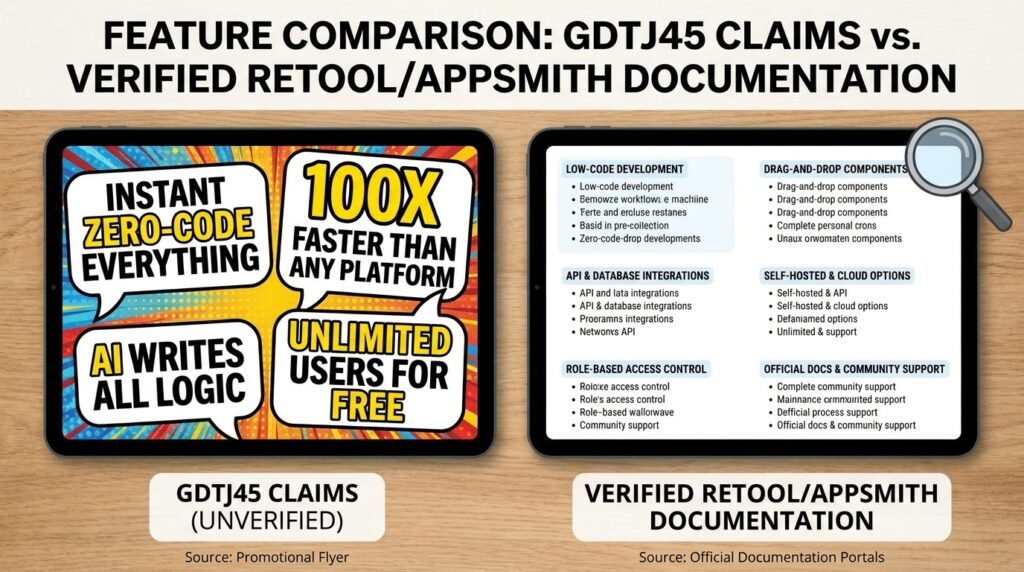
The articles ranking for this term describe a tool that combines visual drag-and-drop building with custom code editing, supports JavaScript, Python, and Java, and includes real-time collaboration. Those are features shared by real tools — Retool, Bubble, Webflow, and AppSmith, among others. GDTJ45 borrows the descriptions of these real platforms without being one of them.
The identifier itself follows no naming convention used by any major software ecosystem. Development tools use either descriptive names (Visual Studio Code, IntelliJ IDEA), version strings (Node 20.x), or internal build tags formatted as tool-name-v1.2.3-build. “GDTJ45” matches none of these patterns.
How did so many articles get written about a fake tool?
The propagation path for GDTJ45 follows the same mechanism documented across several fabricated technical terms that appeared in 2025 and 2026.
Here is the actual sequence:
- An AI content tool generated a seed article framing “GDTJ45 builder software” as a new development platform. The article borrowed real features from tools like Retool and Bubble and attached the invented name to them.
- Other AI-assisted content sites scraped or paraphrased the first article. Because no authoritative counter-source existed, the term passed through multiple content pipelines as if it were factual.
- Search engines indexed the volume. Once eight or ten pages used the term with consistent descriptions, the pattern looked like genuine interest, not fabrication.
- Developers and programmers searched it. Any unfamiliar tool name in a technical context gets searched. That traffic confirmed the term’s apparent legitimacy in ranking signals.
The result: as of April 2026, searching “gdtj45 builder software” returns pages from at least a dozen domains, none of which link to an official product page, a GitHub repository, or a developer documentation site — because none exist.
The Fabricated-Tool Detection Framework: Verify Before You Evaluate
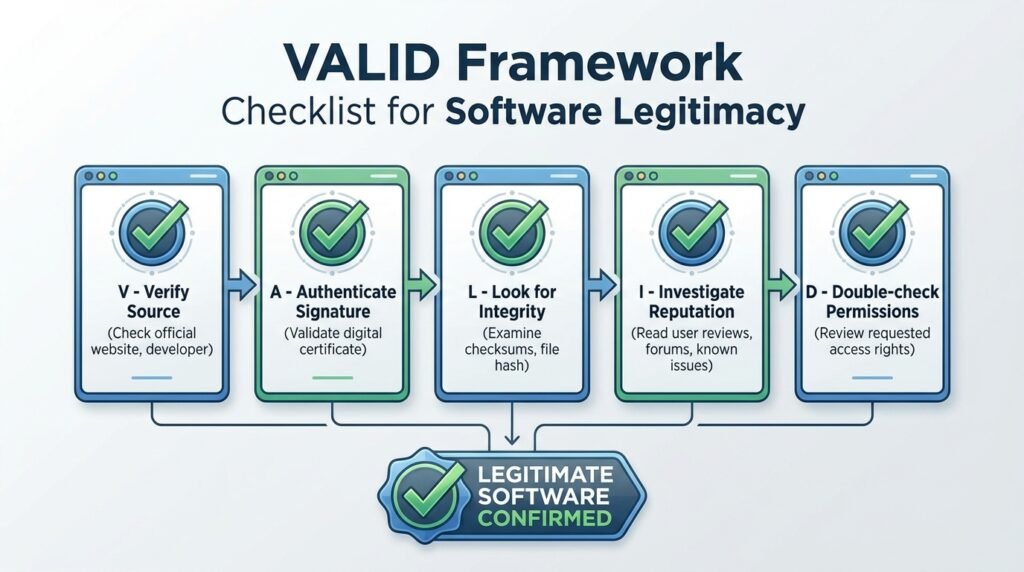
No other article in this search space offers a systematic way to verify whether a software tool is real before spending time evaluating it. Here’s a five-point check you can run in under three minutes.
The VALID framework for unfamiliar software tools:
V — Vendor search. Search the exact tool name on G2 (g2.com), Capterra (capterra.com), and Product Hunt (producthunt.com). Legitimate software tools appear on at least one of these within months of launch. GDTJ45 appears on none.
A — Active repository. Search GitHub and GitLab for the tool name. Real developer tools — even early-stage ones — have public repositories, issues, and commit histories. No repository for GDTJ45 exists.
L — Linked documentation. Every article about a real tool links to official documentation, a company site, or a verified download page. Every GDTJ45 article links back to other GDTJ45 articles, creating a closed loop with no authoritative source at the center.
I — Inconsistent specifics. When a tool is real, independent articles agree on core facts: pricing tiers, founding year, company name, and headquarters. GDTJ45 articles contradict each other. One says it launched in 2024, another says 2026. One cites “2.8 million active users,” another cites no users at all.
D — Download path. Any real software tool has a confirmed download URL — either an official site, a GitHub releases page, or a package registry like npm or PyPI. For GDTJ45, following any “official download” reference leads either to a generic page or a loop back to the same content network.
| Check | Real Tool (e.g., Retool) | GDTJ45 Builder Software |
|---|---|---|
| G2/Capterra listing | Yes — hundreds of reviews | Not found |
| GitHub repository | Yes — active commits | Not found |
| Official documentation URL | docs.retool.com | No verifiable URL |
| Consistent facts across sources | Yes | Contradictory |
| Verified download page | retool.com/download | No verified page |
| Company/founder named | David Hsu, Retool Inc. | No named entity |
What’s actually different across GDTJ45 articles — and why that matters
Most developers searching this term read one article and move on. Reading five reveals something telling: the numbers don’t match.
- One article claims GDTJ45 “recorded 2.8 million active users in 2024, marking a 34% increase from the previous year.”
- Another states it “emerged in 2026 as a modular development platform.”
- A third references GitHub Copilot statistics as proof of GDTJ45’s performance gains — using a completely different product’s data to support claims about this one.
- One article describes it as software for construction project management. Another describes it as a code editor. A third calls it a no-code platform.
A real software product has a defined, consistent identity. Its description doesn’t change based on which content farm generated the article. The variance across GDTJ45 articles isn’t editorial interpretation — it’s the fingerprint of independent AI content generation with no source material to constrain it.
This matters beyond curiosity. Developers acting on fabricated reviews or features waste time in evaluation. Procurement teams that use AI-generated “tool comparisons” as research inputs can end up recommending tools that don’t exist. Content teams that produce articles about fake tools — even unknowingly — accumulate a track record that Google’s quality assessments penalize.
What real tools actually do what GDTJ45 articles describe?
If you found GDTJ45 because you’re genuinely looking for a modular, low-code/pro-code builder platform, the good news is that the use case is real and well-served by verified tools. Here’s what actually exists:
For internal tools and admin panels
Retool (retool.com) is the most widely deployed internal tool builder for developers. It combines a drag-and-drop interface with custom JavaScript, connects to databases and APIs, and supports real-time collaboration. Retool published its pricing and documentation publicly and has raised over $140 million in verified funding according to Crunchbase.
AppSmith (appsmith.com) is the open-source alternative. The repository has over 30,000 GitHub stars, active maintainers, and published release notes. You can self-host it or use the cloud version.
For visual web development with code access
Webflow provides a visual builder with access to underlying HTML, CSS, and JavaScript. Its documentation is at webflow.com/university and the product has verifiable user numbers published in their annual reports.
Builder.io targets component-based development with a visual editor that outputs code you can inspect and modify. The GitHub repository is public at github.com/BuilderIO/builder.
For rapid prototyping and MVPs
Bubble (bubble.io) is a no-code platform with a published pricing page, public roadmap, and a community forum with verifiable user posts dating to 2012. It’s not perfect for every use case — it trades code-level control for speed — but it is real and documented.
The pattern these tools share: they have named founders, published documentation, active community forums, and GitHub presence. If a tool described as doing what GDTJ45 supposedly does doesn’t have all four of those, keep looking.
Why AI-generated software “reviews” are harder to detect than other fake content
AI-fabricated health or financial misinformation is relatively easy to flag — it contradicts documented science or established data. Fake software content is harder because it describes plausible capabilities.
Every feature attributed to GDTJ45 — drag-and-drop building, code injection, real-time collaboration, API integration — exists in real tools. The fabricated article copies the feature set of actual platforms and reassigns it to a fake identifier. To a developer unfamiliar with the specific tools in this space, the description sounds reasonable.
Three patterns that distinguish AI-fabricated software content from genuine reviews:
Pattern 1: No negative feedback. Real software tools have documented limitations, known bugs, and features users wish worked differently. Every GDTJ45 article describes a tool with no weaknesses unless a separate “problems” article was generated specifically to fill that content slot — which is exactly what happened here.
Pattern 2: Statistics without context. Claims like “reduces development time by 40–60%” and “92% efficiency in project completion rates” appear without defining the baseline, the study methodology, or the comparison group. Real benchmarks, like those published by the DORA State of DevOps report, use defined metrics and methodology.
Pattern 3: Feature descriptions that match multiple real tools. If a tool’s feature list reads like a composite of Retool, GitHub Copilot, and Docker, it’s likely that an AI aggregated those features from multiple real sources and attributed them to a fake product.
How to find credible software reviews as a developer in 2026
The volume of AI-generated content about non-existent tools is increasing. Your research process needs to account for this.
Primary sources that maintain editorial standards for software:
- Stack Overflow’s Developer Survey — annual data on which tools developers actually use, with verified sample sizes and methodology published openly
- ThoughtWorks Technology Radar — quarterly assessments of emerging tools by working technologists, with explicit assessment criteria
- GitHub’s repository network — actual usage data. Stars, forks, and commit frequency are verifiable signals that a tool has real users
- Official product documentation — if a company can’t maintain documentation, the product isn’t mature enough to evaluate seriously
For any tool you’re evaluating for production use, the sequence is: GitHub repo → official docs → G2 reviews from verified users → Stack Overflow questions from real developers. Blog content is hypothesis; these sources are evidence.
Frequently Asked Questions
Is GDTJ45 builder software a real product I can download?
No. As of April 2026, no verified download page, GitHub repository, official documentation, or company registration exists for GDTJ45 builder software. Every article describing it as a real tool either cites no authoritative source or links back to other articles in the same content network. It is an AI-generated identifier with no product behind it.
Why does GDTJ45 builder software appear on so many websites?
Because AI content generation tools produced articles about it en masse starting in late 2025, and search engines indexed that volume before authoritative counter-content existed. Each article citing another article in the same network created a false signal of legitimacy. This is the same mechanism that produced similar fake technical terms like “python 54axhg5” around the same period.
Could GDTJ45 be an internal tool at a specific company?
Technically any organization can name an internal tool anything. But the articles ranking for this term describe a commercial product with millions of users, a public download page, and multi-language support — none of which are characteristics of a private internal tool. No company has identified itself as the creator.
What should I use instead of GDTJ45 for internal tool building?
For internal tools and admin dashboards, Retool and AppSmith are the most documented options available in 2026. Retool is commercial with a free tier; AppSmith is open-source with a self-hosted option. Both have verified GitHub repositories, active communities, and published pricing.
How can I tell if a software tool mentioned online is real before evaluating it?
Use the VALID framework outlined in this article: check G2 and Product Hunt for verified listings, search GitHub for an active repository, verify that independent articles agree on basic facts, confirm that a documentation URL exists and leads to real content, and find an official download path. If two or more of these checks fail, treat the tool as unverified.
Are there other fake software tools spreading the same way?
Yes. The pattern of AI-generated fake technical identifiers covers multiple categories: fabricated Python modules, invented developer tools, and non-existent software platforms. The common thread is an alphanumeric string or plausible-sounding name attached to feature descriptions lifted from real, competing products. Critical verification before evaluation is the only reliable defense.
What’s the risk of writing about GDTJ45 as if it’s real?
For individual developers, the main risk is wasted research time. For content teams and SEO practitioners, publishing about fabricated tools contributes to a content quality pattern that Google’s Helpful Content system specifically targets. Sites accumulating AI-generated content about non-existent topics face ranking penalties that affect their legitimate content as well.
The next time a software tool appears in your search results with no GitHub repo, no G2 listing, and no named company behind it, run the VALID check before reading further. Real tools leave traces: commits, documentation, community posts, and at minimum a verifiable download URL. If those traces don’t exist, the tool doesn’t either.
For genuine modular builder platforms, start your evaluation at AppSmith’s GitHub repository or Retool’s documented feature pages — both give you verifiable, current information that holds up to scrutiny.
