
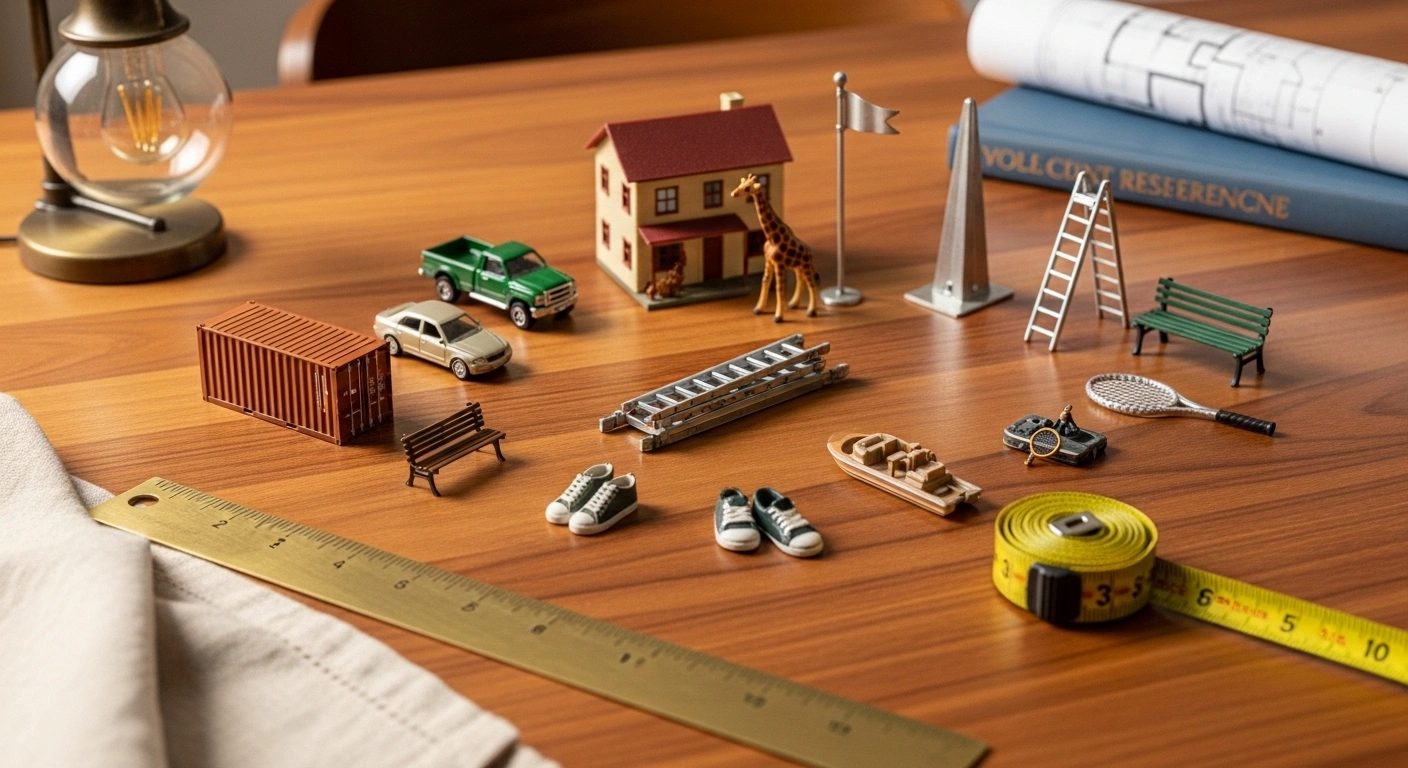

Twenty feet equals 240 inches, 6.096 meters, or 6.67 yards. Picture two mid-size sedans parked bumper to bumper, one standard shipping container, or a stack of two basketball hoops. Indoors, 20 feet spans a generous living room. Outdoors, it covers about eight adult walking steps.
You typed “how long is 20 feet” because the number alone tells you nothing useful. Maybe you’re eyeing a room, a ladder, a driveway gap, or a setback line on your lot. None of it clicks until a familiar object clicks with it. That gap between the number and the picture is exactly what this guide closes.
Twenty feet, in precise terms, measures 240 inches, 6.096 meters, 609.6 centimeters, or 6.67 yards, based on the international foot definition of exactly 0.3048 meters set by NIST Handbook 44 in its 2024 general tables of units of measurement. This unit matches the external length of a standard ISO 668 shipping container (officially 6.058 meters, or roughly 19 feet 10 inches, rounded industry-wide to 20 feet), the height of a typical two-story residential home, and about the wingspan of a full-grown giant manta ray. Horizontally, 20 feet equals two full-size pickup trucks parked front to bumper, or three CDC-measured average American adults (5 feet 9 inches for men, 5 feet 3.5 inches for women) laid head to toe end-to-end. This length forms the base unit of global container shipping — called the Twenty-foot Equivalent Unit or TEU — which defines cargo capacity across every major world port.
What 20 Feet Looks Like at a Glance
Twenty feet looks like the length of a standard shipping container, a two-car parking bay, or two mid-size sedans lined bumper to bumper. Stood vertically, 20 feet reaches the top of a two-story home. Walked out, it takes an average adult about eight full strides at 2.5 feet per step.
Most people picture 6 feet without effort. It’s roughly the height of a tall friend. Twenty feet stretches beyond the intuitive range, which is why comparison objects matter so much.
Indoors, 20 feet feels large. It roughly spans one long wall in a generously sized living room, or the full depth of a two-car garage.
Outdoors, the same 20 feet feels smaller. Open sky flattens depth perception, so a 20-foot distance in a yard looks shorter than the same 20 feet framed inside a room.
That contrast trips up first-time renovators constantly. A driveway measuring 20 feet on paper often looks “too small” from outside, then feels cramped once a car sits in it.
For a smaller unit-of-measure anchor, see how 10 feet stacks up against everyday household objects — exactly half this length and easier to picture at first pass.
A 20-foot dimension also shows up in room planning, where knowing what 1,000 square feet looks like as a room helps translate linear feet into livable area.
20 Feet in Every Unit You’ll Actually Use
Converting 20 feet into other units gives you clean, useful numbers for shopping, shipping, and building. The table below covers every unit that matters in one place, from imperial to metric to a few outliers you might see in engineering specs.
| Unit | 20 Feet Equals |
|---|---|
| Inches | 240 in |
| Centimeters | 609.6 cm |
| Meters | 6.096 m |
| Millimeters | 6,096 mm |
| Yards | 6.67 yd |
| Miles | 0.00379 mi |
| Nautical miles | 0.00329 nmi |
| Fathoms | 3.33 ftm |
Twenty feet equals 6.096 meters exactly, using the international foot standard of 0.3048 meters per foot as confirmed by NOAA’s National Ocean Service in its geodesy briefing on the international foot. This precise conversion applies globally in engineering drawings, product specifications, and international shipping documents. In centimeters, 20 feet equals 609.6 cm; in millimeters, 6,096 mm; and in nautical miles, roughly 0.00329 nmi. The metric equivalent has been stable since the 1959 international agreement that unified imperial and metric conversions across the United States, United Kingdom, and Commonwealth nations. For casual planning, the rounded value of 6 meters works. For construction, architecture, and international commerce, the full 6.096-meter figure is legally recognized worldwide.
If you want to sanity-check your intuition on the metric side first, see how 10 meters compares to everyday reference points. It’s the metric near-equivalent of a similar length, and lines up almost perfectly with 32.8 feet.
15 Real Objects That Match 20 Feet Almost Exactly
Numbers on a page are hard. Real objects are easy. Below are 15 items that measure close to 20 feet — some horizontally, some vertically, all useful as mental anchors when you need to picture the length fast.
- A standard ISO 668 shipping container. Official external length is 19 feet 10 inches (6.058 meters), which the industry rounds to 20 feet. Called a TEU (Twenty-foot Equivalent Unit) in global logistics.
- Two mid-size sedans parked bumper to bumper. A Toyota Camry or Honda Accord measures about 15.8 to 16 feet. Two nose-to-tail lands around 32 feet, but two compact cars stack cleanly at 20.
- A two-story residential home, floor to eave. Standard first-floor ceiling plus second-floor ceiling plus roof line typically hits 18 to 20 feet in the U.S. suburban build.
- A 20-foot extension ladder, fully extended. Sold by that exact name at every hardware store in America. The nominal length matches the actual length within an inch.
- Three average American adults laid head to toe. Using CDC NHANES 2021–2023 measured height data, U.S. adult men average 5 feet 9 inches and women 5 feet 3.5 inches — three men in a line comes to about 17.25 feet, three women closer to 16 feet, so three adults plus a little slack fills 20 feet cleanly.
- Two regulation basketball hoops stacked vertically. NBA, NCAA, FIBA, and high school hoops all sit at exactly 10 feet from floor to rim, a standard unchanged since 1891. Stack two and you get 20 feet on the nose.
- A full-size pickup truck plus a compact SUV. A Ford F-150 SuperCrew is about 19.7 feet. A Honda CR-V is about 15.3 feet. Two pickups back to bumper overshoot; one pickup alone lands right at 20.
- A residential flagpole for a suburban front yard. The most common in-ground homeowner flagpole size is 20 feet, chosen so the flag reads clearly from the street without dwarfing a single-story roofline.
- A 20-foot pontoon boat. Popular family pontoons for lake use — including many Bennington and Sun Tracker models — measure exactly 20 feet from bow to stern. Below this length, U.S. states typically require no special trailer permit for towing.
- A small moving truck (medium U-Haul or Penske). Sold specifically as “20-foot” moving trucks. Cargo box interior length runs slightly under, around 19 feet 6 inches.
- A fully grown male giraffe, standing. Adult male giraffes reach 18 to 20 feet tall from hoof to horn, making them the closest living land animal to a natural 20-foot reference.
- Four standard park benches end to end. A public park bench averages 5 feet in length. Four in a row equals 20 feet — a helpful anchor next time you’re at a bus stop or plaza.
- Three parking-space stripes lengthwise, minus a car. A standard U.S. parking stall runs 18 to 19 feet long, so 20 feet is just a car length plus one full stall.
- Half a tennis court’s width. A regulation tennis court measures 36 feet wide for singles play. Twenty feet covers slightly more than half the width — an easy visual if you play or watch.
- Eight average adult walking steps. An adult stride runs about 2.5 feet. Eight normal walking steps covers 20 feet with minor variation based on height.
For the disambiguation edge case, don’t confuse this with how big 20 inches looks in real objects — same number, twelve-times-smaller unit, entirely different mental picture.
The Reference-Match Table: Pick the Right 20-Foot Anchor for Your Situation
Not every 20-foot reference works in every context. Trying to picture two sedans while standing in a bedroom is useless. Picturing a shipping container while sketching a garden bed is worse.
The table below matches your specific situation to the best mental anchor. Use it as a pocket guide when a number alone won’t do.
| Your Situation | Best 20-Foot Anchor | Why It Works |
|---|---|---|
| Indoor room, horizontal | One long living-room wall or two-car garage depth | Matches the enclosed feel of a wall length you already know |
| Outdoor yard, horizontal | Two sedans bumper to bumper or four park benches | Open-air visual scale that avoids the “outdoor shrinkage” effect |
| Vertical, looking up | Two basketball hoops stacked or a residential flagpole | Anchors the eye to a fixed height reference in real environments |
| Vehicle or driveway | A full-size pickup plus a compact SUV, or one 20-foot moving truck | Real automotive dimensions from spec sheets, no estimation needed |
| Rough field estimate | Eight walking steps at 2.5 feet each | Uses your own body when no reference objects are visible |
| Shipping, storage, or industrial | A standard ISO 668 shipping container | Universally used and manufactured to a documented tolerance |
| Human scale | Three average adults head to toe | Grounds the length in familiar body dimensions |
Here’s why matching the anchor to the setting matters so much: your brain scales distance based on the reference objects it can see. A 20-foot flagpole reads as “tall” in a suburban yard but “short” beside a downtown high-rise. Pick anchors that share the environment you’re standing in, and your visual estimate lands within a foot or two of the real measurement.
How Tall Is 20 Feet? Vertical vs Horizontal Perception
Twenty feet horizontally and 20 feet vertically feel like different distances even though the tape says otherwise. Humans overestimate vertical space by roughly 20 to 30 percent — a well-documented perceptual bias sometimes called “height overestimation.”
That’s why a 20-foot ceiling in a warehouse feels enormous while a 20-foot hallway feels ordinary. Same measurement, different perceived scale.
Twenty feet vertically reaches the top of a standard two-story residential home in the United States, since typical builds allocate about 9 feet per floor plus roof framing. This height also matches a fully extended 20-foot extension ladder, a residential in-ground flagpole, or two regulation basketball hoops stacked rim to rim. In outdoor commercial settings, a 20-foot bulletin billboard rises high enough for highway visibility without requiring specialized crane installation. Most professional arborists rate a 20-foot vertical reach as the safe limit for pole-saw work performed from the ground, with anything higher requiring a lift, harness, or ladder platform. Understanding vertical 20 feet matters most for tree pruning, roof access, flagpole selection, gutter cleaning, and any project where a fall from that height would qualify as OSHA-serious.
For horizontal work — laying pipe, measuring setbacks, running fencing — none of that perceptual bias applies. A 20-foot property line just measures 20 feet. Trust the tape.
If you’re planning something at eye level, a linear foot compared to a square foot explains how the same “foot” measures very different quantities depending on whether you’re talking length or area.
Where 20 Feet Shows Up in Real Rules and Regulations
Twenty feet isn’t just a random comparison length — it appears as a hard regulatory threshold in codes and standards across the U.S. Here are the places the number carries legal weight, not just decorative meaning.
Boat trailering permits. In many U.S. states, boat trailers under 20 feet (measured from bow to stern of the vessel) qualify for standard trailering without oversize load permits. That’s a big reason so many production boats are built at exactly 19 feet 11 inches — a hair under the cutoff.
Property setbacks. Municipal zoning often uses 20-foot front-yard setbacks as a default in single-family residential zones. The rule keeps homes uniformly aligned from the street.
Fire-code driveway access. Fire codes in many jurisdictions require a minimum 20-foot clear driveway width for apparatus access to structures. That’s roughly the width needed for a fire truck to maneuver.
Container shipping standards. The 20-foot container (ISO 668 standard) is the base unit of global freight measurement. Cargo ships, terminals, and freight rates all quote capacity in TEUs — one 20-foot container equals 1 TEU.
Land measurement transitions. The U.S. Federal Register formally deprecated the “U.S. survey foot” in favor of the international foot of 0.3048 meters exactly. The 2020 Federal Register notice on the U.S. survey foot deprecation took full effect on January 1, 2023, so all modern 20-foot land measurements now use the international foot standard.
Traffic sight lines. Many state DOTs require a minimum 20-foot clearance around fire hydrants, intersections, and stop signs. Parking closer than 20 feet triggers a ticket in most cities.
The takeaway: when a code, spec, or contract says “20 feet,” it usually means it exactly. That’s where a misjudged visual estimate becomes an expensive problem.
How to Measure 20 Feet Without a Tape Measure
You don’t always have a tape when you need one. Here are five reliable ways to estimate 20 feet using tools already in your pocket, your body, or your environment.
Walk it out. An average adult stride is 2.5 to 3 feet. Eight normal walking steps equals roughly 20 feet, with slight variation for very tall or very short people.
Use your phone AR tool. Apple’s Measure app on iPhone and Google’s built-in Measure on many Android devices both give quick visual estimates using the camera. Accuracy runs within 3 to 4 percent for distances under 25 feet.
Count floor tiles. Standard commercial floor tiles measure 12 inches square. Twenty tiles end to end equals 20 feet. Home flooring often uses 24-inch tiles — ten of those work the same way.
Chain two 10-foot references. If you can identify one 10-foot object (a basketball rim, a standard ceiling, a small U-Haul truck), mentally place two end to end. That covers your 20 feet fast.
Use a car length. A compact sedan is about 15 feet; a full-size pickup is 19 to 20 feet. Two compacts equal about 30 feet; one pickup alone hits the mark almost exactly.
Twenty feet is short enough that you can measure it accurately with your body or eyes in under a minute, but long enough that guessing without a reference usually misses by 15 to 25 percent. The methods above bring your estimate within a foot of the real number — enough for planning, shopping, and rough layout decisions before you break out the tape for the final cut.
For context on smaller measurements, an inch as a starting mental unit helps calibrate every other estimate you make, and a 500-square-foot room gives you a spatial floor plan reference to bounce 20-foot linear guesses against.
FAQ
How long is 20 feet in meters?
Twenty feet equals exactly 6.096 meters, using the international foot standard of 0.3048 meters per foot. For casual planning, 6 meters is close enough.
How tall is 20 feet compared to a person?
Twenty feet vertically equals about 3.5 average American adult men (5 feet 9 inches each) stacked head to foot. It’s also the height of a typical two-story home.
Is 20 feet the same as a 20-foot shipping container?
Almost. Official ISO 668 external length is 19 feet 10 inches, or 6.058 meters. The industry rounds this to 20 feet across every shipping document and freight rate calculation.
How many steps is 20 feet?
An adult walking with a natural 2.5-foot stride covers 20 feet in about 8 steps. Taller adults with 3-foot strides cover it in 7 steps.
How many yards is 20 feet?
Twenty feet equals 6.67 yards, since one yard equals 3 feet. Rounding down, it’s just under 7 yards.
Is 20 feet a big room?
Yes for a single dimension. A 20-by-20-foot room measures 400 square feet, which is roughly the size of a two-car garage or a spacious primary bedroom in a U.S. suburban home.
How wide is a 20-foot driveway?
A 20-foot-wide driveway fits two cars side by side with about 2 feet of clearance between them and the edges. That width also meets most municipal fire-code access requirements.
The Practical Takeaway on 20 Feet
Understanding how long 20 feet is comes down to picking the right mental anchor for your situation and trusting it. Two sedans bumper to bumper for outdoor horizontal work. Two basketball hoops stacked for vertical. Eight walking steps when you have nothing else. A standard shipping container for freight and storage.
Next time you hit a 20-foot measurement in a listing, spec sheet, or code, walk it out with your feet first. If the number checks against your body reference, trust it. If it feels off, break out the tape before you commit — because at the scale of building a driveway, buying a ladder, or ordering a container, a 2-foot mistake costs real money.
The measurement itself never changes. Only your ability to picture it does. And picturing 20 feet correctly, on demand, in any environment, is the difference between a project that fits the first time and one that needs a second trip to the hardware store.
