
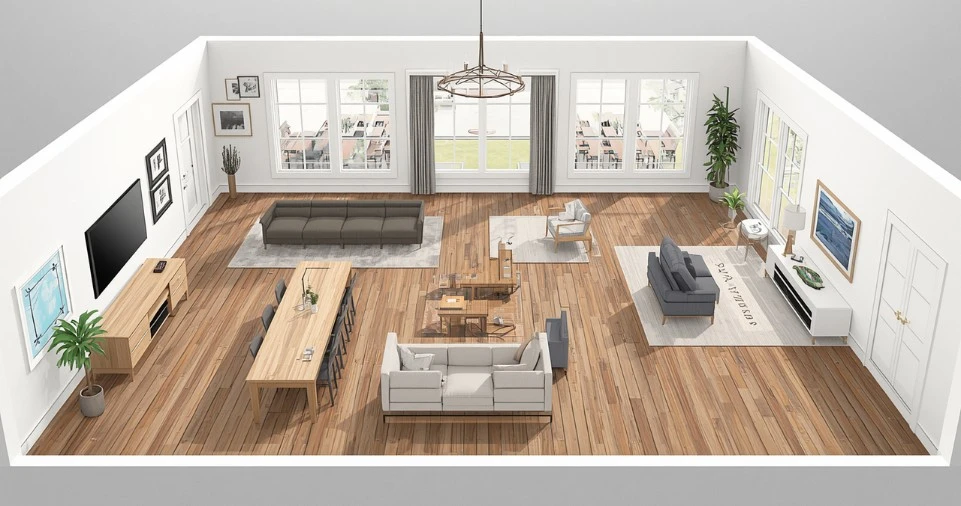

300 square feet is a room roughly the size of a school bus interior or a comfortable studio apartment. It measures about 15 feet by 20 feet (or 17.32 feet by 17.32 feet if perfectly square) and converts to approximately 27.87 square meters or 33.33 square yards. It’s a common size for full studio apartments, large hotel rooms, spacious home offices, and mid-large storage units.
If you’ve ever seen “300 sq ft” on a rental listing or floor plan and wondered what that actually looks like, this guide walks through the real dimensions, what fits inside, and how it compares to spaces you already know.
Quick Answer: How Big Is 300 Square Feet?
- Dimensions: 15 ft × 20 ft (rectangular), 17.32 ft × 17.32 ft (square), or 10 ft × 30 ft (long)
- Metric conversion: 27.87 square meters
- Square yards: 33.33 square yards
- Closest everyday comparison: a standard school bus interior or a comfortable studio apartment
- Common uses: studio apartment, large hotel suite, home office, storage unit, tiny home
300 Square Feet in Other Units
Here’s the conversion at a glance:
| Unit | Equivalent to 300 sq ft |
|---|---|
| Square meters (m²) | 27.87 m² |
| Square yards (yd²) | 33.33 yd² |
| Square inches (in²) | 43,200 in² |
| Square centimeters (cm²) | 278,709 cm² |
| Acres | 0.00689 acres |
The formula is simple: square feet = length (ft) × width (ft). To convert to square meters, divide by 10.764. To convert to square yards, divide by 9.
What Are the Dimensions of a 300 Square Foot Room?
Any two dimensions that multiply to 300 will work. These are the most common:
| Layout | Dimensions | Shape | Best For |
|---|---|---|---|
| Rectangular | 15 ft × 20 ft | Balanced rectangle | Studios, large bedrooms, small living rooms |
| Square | 17.32 ft × 17.32 ft | Perfect square | Master suites, home offices, sitting rooms |
| Long rectangular | 10 ft × 30 ft | Long and narrow | Storage units, galley studios |
| Wide rectangular | 12 ft × 25 ft | Slightly long | Small apartments, converted garages |
The 15×20 rectangle is one of the most common — it’s close to the interior of a converted single-car garage plus a small extension, or a typical urban studio layout.
10 Real-Life Comparisons to Visualize 300 Square Feet
Numbers only get you so far. These everyday comparisons make 300 sq ft click:
1. A standard school bus interior. A yellow full-size school bus has an interior floor area of roughly 300 sq ft. This is one of the most reliable visual benchmarks because most adults have walked through one.
2. A 40-foot shipping container. The interior floor of a 40 ft container is about 304 sq ft — almost exactly 300 sq ft. A near-perfect match.
3. A comfortable studio apartment. Most “no-compromise” urban studios in the U.S. range from 300 to 450 sq ft. 300 sq ft is the lower end where everything fits without feeling cramped.
4. A 10×30 storage unit. One of the largest common self-storage sizes. Holds a 4–5 bedroom home’s contents or two vehicles with limited walking space.
5. A large hotel suite. Junior suites and extended-stay rooms often measure 280–350 sq ft — bed, sitting area, small kitchenette, full bathroom.
6. Two parking spaces plus. Two side-by-side U.S. parking spaces total 324 sq ft. 300 sq ft is roughly two parking spots — think driveway pull-in for two cars.
7. A converted single-car garage. Single-car garages range from 200 to 300 sq ft. The larger end — often called an “oversized single” — is right at 300 sq ft.
8. A modest tiny home. Many upper-end tiny homes measure 300–400 sq ft. This size fits a proper bedroom, kitchen, bathroom, and living room without extreme compromise.
9. Half a two-bedroom apartment. A typical U.S. 2-bedroom apartment is 900–1,100 sq ft. 300 sq ft is roughly one-third — enough for the living room and kitchen alone.
10. A generous home office plus meeting space. 300 sq ft holds a full executive desk, seating area for 3–4 guests, and a wall of storage — comparable to a mid-tier corporate office.
Quick trick to feel it in person: if you’ve ever walked the length of a school bus, you’ve walked 300 sq ft. Or grab painter’s tape and mark a 15 × 20 rectangle in a large room or driveway.
What Can You Fit in 300 Square Feet?
The answer depends on the function. Here’s what actually fits, use case by use case.
As a Studio Apartment
- Queen-size bed (not Murphy) with room to walk
- Sofa and coffee table
- Full dining table (for 2–4)
- Kitchenette or small full kitchen along one wall
- Small bathroom included in the count
- Wardrobe or closet plus vertical storage
As a Large Bedroom or Master Suite
- King-size bed with headboard
- Two nightstands
- Full dresser
- Sitting area with chair and side table
- Desk or vanity
- Walk-in closet (potentially within the footprint)
As a Home Office
- Executive desk with return
- Ergonomic chair
- Full wall of built-in shelving
- Guest seating area (2–3 chairs, small coffee table)
- Filing cabinets, printer stand, and storage
- Small conference or meeting corner
As a Storage Unit
- Contents of a 4–5 bedroom home
- Two mid-size vehicles or one vehicle plus household goods
- Full home gym setup (rack, bench, cardio equipment, weights)
- Business inventory for a small-to-mid e-commerce operation
Is 300 Square Feet Enough to Live In?
For most single adults, yes — comfortably. For couples, it’s workable with good design. 300 sq ft is often cited as the sweet spot where “tiny living” starts to feel more like “efficient living” and less like a compromise.
300 sq ft works well for you if:
- You live alone or with a compatible partner
- You cook simple to moderately elaborate meals
- You have a manageable amount of belongings
- You value low rent, low utilities, and location
- You want a “real” bathroom and kitchen, not a hallway version
300 sq ft feels tight if:
- You share it with more than two people
- You work from home with heavy equipment or need a dedicated office
- You entertain frequently or host overnight guests
- You collect anything bulky
How to Make a 300 Square Foot Space Feel Bigger
At 300 sq ft you have real design flexibility. What works:
- Zone with furniture. Use a bookshelf, sofa back, or rug to create distinct “sleeping,” “living,” and “dining” zones without walls.
- Vertical storage on every wall. Floor-to-ceiling shelving reclaims massive amounts of usable space.
- Multi-function furniture. Storage ottomans, expandable tables, sofa beds, wall-mounted desks that fold up.
- Light, neutral palette with one bold accent. At 300 sq ft you can risk one accent wall or bold rug without shrinking the room.
- Mirrors on the longest wall. A large mirror doubles perceived depth.
- Barn doors or pocket doors. Reclaims swing space where standard doors would eat 10–15 sq ft.
- Under-bed and overhead storage. Bed risers plus overhead shelving nearly doubles storage capacity.
How 300 Square Feet Compares to Other Common Sizes
| Size | Rough Equivalent | Typical Use |
|---|---|---|
| 100 sq ft | Walk-in closet, small bathroom | Small bedroom, single dorm room |
| 200 sq ft | One-car garage, master bedroom | Micro-studio, home office |
| 250 sq ft | Mid-range hotel room | Micro-studio, tiny home |
| 300 sq ft | School bus interior, 40 ft shipping container | Studio apartment, tiny home, large office |
| 400 sq ft | Two-car garage | 1-bedroom apartment, tiny home max |
| 500 sq ft | Small 1-bedroom apartment | Comfortable studio or 1-bedroom |
| 1,000 sq ft | Standard 2-bedroom apartment | Small family home |
The jump from 200 to 300 sq ft is a meaningful upgrade — see our companion guide on how big 200 square feet actually is for the smaller-footprint reference point. The extra 100 sq ft is often the difference between “compromise” and “comfortable.”
Frequently Asked Questions
How many square meters is 300 square feet?
300 square feet equals approximately 27.87 square meters. The exact conversion is 300 ÷ 10.764 = 27.87 m².
What are the dimensions of a 300 sq ft room?
The most common dimensions are 15 ft × 20 ft. A square 300 sq ft room measures 17.32 ft × 17.32 ft. Any two measurements that multiply to 300 work — 10 × 30 and 12 × 25 are also common.
Is 300 sq ft big enough for a studio apartment?
Yes, comfortably. 300 sq ft is where studios stop feeling like micro-units and start feeling like real apartments. You fit a full-size bed, living area, dining space, kitchen, and bathroom without extreme compromise.
Can two people live in 300 square feet?
Yes, but design discipline matters. Couples in 300 sq ft benefit from Murphy beds, multi-function furniture, and clear zoning between activities. It’s a common size within the tiny-house movement for couples.
How much does a 300 sq ft storage unit cost?
In the U.S., a 10×30 self-storage unit typically rents for $200 to $550 per month, depending on the city, climate control, and access hours.
Is 300 sq ft the same as a school bus?
Very close. A standard full-size school bus interior measures roughly 290–310 sq ft — 300 sq ft is the middle of that range and one of the most memorable visual benchmarks.
How many people can fit in 300 sq ft?
For a standing gathering, 25–30 people fit comfortably (about 10 sq ft per person). For a seated dinner, plan for 10–12 without crowding.
Is 300 sq ft enough for a home office?
More than enough. 300 sq ft is a generous home office — executive desk, seating for guests, full storage wall, and a small meeting area. Larger than most private offices in corporate buildings.
The Bottom Line
300 square feet is where “tiny” starts feeling like “efficient.” It’s the interior of a school bus, the floor of a 40-foot shipping container, the size of a comfortable studio apartment, or a well-appointed junior suite. Whether you’re evaluating an urban studio, planning a tiny home, sizing a home office, or shopping for storage, 300 sq ft is a footprint where you can fit real life without heroic compromise.
Next time you see “300 sq ft” on a listing, you won’t need to guess. Picture a school bus. Picture a studio apartment. Picture a 15 × 20 rectangle. That’s the space.
Once you can visualize 300 sq ft, the same anchor-object technique scales to any measurement — from small rooms all the way up to land parcels of 700 acres or more.
