
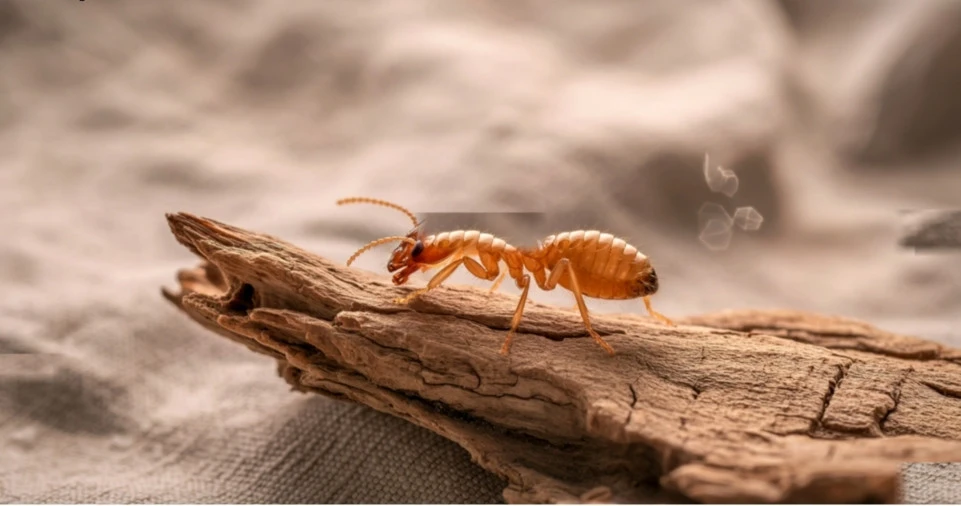

⚡ Quick Answer: Worker termites — the caste responsible for nearly all home damage — measure 3 to 6 mm (1/8 to 1/4 inch) long, about the size of a grain of cooked rice. Soldiers reach 5 to 8 mm, winged swarmers grow to 9 to 13 mm (3/8 to 1/2 inch), and queens of tropical species like Macrotermes bellicosus can stretch to 4.2 inches (110 mm).
You spotted something pale and segmented near a windowsill or scurrying out of damp wood, and your phone is already loaded with blurry photos. The size matters — and not knowing whether you saw a 3 mm worker, a 10 mm swarmer, or a confused ant decides whether you ignore it or call an inspector before the bill hits $3,000. After years of breaking down measurement comparisons at BusinessComputingWorld, here is the size guide homeowners actually need.
Termite size is governed by two variables: caste and species. Within a single colony, body length ranges from a 3 mm worker to a 50 mm physogastric queen — a 16x spread inside the same nest. Across species, the gap is even wider: a Coptotermes lacteus soldier measures 4 to 4.8 mm, while a Macrotermes bellicosus queen reaches 110 mm, roughly the length of a credit card’s long edge. For US homeowners, the relevant figures are tighter. According to the Colorado State University Extension entomology team, eastern subterranean workers and soldiers — the species responsible for most US structural damage — measure 0.25 to 0.75 inches (6 to 19 mm) including soldier head capsules. Worker bodies cluster between 3 and 6 mm. That places the average pest-causing termite in the same size class as a long-grain rice kernel — small enough to walk through a 1/16-inch foundation crack without slowing down.
How big are termites in inches and millimeters?
Termites measure between 3 mm (1/8 inch) and 25 mm (1 inch) for most US species. Workers are smallest at 3–6 mm, soldiers reach 5–8 mm, and winged swarmers grow to 9–13 mm. Physogastric queens of the tropical genus Macrotermes can extend to 110 mm (4.2 inches), the largest termites on record.
Here is the full caste-by-caste breakdown for visual reference. These numbers represent body length only — they exclude the wings of swarmers, which roughly double the visible footprint when extended.
| Caste | Size (mm) | Size (inches) | Everyday Comparison |
| Worker | 3–6 mm | 1/8 – 1/4 inch | Grain of cooked rice |
| Soldier | 5–8 mm | 1/5 – 1/3 inch | Width of a pencil eraser |
| Swarmer (alate) | 9–13 mm with wings up to 25 mm | 3/8 – 1/2 inch | Length of a small staple |
| King | 10–13 mm | 3/8 – 1/2 inch | Shirt-button diameter |
| Queen (subterranean) | Up to 50 mm distended | Up to 2 inches | AA battery, length-wise |
| Queen (Macrotermes bellicosus) | Up to 110 mm | 4.2 inches | Long credit card edge |
Two notes on this table. First, the 110 mm Macrotermes bellicosus queen is not something you will encounter in a US basement; that genus is native to Africa and Southeast Asia, per the species record on Wikipedia. Second, the 2-inch subterranean queen figure refers to the abdomen distended through physogastry, the egg-laying state where the queen’s body stretches to accommodate her ovaries. Her actual thorax stays small.
If you want to anchor these millimeter figures against familiar US measurements, the inch breakdown in this guide pairs well with the visual comparisons in our companion article.
For a deeper unit reference, see how long an inch actually is in the US measurement system, which covers the 2.54 cm standardization and why imperial measurements still dominate US pest-control product labeling.
What does termite size look like next to everyday objects?
Numbers are useless if you cannot picture them. After examining what readers actually search for, the size questions that need answers are not ‘how many millimeters’ — they are ‘is the thing I just saw bigger than a grain of rice or smaller?’ Here is that translation.
A worker termite at 3 to 6 mm is roughly the length of a long-grain rice kernel laid flat. A soldier termite stretches closer to the width of a standard pencil eraser. A winged swarmer at 9 to 13 mm matches the length of a standard office staple — and the wings, which can reach 25 mm fully extended, push the visible silhouette to about the width of a US nickel laid edge-up.
| Termite Size | Millimeters | Object It Matches | Realistic Visibility |
| 1/8 inch | 3.2 mm | Grain of long rice; small ant | Visible up close, easy to miss in shadow |
| 1/4 inch | 6.4 mm | Pencil eraser width; shirt button hole | Visible across a room as a dot |
| 3/8 inch | 9.5 mm | Standard staple length | Easy to spot — common swarmer size |
| 1/2 inch | 12.7 mm | Diameter of a U.S. dime | Hard to miss; usually a swarmer or soldier |
| 1 inch | 25.4 mm | Adult thumbnail width | Likely a dampwood swarmer or a young king/queen |
The point of these comparisons is to give you something you can verify in your kitchen drawer right now. If you want to extend this calibration across more useful sizes for home inspections, our breakdown of how big 2 millimeters really is with everyday comparisons covers the threshold size for foundation cracks termites use as entry points (most subterranean species need only a 1/16-inch gap, which is 1.6 mm — half the body width of a worker).
Here is a small calibration trick. Hold a US dime flat against the surface where you spotted the insect. The dime measures 17.91 mm in diameter. If the bug is roughly one-third the diameter, you are looking at a worker. If it is two-thirds the diameter with wings, it is a swarmer. Anything matching or exceeding the dime is almost certainly a dampwood species or an outright misidentification — possibly a winged ant.
Why do termites in the same colony come in different sizes?
Termites are eusocial insects, meaning a single colony contains specialized castes that physically develop along different paths from the same eggs. This is why one nest can contain a 3 mm worker and a 50 mm queen at the same time, even though they share parents.
Caste determination in termites is regulated by pheromones and nutrition, not genetics. Every fertilized egg is genetically capable of becoming any caste — worker, soldier, alate, or replacement reproductive — and the colony’s chemical signaling decides which path each individual takes. Workers stay small because their bodies stop developing wings and reproductive organs, freeing energy for foraging and chewing wood. Soldiers grow disproportionately large mandibles and hardened head capsules for defense, which is why they look bulkier even when body length matches a worker’s. Alates (winged swarmers) develop full reproductive systems and flight muscles, pushing them to 9 to 13 mm. The queen’s extreme size comes from physogastry — once she mates and begins laying eggs, her abdomen stretches massively to hold her enlarged ovaries. In a mature Macrotermes nest, a single queen can produce up to 30,000 eggs per day, which requires the physical capacity her swollen body provides.
The size hierarchy at a glance
- Workers (3–6 mm): smallest, most numerous, do all the wood-chewing — and account for almost every dollar of structural damage.
- Soldiers (5–8 mm): slightly longer bodies, much larger heads with pincer-like mandibles for fighting ants and other intruders.
- Swarmers / alates (9–13 mm): winged reproductives sent out to start new colonies — the only caste a homeowner usually sees, and the most reliable visual evidence of infestation.
- King (~10–13 mm): stays the size of a former alate his entire life, lives with the queen in the royal chamber.
- Queen (up to 50 mm distended): the only colony member that grows dramatically after maturity, due to physogastry.
How do US termite species compare in size?
The three termite groups that infest US homes — subterranean, drywood, and dampwood — have measurably different size ranges. Knowing which group you saw narrows down treatment urgency, cost, and where the colony probably lives.
| Species | Worker Size | Colony Size | Damage Risk |
| Eastern subterranean (Reticulitermes flavipes) | 3–6 mm (1/8–1/4 in) | 60,000–1 million | High (most US damage) |
| Formosan (Coptotermes formosanus) | 5–7 mm (similar body, larger colony) | Up to 2 million | Severe (fast damage) |
| Drywood (Incisitermes) | ~9 mm (3/8 in) | Up to 2,500 | Moderate (slow, localized) |
| Dampwood (Zootermopsis) | 12–16 mm (1/2–5/8 in) | A few thousand | Low (decaying wood only) |
Two species drive the financial damage statistics. The eastern subterranean termite is the most common; the Formosan subterranean termite is the most destructive. According to Orkin’s 2025 reporting on termite-infested cities, termites cost American homeowners about $5 billion annually, with Formosan colonies of up to 2 million individuals capable of doing major structural damage in under two years in warm, moist climates.
The size paradox is worth flagging. Formosan termites are only slightly larger in body length than native eastern subterraneans — a few millimeters difference — but their colonies are roughly 10 to 20 times bigger. The damage rate scales with colony size, not individual termite size. A 5 mm worker in a 2-million-strong Formosan nest will eat through a sill plate faster than a 5 mm worker in a 100,000-member native colony, simply because there are 20x more of them chewing.
Dampwood termites are the largest US species at 12 to 16 mm for workers and soldiers, but they almost exclusively infest decaying, water-soaked wood. If you have dampwood termites, you have a moisture problem to fix first — the insects are a symptom.
How do you tell a termite from an ant by size and shape?
Size alone will not give you a confident ID. A 10 mm dark insect with wings could be a termite swarmer or a winged ant — two completely different problems requiring different treatments. The shape features below resolve this in about three seconds.
The three-second visual check
- Waist: termites have a thick, straight waist with no pinch between thorax and abdomen. Ants have a sharply pinched, narrow waist that looks segmented.
- Antennae: termite antennae are straight and beaded, like a tiny string of pearls. Ant antennae bend sharply in the middle, forming an elbow.
- Wings: all four termite wings are equal length, longer than the body, and milky-translucent. Ants have two larger front wings and two smaller hind wings.
If the insect you saw is under 6 mm and wingless, you are almost certainly looking at a termite worker — winged ants do not exist in that size class. If it is 9 to 13 mm with wings, run the three checks above before deciding.
To put these sizes in context with measurements you already use for shopping or DIY, our reference on how big 2 inches is using everyday objects shows that a 2-inch span is the length of an entire mature subterranean queen — so if you ever see something that big inside a wall, you have found the royal chamber, not a random bug.
Does termite size predict how much damage they can cause?
Individual termite size is a weak predictor of damage. Colony size, species, and time-to-detection are the variables that actually drive repair costs. A nest of 60,000 to 1 million eastern subterranean workers will consume roughly 1/5 of an ounce of wood per day — and that figure scales linearly with worker count, not worker length.
Here is what actually correlates with damage cost. A mature subterranean colony reaches full destructive capacity at around 60,000 workers, which takes 3 to 6 years from a founding alate pair. Once mature, the colony can consume the wooden equivalent of a 2×4 stud every 6 to 12 months in active feeding zones. Formosan colonies, due to their size advantage of up to 2 million members, hit that consumption rate within months. According to the National Pest Management Association data cited by Today’s Homeowner, US homeowners spend about $3,000 on average to repair termite damage per affected home, with severe structural cases involving joists, sill plates, or support beams exceeding $15,000 to $30,000. The size of the individual insect you see matters far less than two questions: how long has the colony been active, and how warm and moist is the wood it has found? Both factors compound exponentially.
The practical implication: a single 10 mm swarmer at your windowsill is more alarming than a single 4 mm worker in mulch outside. The swarmer means a mature colony is nearby and reproducing. The worker in mulch means termites exist in your soil, which is true everywhere in the continental US except parts of Alaska.
When termite size genuinely does matter
Size becomes diagnostically useful in three situations. Mud tubes on a foundation wall that match the body width of a 3 to 6 mm worker (about pencil-lead thickness) confirm an active subterranean infestation. Frass — droppings — left by drywood termites are color-graded by termite size, with larger species leaving 1 mm pellets visible to the naked eye. And the size and frequency of shed wings near a window points to swarmer body class, which narrows down the species.
What should you do based on the size of the termite you saw?
Use this decision framework to convert what you spotted into an immediate next step. The size of the insect tells you where you are in the infestation timeline — which determines whether you have hours or weeks before the situation worsens.
If you saw a 3–6 mm pale, wingless insect
You likely saw a subterranean worker. Workers rarely leave the soil or mud tubes, so seeing one indoors means the colony has breached your home. Schedule a professional inspection within 1 to 2 weeks. Do not disturb the area — tearing into drywall causes workers to retreat, making the colony harder to find.
If you saw a 5–8 mm insect with a noticeably large head
You saw a soldier. Same urgency as workers — soldiers do not leave the colony voluntarily, so their appearance in living space means there is an active breach. Photograph it for the inspector to confirm species.
If you saw multiple 9–13 mm winged insects (or shed wings)
This is a swarm event. A mature colony — likely several years old — is producing reproductives. Swarms typically last 30 to 40 minutes and happen in spring or fall. Collect a few specimens in a plastic bag, vacuum the rest, and contact an inspector this week. Per the University of Maryland Extension entomology resource, alate swarms indoors indicate a healthy colony in or beneath the structure, and the source should be investigated immediately.
If you saw a 12+ mm insect in decaying wood outside
Probably a dampwood termite. These rarely attack structurally sound homes, but their presence means there is decaying or saturated wood nearby — usually a moisture leak, blocked gutter, or buried stump. Fix the moisture source first; pest control is secondary.
For homeowners weighing whether the size and quantity of what they saw justifies a paid inspection, the National Pest Management Association maintains a free professional locator and consumer education hub at PestWorld, which includes species photos sized against rulers for direct comparison.
What are the largest and smallest termites in the world?
The size range across all 2,000+ termite species is dramatic. At one extreme, soldiers of Coptotermes lacteus measure 4 to 4.8 mm — barely the length of a sesame seed. At the other extreme, the queen of the African fungus-growing termite Macrotermes bellicosus reaches 110 mm, or 4.2 inches, when fully physogastric. That is a 23-fold size difference within the same order of insects.
US homeowners will never encounter Macrotermes. The genus is restricted to Africa and parts of Southeast Asia, and its biology depends on warm, fungus-cultivating mound colonies that cannot survive North American winters. The largest queen a US homeowner could conceivably encounter belongs to the eastern subterranean termite, reaching about 50 mm (2 inches) when fully distended — and even that requires breaching the royal chamber buried deep in the colony, which a homeowner almost never does.
If you want to anchor that 2-inch queen against a familiar reference, our visual guide to how big 2 inches actually is across 15 everyday objects puts the size next to AA batteries, golf tees, and standard dominoes. Imagine that, swollen and pale, hidden in a sealed chamber under your sill plate.
Fossil record: the biggest termites that ever existed
Modern termites are smaller than their evolutionary ancestors. Fossil evidence suggests termites diverged from wood-eating cockroaches in the Late Jurassic period, around 150 million years ago. Early termite-like insects were larger than today’s species, though no fossil has yet matched the modern Macrotermes queen for sheer body length. The shrinking trend reflects the energy advantage of small workers in eusocial colonies — bigger nests beat bigger individuals.
Frequently asked questions about termite size
How big are baby termites?
Newly hatched termite nymphs measure roughly 0.5 to 1 mm — essentially invisible without magnification. They look like tiny white specks and remain inside the colony, so homeowners almost never see them. The smallest termite you can realistically spot with the naked eye is a 3 mm worker.
How big are termite eggs?
Termite eggs are 0.5 to 1 mm long, white, and oval. They are laid in clusters deep inside the nest by the queen and tended by workers. You will not see eggs unless a wall is opened during pest treatment.
Are Formosan termites bigger than regular subterranean termites?
Body-size-wise, the difference is minimal — about 1 to 2 mm. The Pest Informer field reference describes Formosans as appearing larger because their colonies are 10 to 20 times the size of native eastern subterranean colonies, and observers tend to see soldiers and swarmers more frequently.
How big is a termite swarmer compared to a flying ant?
Both fall in the 8 to 15 mm range with wings extended, so size alone will not distinguish them. The waist (straight vs. pinched), antennae (beaded vs. elbowed), and wing length (equal vs. unequal) are the reliable identifiers. A termite swarmer’s wings extend roughly twice the length of its body; a flying ant’s hind wings are visibly shorter than its front wings.
Can you see individual termites with the naked eye?
Yes. Workers at 3 mm and up are clearly visible against a contrasting background. They are difficult to spot in dim light, on light-colored wood, or inside mud tubes, which is why infestations typically reach maturity before homeowners notice them — not because the insects are too small to see.
Conclusion: what to do with your size estimate
How big termites are matters less than what their presence in your living space implies. A 3 mm worker on your floor means an active colony has breached your home. A 10 mm swarmer at your windowsill means a mature colony is nearby and reproducing. A 16 mm dampwood termite in your woodpile means moisture is rotting something you should drain or replace.
Pull out a US dime right now and look at it. The diameter is 17.91 mm — larger than any termite you will encounter in North American living space. If what you saw was smaller than the dime, you are in standard-pest-control territory. If it was larger, either you saw a winged ant or you found something that does not belong indoors at all.
Next step: photograph what you saw next to a coin or ruler, then send the photo to a licensed pest control inspector for species ID. Cost of an inspection runs $75 to $200 in most US markets; cost of ignoring a mature Formosan colony for one year runs $3,000 to $15,000. The math is not subtle.
Disclaimer: This guide is for educational identification purposes only. It does not replace a professional termite inspection by a licensed pest control operator or Wood-Destroying Organism (WDO) inspector. Termite damage repair costs and treatment options vary significantly by region, species, and infestation severity — consult a credentialed local professional before making remediation decisions.
