
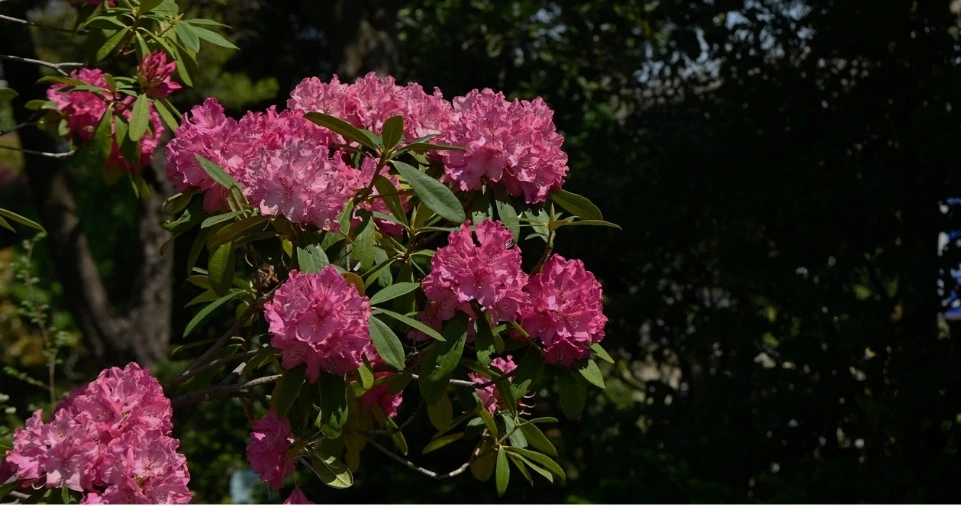

How big do rhododendrons get? Sizes range from 16 inches to over 100 feet, split across dwarf, medium, and tree-form species.
Most garden hybrids reach 5 to 6 feet in a decade. Large native rhododendrons can push past 30 feet in ideal Southern conditions.
You bought a rhododendron the size of a beach ball. Ten years later, it’s swallowing the porch.
The tag just said “medium.” Nobody warned you that “medium” covers everything from a footstool to a small tree.
Size class, species genetics, and light exposure decide the outcome — not the shrub tag or the fertilizer schedule.
The genus Rhododendron contains over 1,000 species and roughly 25,000 registered hybrids according to the American Rhododendron Society (as of 2025), with mature sizes spanning from prostrate ground-cover forms under 12 inches to forest trees exceeding 100 feet in the wild. Home gardens rely on four practical size classes: dwarf (under 3 feet), semi-dwarf (3–4 feet), medium (4–6 feet), and large (6–15+ feet). Standard broadleaf evergreen hybrids such as ‘Nova Zembla,’ ‘Roseum Elegans,’ and ‘Chionoides’ typically reach 5 to 6 feet tall and wide within their first 10 years, then continue expanding slowly for decades. Native American species behave differently — Rhododendron maximum and R. catawbiense commonly pass 15 feet in Southern Appalachian forests, with individual mountain specimens documented near 30 feet. Growth speed depends far more on species genetics, soil acidity (pH 4.5–6.0), and available light than on fertilizer schedule.
How Big Do Rhododendrons Get? A Quick Answer With Real Numbers
How big do rhododendrons get in practice? Most garden rhododendrons reach 3 to 6 feet tall and wide within their first decade.
Compact dwarfs stop near 24 inches. Full-size hybrids can climb past 10 feet, and native tree-form species reach 20 feet or more.
That range is too wide to be useful on its own. The Real-World Size Ladder below maps each class to mature dimensions and an everyday object you already know.
| Size Class | Mature Height | Mature Width | 10-Year Size | Everyday Comparison | Example Variety |
|---|---|---|---|---|---|
| Dwarf | 1–3 ft | 1–3 ft | 12–24 in | Kitchen trash bin | ‘Blue Tit’, ‘Ramapo’ |
| Semi-dwarf | 3–4 ft | 3–5 ft | 24–36 in | Retriever standing on hind legs | ‘PJM Elite’, ‘Dora Amateis’ |
| Medium | 4–6 ft | 4–6 ft | 4–5 ft | Standard refrigerator | ‘Nova Zembla’, ‘Chionoides’ |
| Large | 6–15 ft | 6–12 ft | 5–8 ft | Two adults stacked | ‘Roseum Elegans’, ‘Anna Rose Whitney’ |
| Tree-form | 15–30+ ft | 10–20 ft | 8–15 ft | Small two-story building | R. maximum, ‘Cynthia’ |
Use the ladder as a sanity check before buying. Match the mature width column against your actual walkway or foundation clearance.
Width sneaks up on people faster than height. A “5-foot” rhododendron is also 5 feet wide, which eats a lot of walkway.
The Four Size Classes of Rhododendrons Explained
Every rhododendron sold falls into one of four cultivated size classes based on 10-year growth. Class labels appear on plant tags at reputable nurseries and predict mature dimensions better than any other single factor.
Dwarf rhododendrons stay under 3 feet in every dimension. Popular examples include ‘Blue Tit,’ ‘Ramapo,’ and ‘Purple Gem.’ At maturity, most dwarfs sit at roughly 20 inches tall — about the height of a laundry basket.
Semi-dwarf types settle between 3 and 4 feet tall and slightly wider. ‘PJM Elite’ is a workhorse in this class. It handles more sun than typical rhododendrons and shrugs off cold to USDA Zone 4.
Medium rhododendrons hit 4 to 6 feet at maturity. This class contains most of the well-known landscape hybrids. ‘Nova Zembla’ produces deep red trusses and reaches 5 feet by 5 feet in about 10 years.
Large rhododendrons run 6 to 15 feet tall and roughly the same across. ‘Roseum Elegans’ and ‘Anna Rose Whitney’ hit 8 to 10 feet in mature landscapes. These are the specimens neighbors point at from the sidewalk.
As of 2025, small-garden dwarf rhododendrons have become the most-featured category in horticultural media coverage. The trend reflects shrinking suburban lot sizes.
Above the four cultivated classes sits a fifth category — tree-form species. The Rhododendron subgenus Hymenanthes includes species that grow as small trees up to 20 meters (65 feet) tall. Records at Oregon State University’s landscape plants database confirm the classification. Some species carry foliage over 40 cm long. Wild specimens of Rhododendron arboreum in the Himalayas have been documented past 100 feet. In cultivated Western gardens, tree-form rhododendrons top out closer to 30 feet. Temperate climates limit both their growth rate and vertical potential.
How Fast Do Rhododendrons Grow Each Year?
Rhododendrons average 6 to 12 inches of new vertical growth each year. Vigorous species and hybrids can exceed 2 feet.
Slow alpine dwarfs sometimes add less than 1 inch annually.
Rhododendron growth rate hinges on species class, climate, and age. Dwarf varieties typically add 4 to 6 inches per year at maturity. Vigorous large hybrids like ‘Cynthia’ can add a full foot of new growth in a good season. Growth peaks between years 3 and 10 after planting. Cultivated rhododendrons then slow to roughly half their earlier rate. Most well-tended garden shrubs average 25 to 30 cm (10–12 inches) of new growth annually. Alpine species such as Rhododendron sanguineum, a Chinese high-altitude dwarf, grow less than one centimeter per year.
Adding just six inches per year sounds slow. Over a decade it becomes a 5-foot shrub that can swallow a mailbox.
At the opposite end, a full foot of new growth yearly changes the math. A young rhododendron reaches over 10 feet tall in the same 10 years.
That is a fence-obscuring hedge on nothing but rain and morning sun.
Three factors move a rhododendron toward the top of its growth range. Acidic soil (pH 5.0–5.5) matters most.
Dappled shade for 4 to 6 hours a day comes second. Steady moisture without waterlogging seals the picture.
Missing any one of the three drops growth speed sharply.
Very slow-growing types include the Chinese species Rhododendron sanguineum. It tops out at 30 to 150 cm in height even after decades in cultivation.
What Does a Rhododendron’s Full Size Actually Look Like in Your Yard?
Numbers only mean so much until you match them against something familiar. A rhododendron’s full size is easier to picture when you translate the feet into real-world scale.
A 3-foot dwarf rhododendron matches a standard toddler’s height, a kitchen barstool, or a small dog crate.
For a 5- to 6-foot medium rhododendron, picture an average adult standing up. Its silhouette matches a home refrigerator with the door closed.
A large rhododendron pushing the 10-foot mark stands at basketball rim height. That is roughly one story of a residential home from floor to ceiling with a bit to spare.
Old landscape specimens can reach 20 feet. That equals a shipping container laid on its side, or the height of a two-story home.
These are the shrubs that outlive the house they were planted beside.
At the very extreme end, wild tree-form species cross 10 meters in mature Himalayan forests. That is taller than a residential telephone pole and about as tall as a three-story building.
Width almost always tracks height in cultivated hybrids. A 6-foot-tall rhododendron is usually a 6-foot-wide rhododendron.
Plan the footprint, not just the profile.
How Much Space Does a Rhododendron Need?
How much space does a rhododendron need? Standard medium hybrids require 4 to 6 feet of clearance in every direction from another shrub, wall, or hardscape.
Rhododendron spacing depends on mature width, not planting size. Medium rhododendrons need 4 to 6 feet between plants and 2.5 to 3 feet of setback from house foundations. Large hybrids need at least 4 feet from a foundation wall. Give them 8 feet of clearance from other large shrubs or small trees. Dwarf types can sit as close as 2 feet apart. According to University of Missouri Extension, a proper planting bed should measure at least 18 inches deep by 30 inches wide. Leave 18 inches of clearance from the bed edge. Overcrowded rhododendrons compete for shallow root space and stunt each other permanently.
Foundation planting causes the most regret. A 5-foot rhododendron planted a foot from the siding will hit the wall by year 5.
Rain shadow makes the problem worse. Roof overhangs block half the water a rhododendron needs.
Lime leaching from concrete also raises soil pH beyond the plant’s tolerance.
Container growing changes the math. A 15-gallon pot restricts a medium hybrid to about 60% of its normal size.
Expect 3 to 4 feet in a container instead of 5 to 6.
How Long Until a Rhododendron Reaches Full Size?
How long until a rhododendron reaches full size? Most cultivated varieties hit 80% of mature height in 10 to 15 years.
The final 20% arrives slowly over the next 20 to 40 years.
Dwarf types mature fastest — usually in 5 to 7 years. That is close to a lilac’s timeline.
Medium hybrids typically need 10 years to hit their advertised 5-to-6-foot size. Growth continues after that but visibly slows.
Large hybrids like ‘Roseum Elegans’ need 15 to 20 years to reach 8 to 10 feet. Individual specimens keep pushing wider for another 30 years.
Tree-form species work on a different clock entirely.
Native R. maximum in Appalachian old-growth forest can add under three inches of upward growth per year. It keeps growing for over 100 years.
A medium hybrid planted at 18 inches tall usually follows this pattern:
| Year | Approximate Height |
|---|---|
| Year 1 | 20 inches |
| Year 3 | 32 inches |
| Year 5 | 42 inches |
| Year 10 | 5 feet |
| Year 20 | 6.5 feet |
| Year 40 | 7 feet |
Growth speed also swings with weather. A dry summer knocks 30 to 40% off a rhododendron’s normal annual gain.
No amount of watering fully replaces natural rainfall.
Can You Keep a Rhododendron Small?
Can you keep a rhododendron small? Yes — with three interventions applied consistently for the life of the plant.
Genetic selection matters most. A dwarf variety like ‘Ramapo’ will stay near 2 feet even in perfect conditions.
Trying to keep a ‘Cynthia’ at 3 feet is fighting the plant’s DNA every year.
Container growing offers the second lever. A 15- to 20-gallon pot caps most medium hybrids at about 60% of their in-ground size.
Root restriction slows top growth automatically.
Pruning provides the third. Rhododendrons tolerate hard rejuvenation cuts back to the main trunks, but heavy pruning sacrifices two seasons of flowers.
Light annual shaping right after bloom is the sustainable path.
The one thing that will NOT keep a rhododendron small is starving it. Reduced fertilizer and water produce a weak, ugly, still-oversized plant.
Deadheading — snapping off spent flower trusses — also plays a role. It redirects energy from seed production into next year’s buds rather than into runaway vegetative growth.
How Big Do Rhododendrons Get in Extreme Cases?
How big do rhododendrons get at their absolute maximum? Wild Himalayan Rhododendron arboreum trees have been recorded past 100 feet in Bhutan and Nepal.
The largest rhododendrons on record grow in Asia. Rhododendron arboreum, the tree rhododendron, can reach 20 meters (65 feet) in cultivation. In the wild it passes 30 meters (100 feet), according to the Rhododendron Species Botanical Garden in Federal Way, Washington. In cool, wet climates like the Pacific Northwest and Scottish highlands, large-species specimens routinely pass 25 feet in height. In the American East, Rhododendron maximum — the great rhododendron — averages 13 feet, with exceptional specimens near 33 feet. The Rhododendron Species Botanical Garden itself holds over 10,000 mature specimens on 22 acres as of 2025. Some cultivated trees on-site exceed 40 feet.
Not every climate supports extreme growth. Hot, dry summers cap most rhododendrons well below their genetic potential.
In Southern gardens, expect 60% of the sizes reported for the Pacific Northwest even from identical varieties.
Cold also plays a role. USDA Zone 4 gardens limit even hardy hybrids to roughly 4 to 5 feet.
Winter dieback trims new growth every year.
That said, indoor botanic conservatories in Scotland and New Zealand have grown Himalayan giants to over 40 feet under glass.
The American native Rhododendron maximum sometimes outperforms even those numbers in the wild. Individual mountain specimens near the North Carolina border have been documented at 33 feet.
Frequently Asked Questions
How tall do rhododendrons grow in one year?
Average annual growth for a healthy garden rhododendron sits between 6 and 12 inches. Slow alpine species may add less than two inches. Vigorous large hybrids push toward 24 inches in a strong season.
How wide does a rhododendron get?
Cultivated rhododendrons grow roughly as wide as they are tall. A 5-foot medium hybrid usually reaches about 5 feet across. Large specimens can spread wider than tall at maturity.
How long does it take a rhododendron to reach full size?
Dwarf types finish maturing in 5 to 7 years. Medium hybrids reach their advertised size in about 10 years. Large and tree-form species can keep growing slowly for 40 to 100 years.
What’s the smallest rhododendron?
Prostrate alpine species like Rhododendron radicans stay under 6 inches tall and spread horizontally as ground-cover. The smallest cultivated dwarf rhododendrons — including ‘Blue Tit’ and ‘Ginny Gee’ — top out around 16 inches.
Do rhododendrons grow faster in sun or shade?
Rhododendrons grow fastest in bright, dappled shade with 4 to 6 hours of filtered light daily. Deep shade slows growth to a crawl. Direct afternoon sun scorches leaves and stunts new growth in most varieties.
Which USDA zone grows the biggest rhododendrons?
USDA Zones 7 and 8 produce the largest cultivated rhododendrons — cool, wet, and free of hard freezes. The Pacific Northwest and coastal British Isles routinely grow specimens well beyond published size ranges. Check your local class on the USDA hardiness zone map.
What to Do Before You Plant
Size is fixable if you catch it before you dig.
A rhododendron in the wrong spot spends 30 years arguing with its yard.
Start with two measurements. Note the actual distance from the planned spot to the nearest wall, walkway, or neighboring shrub.
Double it.
Match that number against the mature-width column in the Real-World Size Ladder above.
Pick the class that fits your actual space. Do not pick a class that only fits after future pruning.
Ask the nursery for the specific cultivar name and its published mature size. “Rhododendron” alone tells you almost nothing.
Two cultivars in the same size class can differ by 3 feet at maturity.
When in doubt, size down.
A too-small rhododendron becomes a sculpted, healthy specimen. A too-large rhododendron becomes an annual pruning project or a chainsaw job in year 12.
Visit a mature rhododendron collection before buying anything large.
Botanical gardens across the Pacific Northwest, Southeast, and British Isles let you walk under 40-year-old specimens. Seeing what a “6-foot medium” turns into after four decades changes every purchase decision.
