
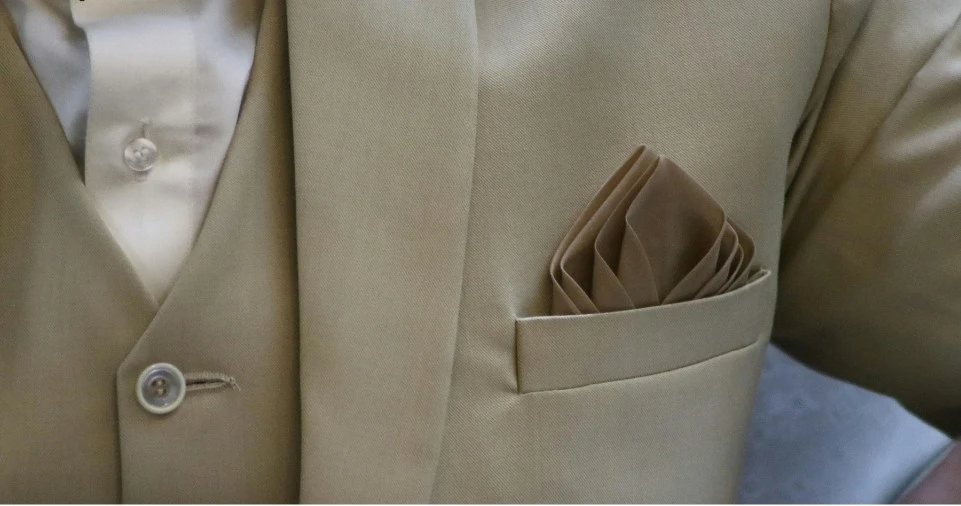

⚡ Quick Answer: A pocket square is typically 10 to 17 inches square (25 to 43 cm), with 12 × 12 inches (30 × 30 cm) and 13 × 13 inches (33 × 33 cm) the most common sizes. Silk squares run larger (16–18 inches / 40–45 cm) to prevent slipping. Linen, cotton, and wool squares stay smaller (10–13 inches) so they don’t bunch in the breast pocket.
You bought a pocket square online, slid it into your jacket, and watched it either vanish into the pocket or balloon out like a doily. Both ruin the line of the suit, and both come from the same root cause: the square is the wrong size for the fabric and the pocket. Standard breast pockets only open about 4 to 5 inches wide, which means fabric weight and dimension matter more than most guides admit. After eight years of measuring objects and writing dimension explainers at BusinessComputingWorld, the math here is unambiguous.
The pocket square sits in a defined size range. According to Gentleman’s Gazette (2024), standard pocket squares run from 10 inches (25 cm) on the small end up to 18 inches (46 cm) on the large end, with material driving the choice inside that range. Heavier weaves — wool tweed, cotton flannel, structured linen — sit best at 10 to 13 inches square (25 to 33 cm) because the fabric holds shape with less material. Silk and lightweight cotton voile need 15 to 18 inches (38 to 45 cm) so the slick fabric has enough body to grip the inside of the pocket and resist slipping. The single most popular size sold by ready-to-wear brands is 12 × 12 inches or 13 × 13 inches (30 × 33 cm), which fits the average 4.5-inch breast pocket cleanly with any standard fold. Hermès anchors the luxury market with a 42 cm Gavroche pocket square — approximately 16.5 inches — designed for puff and presidential folds.
Standard Pocket Square Sizes in Inches and Centimeters
A pocket square measures between 10 × 10 inches (25 × 25 cm) and 17 × 17 inches (43 × 43 cm) for almost every commercial brand sold today. The few outliers run up to 18 inches for specialty silk and down to 9 inches for slim-cut Italian patch pockets. The size you actually want sits inside this range and depends on three variables: fabric weight, fold style, and breast pocket dimensions.
Here are the exact conversions for every size you’ll encounter:
| Size (Inches) | Size (Centimeters) | Best Use Case |
| 9 × 9 in | 23 × 23 cm | Slim Italian patch pockets, minimalist folds |
| 10 × 10 in | 25 × 25 cm | Heavy wool, tweed, structured linen |
| 12 × 12 in | 30 × 30 cm | Most common ready-to-wear size, all folds |
| 13 × 13 in | 33 × 33 cm | Ideal balance — silk twill, linen, cotton |
| 14 × 14 in | 36 × 36 cm | Multi-point folds, double-breasted jackets |
| 15 × 15 in | 38 × 38 cm | Larger silk squares, dramatic puff folds |
| 16 × 16 in | 40 × 40 cm | Premium silk, Hermès Petit Carré range |
| 17 × 17 in | 43 × 43 cm | Hermès Gavroche, statement squares |
| 18 × 18 in | 46 × 46 cm | Maximum standard size, lined breast pockets |
Here’s the conversion that matters most in daily life: multiply inches by 2.54 to get centimeters. A 13-inch square is 33.02 cm. A 16-inch square is 40.64 cm. Most luxury brands list dimensions in centimeters, while American and British retailers default to inches — knowing both translations saves you from buying a 33 cm square thinking it’s the same as a 13 cm one. That’s a 20-cm error worth catching before checkout. For context, 20 inches is roughly the distance from elbow to fingertip — far larger than any standard pocket square.
The 12-inch to 13-inch range covers roughly 70% of pocket squares sold globally, based on retail inventory across Trendhim, TieMart, and major menswear retailers. If you only own one pocket square, a 13 × 13 inch silk-cotton blend fits more situations than any other size.
Why Pocket Square Size Depends on Fabric (The Real Rule)
Fabric weight controls how a pocket square behaves inside the breast pocket, and it dictates the right dimension more than any other variable. The rule is counterintuitive: slick fabrics need larger squares, stiff fabrics need smaller squares. Silk slides down because its surface offers no friction against the pocket lining, so a 16-to-18-inch silk square gives you enough material to wedge against both walls of the pocket. Linen and wool grip naturally, so a 12-inch linen square fills the same pocket without bunching at the seam.
Here’s why that matters: a 12-inch silk square in a typical lined breast pocket will slip down by the end of a 4-hour wedding reception. The same 12-inch square in cotton linen sits perfectly all day. People blame the fold, the pocket, or the jacket — the problem is fabric-to-size mismatch.
Fabric-to-Size Decision Matrix
| Fabric | Recommended Size (Inches) | Recommended Size (Cm) | Why This Size |
| Silk (lightweight) | 16–18 in | 40–45 cm | Slick surface needs volume to prevent slipping |
| Silk twill (heavier) | 13–15 in | 33–38 cm | Mid-weight balances grip and fold cleanness |
| Cotton voile | 13–15 in | 33–38 cm | Light cotton behaves similarly to silk |
| Linen (Italian) | 13–14 in | 33–36 cm | Softer drape needs slightly more fabric |
| Linen (Irish, stiff) | 14–15 in | 36–38 cm | Tested optimal per Gentleman’s Gazette |
| Cotton flannel | 12 in | 30 cm | Heavy weave holds form at smaller size |
| Wool / Wool tweed | 10–12 in | 25–30 cm | Bulky fabric prevents overstuffed pocket |
This matrix comes from Gentleman’s Gazette testing of eight different sizes per fabric type. They found cotton flannel sits best at 12 inches, Italian linen at 13.75 inches, and stiffer Irish linen at 15 inches — data most pocket square guides skip because they treat the accessory as a single uniform category.
What Size Pocket Square Fits a Standard Breast Pocket?
A standard suit jacket breast pocket measures 4 to 5 inches (10 to 13 cm) wide and approximately 3 to 5 inches deep, and the right pocket square is one that fills this space without overflowing or sinking. For most jackets, a 12 × 12 inch or 13 × 13 inch square hits the proportions exactly — large enough to fold three or four times and still anchor at the bottom of the pocket, small enough that the fold doesn’t bulge through the jacket front.
Most ready-to-wear suit jackets — Brooks Brothers, Hugo Boss, Suitsupply, J.Crew — use a breast pocket opening between 4.5 and 5.5 inches wide. Waistcoat (vest) pockets run narrower at 3 to 4.5 inches, which is why a 10-to-11-inch square is the right call for three-piece suits. Italian patch pockets, common on summer sport coats, are shallower than lined British breast pockets, so an Italian-brand square at 10 to 12 inches is intentionally smaller than the American 13-to-14-inch standard.
The 3-to-1 rule for fold sizing: for a flat (presidential) fold, the folded square should be roughly the width of the pocket. Since a 12-inch square folds into thirds at about 4 inches, it matches a 4-inch pocket perfectly. A 17-inch square folded the same way produces a 5.6-inch flat fold — too wide for most pockets, which is why oversized silk squares almost always get folded into puffs instead of flat presidentials.
How Far Should a Pocket Square Stick Out?
Between 0.5 and 1.5 inches (1.5 to 4 cm) of the pocket square should sit above the pocket opening. The exact distance depends on the fold:
- Presidential (flat) fold: 0.5 inch — a clean horizontal line, formal black-tie standard
- One-point fold: 1 to 1.25 inches — single triangle peak above the pocket
- Two-point or three-point fold: 1.25 to 1.5 inches — multiple peaks visible
- Puff fold: 1 to 1.5 inches of rounded, soft fabric — most forgiving for silk
Anything beyond 1.5 inches starts to look theatrical on a standard business or formal jacket. The exception is the Rampley & Co styling guidance for casual sport coats, where 1.5 to 2 inches of a casually stuffed silk puff can read as intentional rather than overdone.
Pocket Square Size by Fold Style: What Each Fold Needs
Different folds need different amounts of fabric. A flat presidential fold works with a small 10-inch square because it requires only two folds and a clean edge. A puff fold needs a larger 13-to-15-inch square so the fabric has enough volume to dome above the pocket without collapsing. Multi-point folds — two-point, three-point, crown — need the most fabric, ideally 14 to 16 inches, because each visible point requires its own corner with enough length to stand up.
| Fold Style | Minimum Size | Ideal Size | Best Fabric |
| Presidential (flat) | 10 in (25 cm) | 12 in (30 cm) | Linen, cotton |
| One-point | 12 in (30 cm) | 13 in (33 cm) | Linen, cotton, silk |
| Two-point | 12 in (30 cm) | 13 in (33 cm) | Linen, silk |
| Three-point / Crown | 13 in (33 cm) | 14 in (36 cm) | Silk, lightweight cotton |
| Puff | 12 in (30 cm) | 14 in (36 cm) | Silk, cotton voile |
| Reverse puff | 13 in (33 cm) | 15 in (38 cm) | Silk |
| Cooper / Cagney | 14 in (36 cm) | 16 in (40 cm) | Silk, lightweight linen |
The Hockerty fold guide (March 2026) confirms these ranges: silk pocket squares should be 40–45 cm (16–18 inches) for the slippage reason, linen and cotton work at 33–38 cm (13–15 inches), and wool stays smallest at 30–33 cm (12–13 inches). Match the fold to what you own, not the other way around.
Pocket Square vs Handkerchief: How the Sizes Actually Differ
A pocket square is typically 10 to 17 inches; a handkerchief is typically 12 to 16 inches but often runs larger up to 22 inches. The sizes overlap, which is exactly why people confuse the two. The real distinction is function: a pocket square is decorative and stays in the breast pocket; a handkerchief is utilitarian and lives in a side pocket. The old British rule — “one for show, one for blow” — exists because gentlemen carried both at the same time.
Handkerchiefs need more surface area because they’re meant to be unfolded and used. A 16 × 16 inch cotton handkerchief gives you enough fabric to wipe a brow, dab a spill, or hand to a guest. Pocket squares prioritize visual impact in a 4-inch pocket opening, so their dimensions exist within the constraint of that pocket rather than the constraint of practical use.
| Accessory | Typical Size | Material | Edge Finish | Purpose |
| Pocket Square | 10–17 in (25–43 cm) | Silk, linen, cotton, wool | Hand-rolled or stitched | Decorative |
| Handkerchief | 12–22 in (30–56 cm) | Cotton, linen | Machine hemmed | Utilitarian |
| Bandana | 20–27 in (50–69 cm) | Cotton | Machine hemmed | Casual / utility |
One unbreakable rule: if you carry only one piece of fabric in your jacket, treat it as decoration only. The pocket square comes out for display, not for use. If you actually need to blow your nose at the event, that’s what a separate cotton handkerchief in your trouser pocket is for.
How to Visualize Pocket Square Sizes Without a Ruler
Pocket square dimensions are hard to picture until you anchor them to something you’ve already held. Like building intuition for how big 12 inches looks in real life, anchoring the size to common objects locks the dimension into memory.
12-inch (30 cm) pocket square reference objects:
- A standard 12-inch ruler — the square is exactly that wide and tall
- A vinyl LP record sleeve — almost identical at 12.375 inches
- Two iPad Mini tablets placed side by side — close to 12 inches across
13-inch (33 cm) pocket square reference objects:
- A 13-inch MacBook Air or MacBook Pro diagonal screen measurement
- Approximately the length of an adult forearm from elbow to wrist
- A standard medium-size pizza box (12.5–13 inches across)
15-inch (38 cm) pocket square reference objects (more comparisons in our 15-inch object guide):
- A 15.6-inch laptop’s visible screen width is roughly 13.6 inches — close to a 15-inch square’s visual presence
- A standard laptop cooling pad footprint sits at this dimension
16-inch (40 cm) pocket square reference objects (deeper context at our 16-inch comparison guide):
- A 16-inch MacBook Pro screen diagonal — the same dimension
- Two stacked sheets of US Letter paper laid corner-to-corner
- An extra-large pizza pan — 16 inches is the standard
17-inch (43 cm) pocket square reference objects (for an adjacent size, see how big 18 inches looks in real life):
- A standard 17-inch gaming laptop’s full body width
- An adult’s full hand-span doubled — palm tip to palm tip with arms outstretched
Your forearm is the most reliable on-body reference. For most adults, the distance from elbow to wrist sits between 10 and 12 inches, and elbow to fingertip is 16 to 18 inches. Hold your arm flat and you’ve got a rough pocket square scale anywhere.
How Major Pocket Square Brands Size Their Squares
Major menswear brands sell pocket squares in three predictable clusters: small (10–12 inches), standard (12–14 inches), and large (15–17 inches). Knowing each brand’s house standard saves you from guessing when buying online — especially since most product listings put dimensions in fine print or omit them entirely.
| Brand | Standard Size | Material Focus | Notes |
| Hermès Gavroche | 42 cm (16.5 in) | Silk twill | Petit Carré pocket square line |
| Drake’s London | 33 cm (13 in) | Silk, linen, wool | Mid-range, hand-rolled edges |
| Tom Ford | 33 cm (13 in) | Silk, linen | Standard luxury default |
| Brooks Brothers | 13 in (33 cm) | Silk, cotton | American standard |
| Suitsupply | 33 cm (13 in) | Silk, wool | Mid-market default |
| Charles Tyrwhitt | 33 cm (13 in) | Silk | British classic |
| TieMart | 10–12 in | Polyester, silk | Wedding party staple |
| Howard Yount | 13 × 13 in | Cotton, linen | Forum-favorite size |
Hermès anchors the luxury end. The Gavroche line is specifically designed as a pocket square at 42 cm (about 16.5 inches), distinct from the famous 90 cm Carré scarf. According to The Vault (Rebag), Hermès produces square silk scarves in 20, 40, 70, 90, and 140 cm sizes — only the 40-42 cm size is built as a pocket square specifically.
Five Pocket Square Sizing Mistakes That Ruin the Look
Most pocket square errors trace back to size, not color or fold. Here are the five most common mistakes and how to fix each one.
1. Buying a Silk Square Smaller Than 14 Inches
Small silk squares slip into the pocket within minutes. The fabric’s surface tension is too low to grip the pocket lining. If the budget is tight and the fabric is silk, prioritize size (14+ inches) over thread count or label.
2. Buying a Wool Square Larger Than 13 Inches
Wool at 14+ inches creates a bulge that interrupts the line of the jacket. The fabric is too thick to fold cleanly into a 4-inch pocket. A 12-inch wool square is the sweet spot for autumn and winter dressing.
3. Matching the Pocket Square Exactly to the Tie
Size has nothing to do with this, but it kills more outfits than any sizing error. The pocket square should complement the tie’s color palette — never duplicate the tie’s exact fabric or pattern. Two identical squares of fabric across the chest reads as a costume.
4. Choosing Size by Brand Loyalty Instead of Pocket Dimensions
An Italian-cut sport coat with shallow patch pockets needs a 10-to-11-inch square. A British double-breasted jacket with a deep lined breast pocket can take a 15-to-16-inch square. Brand reputation doesn’t override geometry.
5. Folding a 17-Inch Square the Same Way as a 12-Inch One
A 17-inch square has nearly double the surface area of a 12-inch one (289 sq in vs 144 sq in). Folding it into thirds creates a 5.7-inch flat strip — wider than the average breast pocket. Larger squares need extra folds or pivot to puff styles to fit cleanly. The difference between how 19 inches actually compares to 12 is small on paper but significant inside a 4-inch pocket.
Pocket Square Size FAQ
What is the most common pocket square size?
The most common pocket square size sold globally is 12 × 12 inches or 13 × 13 inches (30–33 cm). This size fits the average 4.5-inch breast pocket cleanly with any standard fold and works across silk, linen, and cotton.
Is a 10-inch pocket square too small?
A 10-inch pocket square is the minimum standard size and works only for heavy fabrics like wool tweed or cotton flannel. For silk, 10 inches is too small — the square will slip into the pocket within hours. Stick to 13 inches or larger for any silk pocket square.
How big is a Hermès pocket square?
A Hermès pocket square (Gavroche line) measures 42 cm × 42 cm, approximately 16.5 inches square. This is intentionally larger than most ready-to-wear brands to allow for dramatic puff folds and to prevent the silk from slipping in the pocket.
What size pocket square do I need for a wedding?
For a wedding, a 13 × 13 inch (33 cm) pocket square in silk or silk-cotton blend handles every fold style — flat for the ceremony, puff for the reception. If the wedding party is wearing matching squares, confirm the size with the group; standard wedding party squares from retailers like TieMart often run 10–12 inches.
How do I measure a pocket square I already own?
Lay the pocket square flat on a clean surface and measure one edge from corner to corner with a ruler or tape measure. Pocket squares are perfect squares, so one measurement is enough. If you don’t have a ruler, two iPhones placed end-to-end equal approximately 12 inches — close enough to identify the size category.
Choosing the Right Pocket Square Size
How big is a pocket square? Between 10 and 17 inches (25 to 43 cm), with 12 to 13 inches the sweet spot for most jackets, most fabrics, and most folds. The variable that actually matters is fabric weight — slippery silks need 14+ inches, structured linens and wools need 13 or less. Match that, and you’ll stop watching your pocket square disappear into the lining or balloon out over the pocket edge.
Your next steps:
- Measure your jacket’s breast pocket width (most are 4–5 inches)
- Pick a fabric based on the season — silk for spring/summer, linen mid-year, wool for autumn/winter
- Buy a 13 × 13 inch silk-cotton blend as your first square — it’s the most versatile dimension for almost any pocket
- Learn one fold (presidential or puff) and master it before moving on
Once you’ve built the muscle memory for 13 inches as a baseline, every other pocket square decision becomes a small adjustment off that anchor.
