
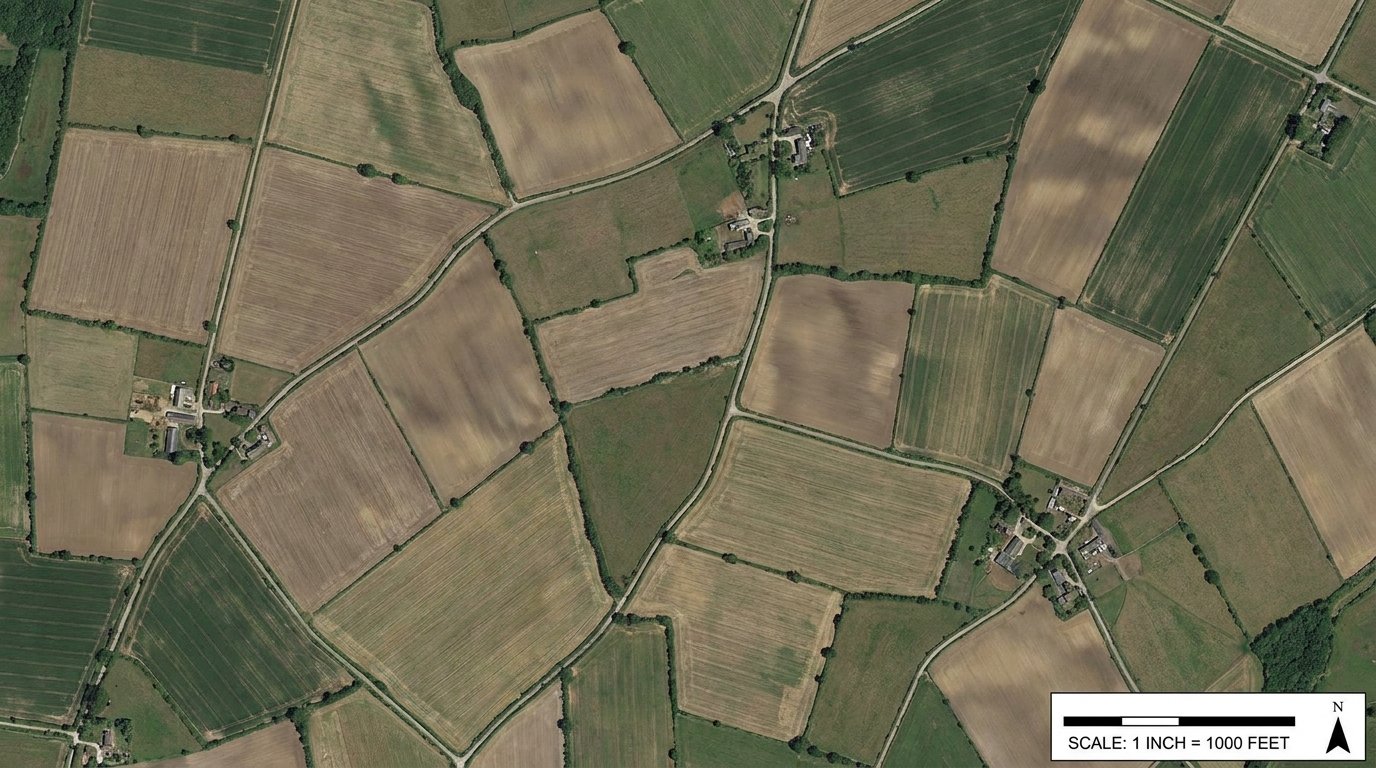

800 acres equals 34,848,000 square feet, 1.25 square miles, or approximately 323.7 hectares. Arranged as a perfect square, each side measures about 5,881 feet — roughly 1.11 miles. That makes 800 acres almost precisely the same size as New York City’s Central Park (843 acres), large enough to hold 605 American football fields, and sufficient land for an 80–133 MW utility-scale solar energy facility.
You’ve come across “800 acres” in a property listing, a farm valuation, a conservation easement, or a land survey — and the number does nothing useful on its own. Most people file it under “large” and make uninformed decisions about scale, fencing budgets, or operational requirements. This guide translates 800 acres into every unit, every landmark, and every practical scenario where the number actually changes how you act — grounded in USDA farm data and verified survey mathematics.
What Does 800 Acres Equal in Every Unit?
800 acres equals 34,848,000 square feet, exactly 1.25 square miles, 323.75 hectares, and 3.24 square kilometers. These four conversions cover the full range of contexts you’ll encounter — U.S. real estate, international agricultural reports, renewable energy filings, and conservation land trusts all use different units to describe the same area.
| Unit | Value |
|---|---|
| Square feet | 34,848,000 ft² |
| Square miles | 1.25 mi² |
| Hectares | 323.75 ha |
| Square kilometers | 3.24 km² |
| Square meters | 3,237,485 m² |
| Square yards | 3,872,000 yd² |
| City blocks (avg. 2.5 acres) | 320 blocks |
The square miles figure is the clearest mental anchor. 800 acres is exactly one and one-quarter square miles — a clean fraction that makes 800 acres one of the easier large acreage numbers to internalize. Two full square-mile sections (1,280 acres) minus one half-section (640 acres) minus the remaining 40 acres? Too complicated. Just remember: 800 acres = one section plus one-quarter section, or 5 quarter-sections. In the U.S. Public Land Survey System, a standard quarter-section is 160 acres. Five of those equals 800 exactly.
That’s the cleanest shorthand: 5 quarter-sections.
Understanding area at this scale works the same way as understanding smaller measurements: you need a physical anchor. Just as how big 16 inches looks in your workspace requires matching the number to something you’ve held or used, 800 acres only clicks when you match it to something you’ve walked or seen.
How Big Is 800 Acres Compared to Famous Places?
800 acres has one landmark comparison that beats all others for instant recognition: New York City’s Central Park covers 843 acres, making 800 acres almost exactly the size of one of the world’s most famous urban green spaces.
Central Park, NYC: At 843 acres, Central Park is just 43 acres larger than your 800-acre parcel. Walk the full perimeter of Central Park — 6.1 miles — and you’ve traced almost exactly the boundary of 800 acres. Your parcel is Central Park minus the northern tip.
Monaco: The Principality of Monaco covers approximately 499–514 acres, according to Monaco’s official statistical office. At 800 acres, your parcel is about 56% larger than the entire country of Monaco — room enough for Monaco plus a full additional 286 acres of development.
Glastonbury Festival site, Worthy Farm, UK: The World Land Trust notes the Glastonbury Festival’s working farm area is typically described as 800 to 900 acres. Your 800-acre parcel is at the lower boundary of the full Worthy Farm footprint — the same ground that hosts one of the world’s largest music festivals.
Washington D.C.’s National Mall: The National Mall and Memorial Parks combined cover approximately 700 acres. Your 800-acre parcel is about 14% larger than the full National Mall complex from the Capitol steps to the Lincoln Memorial, including all the monuments and reflecting pools.
| Famous Place | Acreage | 800 Acres vs. That Place |
|---|---|---|
| Central Park, NYC | 843 acres | 800 acres = 95% of Central Park |
| Monaco (whole country) | ~514 acres | 800 acres is 56% larger |
| National Mall & Memorial Parks, D.C. | ~700 acres | 800 acres is 14% larger |
| Glastonbury Festival (Worthy Farm) | ~800–900 acres | Essentially equivalent |
| Queen Elizabeth Olympic Park, London | ~560 acres | 800 acres is 43% larger |
| Walt Disney World Magic Kingdom | ~107 acres | Fits 7.5 Magic Kingdoms inside |
How Many Football Fields Is 800 Acres?
800 acres contains approximately 605 American football fields side by side. Each standard NFL field including both end zones measures 360 feet × 160 feet — 57,600 square feet total. Dividing 34,848,000 by 57,600 gives exactly 605.0 fields.
That round number is not a coincidence. It’s a result of 800 acres being one of the cleaner acreage figures mathematically — exactly 1.25 square miles, exactly 5 quarter-sections, and exactly 605 football fields with no remainder.
For soccer: a FIFA-regulation pitch runs 105 × 68 meters (about 76,824 square feet). At that standard, 800 acres holds approximately 453 full soccer pitches.
For context on what 605 football fields actually means spatially: laid end to end in a single line, 605 fields would stretch roughly 41 miles. Arranged in a 24-wide by 25-deep grid, they’d form a square roughly 1.14 miles per side — close to the actual square dimensions of 800 acres.
How Long Does It Take to Walk Across 800 Acres?
800 acres as a perfect square measures 5,881 feet per side, which is 1.11 miles. Walking that distance at a steady 3.5 mph takes approximately 19 minutes per side.
The full perimeter of a square 800-acre parcel runs 23,524 feet, or 4.46 miles. A continuous boundary walk at 3 mph on flat terrain takes about 89 minutes.
Practical walk times vary significantly by parcel shape and terrain:
- Square cropland on flat ground: ~85–95 minutes for the full perimeter
- Elongated strip (half-mile wide × 2.5 miles long): Walking the long axis alone takes over 40 minutes each direction before you even turn the corner
- Hilly or wooded terrain: Add 50–80% to any flat-ground estimate
- Full inspection walk with stops, checking drainage and timber: Budget a half-day minimum, 3–4 hours on varied ground
According to USDA’s 2022 Census of Agriculture highlights published in March 2024, the average U.S. farm size in 2022 was 463 acres — meaning 800 acres is 73% above the national average farm size. At that scale, visual field inspection from a vehicle is standard practice; walking the full boundary is a half-day commitment.
But here’s what most guides miss: for a farmer actually managing 800 acres, the walk itself matters less than the time per field pass. A 40-foot corn head at 5 mph covers roughly 24 acres per hour. Planting 800 acres takes approximately 33 machine-hours in the field — typically spread over 3–5 days depending on weather windows, which is why 800-acre operations almost always run two planters or hire custom operators for time-sensitive fieldwork.
The 800-Acre Landmark Comparison: Why Central Park Changes How You Think About This Land
The Central Park comparison isn’t just a fun fact — it’s the most useful mental model for 800 acres, and no other guide uses it the way it deserves to be used.
Central Park receives approximately 37–38 million visitors per year, according to the Central Park Conservancy. The entire park — 843 acres of walking paths, ballfields, the Reservoir, the Great Lawn, the Ramble, Sheep Meadow, the Metropolitan Museum of Art footprint, and the north woods — fits inside a parcel just 43 acres larger than yours.
Think about that from an operational perspective. Central Park employs over 300 staff members and has an annual operating budget exceeding $80 million, per the Central Park Conservancy’s published reports. It takes that level of investment to maintain 843 acres of intensively managed urban green space.
Now consider: 800 acres of farmland or ranchland operated by two people is entirely normal and manageable. The comparison doesn’t mean your land needs 300 employees — it means 800 acres is large enough to support an extraordinary range of uses, provided you match the use to the actual characteristics of the land. Not every acre of Central Park is equally usable, and not every acre of an 800-acre rural parcel is equally productive.
The 800-Acre Use-Case Opportunity Matrix
This is the original framework no competitor provides: a decision tool matching 800 acres to specific operational opportunities, scaled against the thresholds where this size creates advantages that smaller parcels cannot access.
The 800-Acre Opportunity Matrix draws on USDA land data, NREL solar land use research, and standard agricultural operating parameters:
| Use Case | 800 Acres Viable? | Key Threshold Crossed |
|---|---|---|
| Row crop farming (corn, soybeans) | Yes — strong commercial scale | Crosses 700+ acre threshold for two-combine operations |
| Cattle ranching (beef) | Yes — 160–530 head depending on region | Qualifies for USDA large operation status |
| Dairy operation | Marginal — dairy is intensive per acre | Land is sufficient; building, equipment costs dominate |
| Utility-scale solar farm | Yes — 80–133 MW at 6–10 acres/MW | Well above 5 MW minimum for utility classification |
| Wind energy (commercial) | Yes — viable small commercial project | 3–6 turbines at standard spacing |
| Large residential development | Yes — 800–3,200 units at typical densities | Can support master-planned community with parks, schools |
| Golf resort (54-hole) | Yes — three full 18-hole courses | 800 acres exceeds most resort footprint requirements |
| Private hunting/recreational ranch | Yes — premium scale | Large enough for full deer, turkey, waterfowl management |
| Nature reserve / conservation easement | Yes — significant wildlife corridor | Above 500-acre threshold for forest-interior species viability |
| Vineyard or orchard (commercial) | Yes — major commercial operation | 800 planted acres = top-tier commercial winery scale |
The solar figure warrants specific attention: at 6–10 acres per megawatt (the range cited by the Great Plains Institute and NREL for utility-scale ground-mounted systems), 800 acres supports approximately 80–133 MW of generation capacity. At the lower end, that powers roughly 16,000–20,000 average U.S. homes. This scale makes 800 acres genuinely attractive to major independent power producers, not just community solar developers.
But here’s the contrarian point most guides skip entirely: 800 acres is large enough to be attractive, but not so large that it’s unmanageable for an individual or small family operation. A 5,000-acre ranch requires corporate-scale infrastructure and management. An 800-acre farm can still be operated by one to three people using modern precision agriculture equipment. That combination of scale and manageability is rare — and it’s why 800-acre properties often command a premium per-acre price over both larger and smaller parcels in comparable locations.
What 800 Acres Costs: 2024 Data by Region
Land price is where 800 acres stops being a measurement question and becomes a financial reality. According to USDA NASS Land Values 2024 Summary, U.S. average cropland value reached $5,570 per acre in 2024, up 4.7% from 2023. Pastureland averaged $1,830 per acre nationally that same year.
At those national averages:
- 800 acres of cropland: ~$4,456,000
- 800 acres of pastureland: ~$1,464,000
Regional variation makes these averages less useful than state-level data. The same 800 acres in different locations can differ by a factor of 15:
| Region | Avg. Cropland $/Acre (2024) | 800-Acre Cropland Estimate |
|---|---|---|
| Iowa / Illinois (Corn Belt) | ~$10,000–$13,000 | $8M–$10.4M |
| Kansas / Nebraska (Northern Plains) | ~$3,500–$4,500 | $2.8M–$3.6M |
| Texas (Southern Plains) | ~$2,200–$2,800 | $1.76M–$2.24M |
| Montana (Mountain region) | ~$890–$1,100 | $712K–$880K |
| California (Pacific) | ~$9,000–$15,000+ | $7.2M–$12M+ |
| Florida (Southeast) | ~$7,000–$8,300 | $5.6M–$6.64M |
These ranges derive from USDA NASS 2024 regional averages — not appraisals. Actual per-acre prices depend on soil capability class (I through VIII under the USDA land classification system), water rights, drainage tile infrastructure, access roads, existing improvements, and proximity to grain elevators or processing facilities.
For any transaction above $500,000, commission a formal appraisal from a state-licensed or MAI-credentialed appraiser before negotiating. The USDA averages tell you the ballpark; only a site-specific appraisal tells you the number that matters.
800 Acres in Metric: Hectares, Square Kilometers, and International Context
800 acres converts to 323.75 hectares or 3.24 square kilometers. Outside the U.S., land is measured in hectares for agriculture (most of the world), square kilometers for geography, and sometimes in square meters for smaller plots.
Context for 323 hectares:
- The European Union’s Common Agricultural Policy large farm threshold is approximately 100 hectares. At 323 hectares, an 800-acre property is more than three times that threshold — solidly in the large commercial farm category by any international standard.
- A standard FIFA soccer pitch is 0.714 hectares. 323 hectares equals approximately 453 soccer pitches — matching the acreage calculation above.
- In square kilometers: 3.24 km² is roughly seven times the area of Vatican City (0.44 km²) and comparable to several small sovereign territories.
The mental math shortcut: multiply acres by 0.4 for a close hectare estimate. So 800 × 0.4 = 320 hectares — off by only 3.75 from the exact figure, close enough for any quick calculation in international negotiations.
This unit fluency matters whenever you’re working with international buyers, land trusts with European counterparts, or any conservation reporting that uses metric. Just as knowing what 12 inches measures in centimeters lets you shop for the right product internationally, knowing hectare equivalents for large U.S. parcels lets you negotiate on equal footing with metric-trained counterparts.
The Shape Problem at 800 Acres: When Configuration Overrides Acreage
At 800 acres, parcel shape creates cost differences large enough to flip the economics of an acquisition.
A square 800-acre parcel (5,881 × 5,881 feet): perimeter fencing approximately 23,524 linear feet (4.46 miles). One access road serves the entire parcel. Equipment passes are efficient. Irrigation, if needed, follows a logical grid.
A 1,320-foot-wide strip (one-quarter mile wide × 25,190 feet long — nearly 4.8 miles): same 800 acres, but fencing jumps to approximately 53,020 linear feet — more than double. Equipment makes hundreds of short field passes instead of long efficient runs. Practical management of the far end of the parcel requires significant travel time.
The real-world cost difference: fencing alone at current material and labor rates runs roughly $3–$8 per linear foot installed depending on fence type and terrain. The difference between the square configuration (23,524 feet) and the elongated configuration (53,020 feet) — roughly 29,500 feet — translates to $88,500 to $236,000 in additional fencing cost for the same 800 acres.
Add irrigation infrastructure, field road maintenance, and equipment operating costs, and the shape difference at 800 acres can easily represent $200,000–$400,000 in additional capital and operating cost over the first decade.
Request the GIS parcel map with exact dimensions before any offer. And if the parcel is irregular — L-shaped, T-shaped, or bounded by a river on two sides — hire a land planner to model the operational cost before closing.
Understanding how shape determines function applies at every scale. The way what 20 inches looks like changes depending on whether you’re measuring a monitor or a cabinet shelf is the same logic: the number is fixed, but the usability depends entirely on the physical configuration.
Frequently Asked Questions About How Big 800 Acres Is
What is 800 acres in square miles?
800 acres equals exactly 1.25 square miles. There are 640 acres in one square mile, and 800 ÷ 640 = 1.25. This is one of the cleaner acreage-to-square-miles conversions: 800 acres is precisely five quarter-sections, or one section plus one-quarter section, in the U.S. Public Land Survey System.
Is 800 acres close to the size of Central Park?
Yes. Central Park in New York City covers 843 acres. Your 800-acre parcel is about 95% the size of Central Park — essentially the same scale as one of the world’s most famous urban parks, minus the northern tip.
How many football fields fit in 800 acres?
Exactly 605 American football fields (including end zones) fit in 800 acres. Each standard field measures 57,600 square feet, and 34,848,000 ÷ 57,600 = 605.0. There is no rounding — 800 acres contains exactly 605 NFL-regulation fields.
How long does it take to walk around 800 acres?
The perimeter of a square 800-acre parcel is approximately 23,524 feet, or 4.46 miles. At 3 mph on flat ground, a full boundary walk takes about 89 minutes. In mixed terrain with woods, hills, or wetlands, plan 2.5–4 hours for a thorough perimeter inspection.
What is 800 acres in hectares?
800 acres equals 323.75 hectares. The exact conversion is 1 acre = 0.404686 hectares, so 800 × 0.404686 = 323.75 ha. For quick estimates, multiply acres by 0.4 (giving 320 ha — close enough for most planning purposes).
Is 800 acres a large farm?
Yes, significantly above average. According to the USDA 2022 Census of Agriculture, the average U.S. farm size in 2022 was 463 acres. An 800-acre farm is 73% above that average. At this scale, USDA classification systems place 800-acre operations in the large family farm or large commercial farm tier depending on sales class.
How many homes could fit on 800 acres?
At average U.S. residential lot sizes of approximately 12,632 square feet per lot (including home, yard, driveway), roughly 2,758 homes with yards could fit on 800 acres. At higher-density suburban zoning of 4–8 units per acre, a developer could build 3,200 to 6,400 units — enough for a self-contained neighborhood with schools, parks, and retail.
What does 800 acres of farmland cost?
Using USDA NASS 2024 data, the national average cropland value was $5,570 per acre, placing 800 acres of average cropland at roughly $4.46 million. Corn Belt cropland (Iowa, Illinois) can exceed $10,000 per acre ($8M+), while Mountain region rangeland may trade below $1,000 per acre ($800,000 or less). These are regional averages — not appraisals. Always commission a formal appraisal for a specific parcel.
What to Do Next If You’re Evaluating 800 Acres
Three concrete steps that convert “how big is 800 acres” from a measurement exercise into a decision-ready position:
1. Get the GIS parcel map with exact boundary dimensions. Shape determines fencing cost, equipment efficiency, irrigation design, and access logistics — often more than total acreage does. Ask for the county parcel data or commission a certified boundary survey before modeling any costs.
2. Run a soil capability analysis on the full parcel. USDA’s Natural Resources Conservation Service provides free soil survey data through Web Soil Survey at websoilsurvey.nrcs.usda.gov. Knowing how many of the 800 acres are Class I–II tillable ground versus wetland, timber, or rough pasture drives every financial projection that follows.
3. Map your 800 acres against the Opportunity Matrix. Match your specific parcel — its terrain, location, soil, water rights, and access to infrastructure — against the use cases in the 800-Acre Opportunity Matrix above. The parcel that looks identical on paper to another 800-acre listing across the county may be viable for completely different uses based on a single variable like proximity to a transmission substation.
At 800 acres, you’re operating at a scale that supports real commercial agriculture, meaningful conservation work, substantial renewable energy development, and significant residential development. The measurement tells you the ceiling. What you build under it depends on the specifics.
