
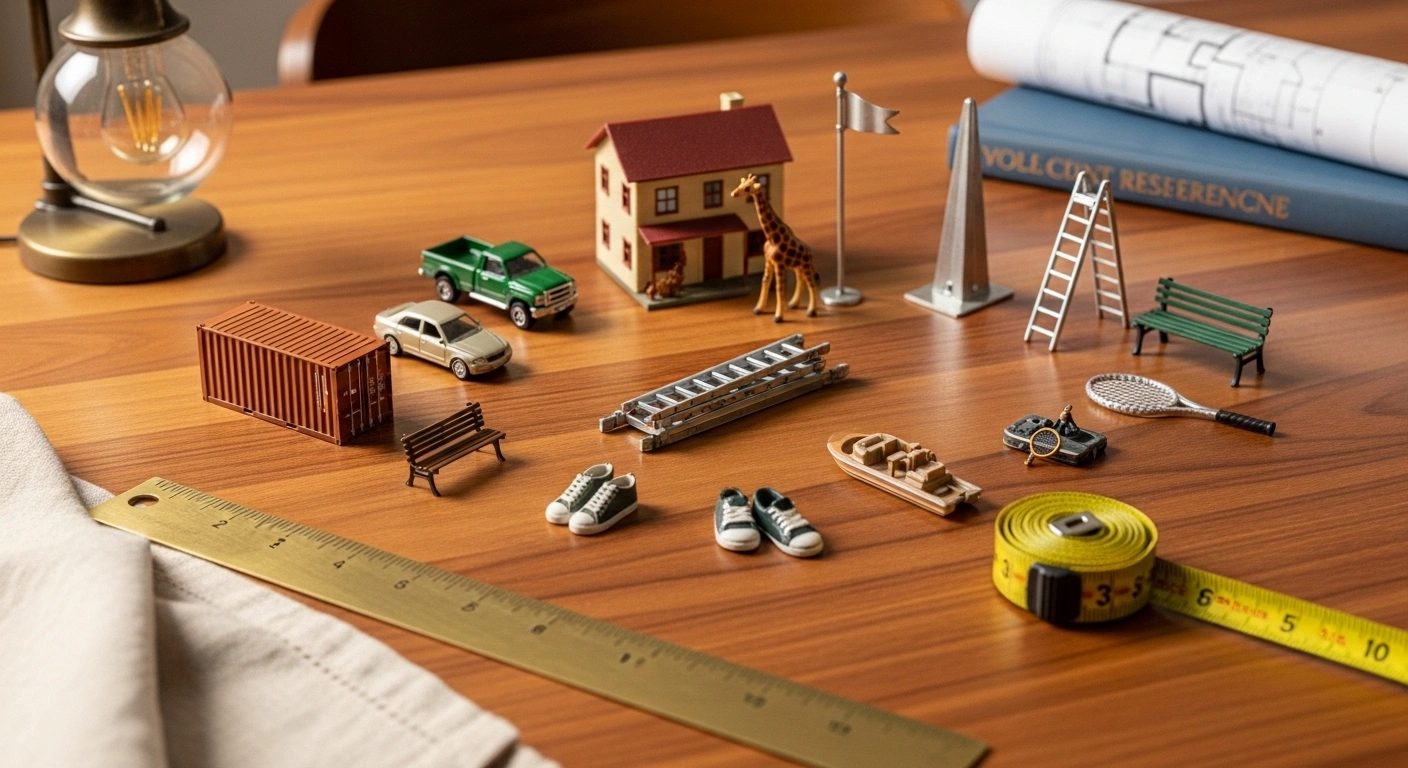

You’re staring at a room, a driveway, or a truck listing that says “20 feet” — and your brain draws a blank. The number sits there, meaning nothing until you connect it to something real.
Twenty feet equals exactly 6.096 meters, 240 inches, or 6.67 yards. But raw numbers don’t build spatial awareness. What actually helps is linking that measurement to objects you’ve already seen hundreds of times — a parked truck, a neighbor’s flagpole, the height of your two-story house. That’s exactly what this guide does.
At businesscomputingworld, we’ve spent years breaking down technical and practical concepts for professionals who make real decisions based on accurate information. This guide goes beyond a basic list of objects. It covers conversions, estimation techniques, and the specific scenarios where knowing 20 feet saves you time, money, or a costly mistake.
How Long Is 20 Feet in Other Units?
Twenty feet is a standard imperial measurement, but depending on your project — international shipping documents, construction blueprints, or scientific calculations — you’ll need metric equivalents. Here’s a complete conversion reference.
| Unit | 20 Feet Equals |
|---|---|
| Inches | 240 in |
| Centimeters | 609.6 cm |
| Meters | 6.096 m |
| Yards | 6.67 yd |
| Millimeters | 6,096 mm |
| Kilometers | 0.006096 km |
The conversion that matters most in practice: 20 feet ≈ 6.1 meters. International shipping, European construction plans, and scientific documents all use meters. Memorize that single number, and you’ll never fumble a metric conversion for this length again.
What Does 20 Feet Actually Look Like?
Here’s a mental exercise that makes this stick permanently.
Stand in your driveway and look at a mid-size sedan — a Toyota Camry, Honda Accord, or similar. That car is roughly 16 feet long. Now mentally add about 25% more length to the end. That’s 20 feet.
Or try this: the average adult male stands about 5 feet 10 inches tall. Line up three and a half adults lying head to toe on the ground. You’re looking at 20 feet.
The most reliable single-object comparison? A standard 20-foot shipping container — the kind stacked on cargo ships, parked at construction sites, and converted into trendy tiny homes. Its exterior length is 19 feet 10.5 inches, which the entire logistics industry rounds to 20 feet. The shipping industry even created a unit of measurement around it: the TEU (Twenty-foot Equivalent Unit), used globally to measure cargo capacity.
But here’s what most people miss: 20 feet is both a horizontal and vertical measurement in everyday life. Horizontally, it’s the length of a moving truck. Vertically, it’s the height of a standard two-story house. Training your brain to see it in both directions doubles the number of reference points you can use.
12 Real-World Objects That Measure 20 Feet
Every comparison below uses objects you can find in your neighborhood, your city, or your nearest park. No obscure references — just things you’ve actually seen.
1. A Standard 20-Foot Shipping Container

The single most accurate real-world match. Intermodal shipping containers built to ISO 668 standards measure 19 feet 10.5 inches externally — close enough that the entire global logistics chain calls them “20-foot containers.” According to the World Shipping Council, there are roughly 250 million TEU movements per year worldwide (2023 data). You’ve seen these on flatbed trucks, at ports, and at construction sites. Next time you spot one, you’re looking at exactly 20 feet.
2. A Two-Story House (Height)
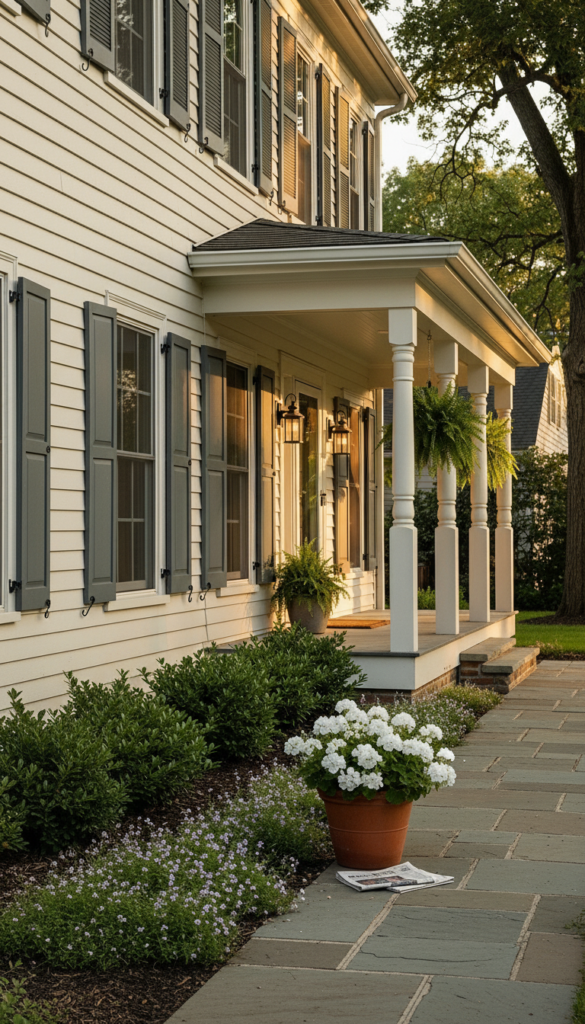
Each story of a residential building averages 10 feet from floor to ceiling, including the structural depth of the floor system. Stack two stories, and you’re at 20 feet — roughly the height from ground level to the roofline edge of a typical suburban home. This is the most useful vertical reference because two-story houses are everywhere.
3. A Medium Moving Truck
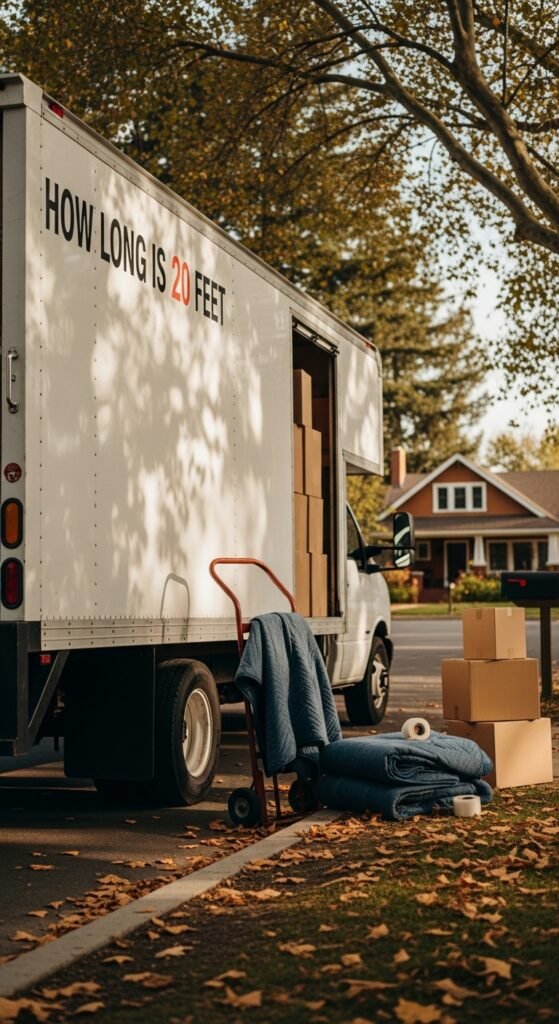
Companies like U-Haul, Penske, and Budget all rent trucks with cargo boxes measuring approximately 20 feet. The U-Haul 20-foot truck, specifically, has a cargo area of 19 feet 6 inches — their most popular size for two-to-three-bedroom apartment moves. On any moving day in any neighborhood, that truck parked out front is your rolling 20-foot ruler.
4. An Adult Male Giraffe (Height)

A fully grown male giraffe stands 16 to 20 feet tall, according to the Smithsonian National Zoo. The tallest recorded giraffe reached 19.3 feet. Their necks alone can stretch 8 feet — roughly the height of a standard doorway. If you’ve visited any zoo with a giraffe exhibit, you’ve looked up at approximately 20 feet.
5. A Residential Flagpole
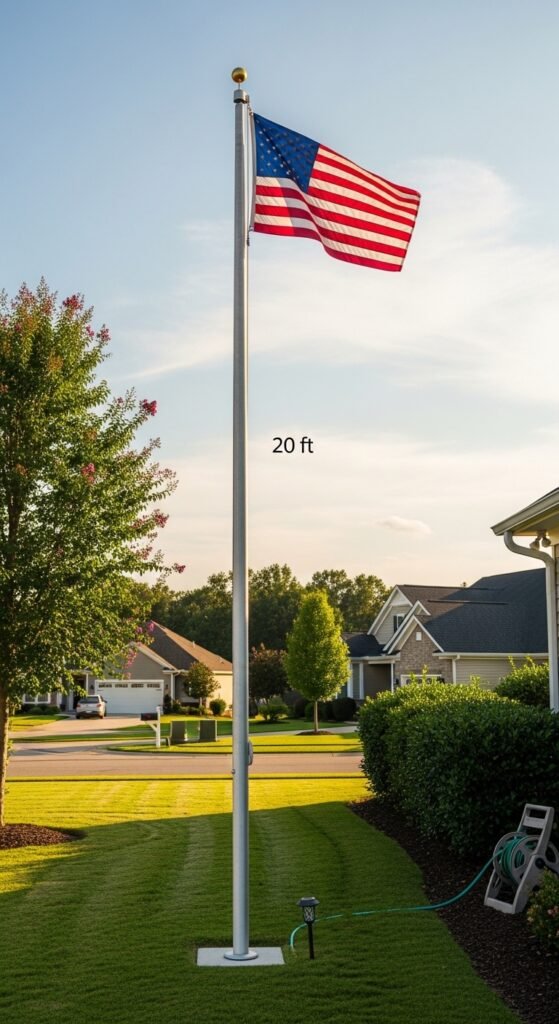
The most popular residential flagpole size sold at hardware stores across the United States is 20 feet. The U.S. Flag Code recommends a 3×5 foot flag for poles of this height, and it’s the standard you’ll see flying in front of homes on the Fourth of July, Memorial Day, and Veterans Day. Walk through any American suburb in summer, and you’ll find dozens of 20-foot reference points planted in front yards.
6. A 20-Foot Extension Ladder (Fully Extended)
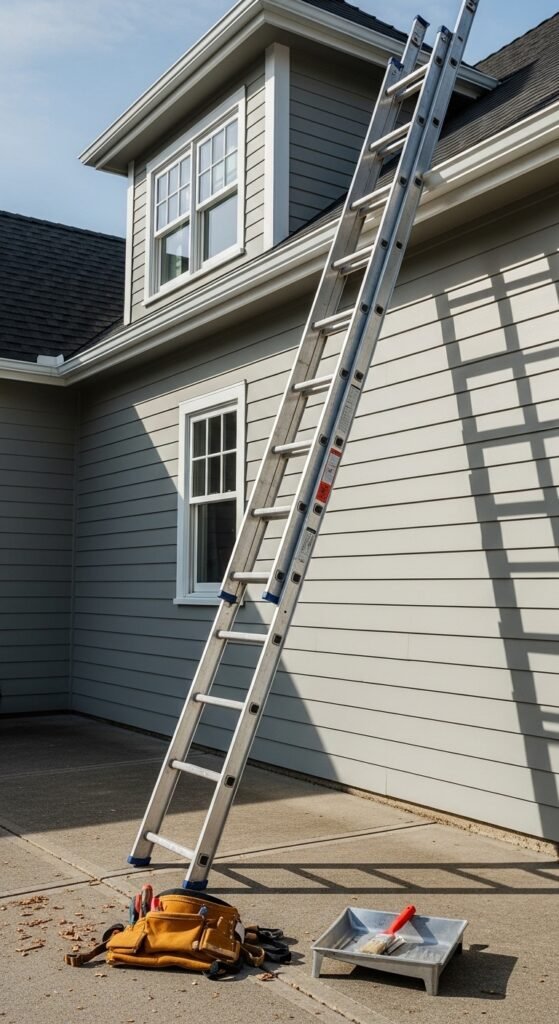
Werner, Louisville, and other major ladder manufacturers all produce 20-foot extension ladders designed to reach second-story windows and gutters. When fully extended (with the required 3-foot overlap between sections for safety, per OSHA guidelines), these ladders give a precise visual of the measurement. Roofers and painters working on your street are demonstrating 20 feet in action.
7. Three Average Adults Lying End to End
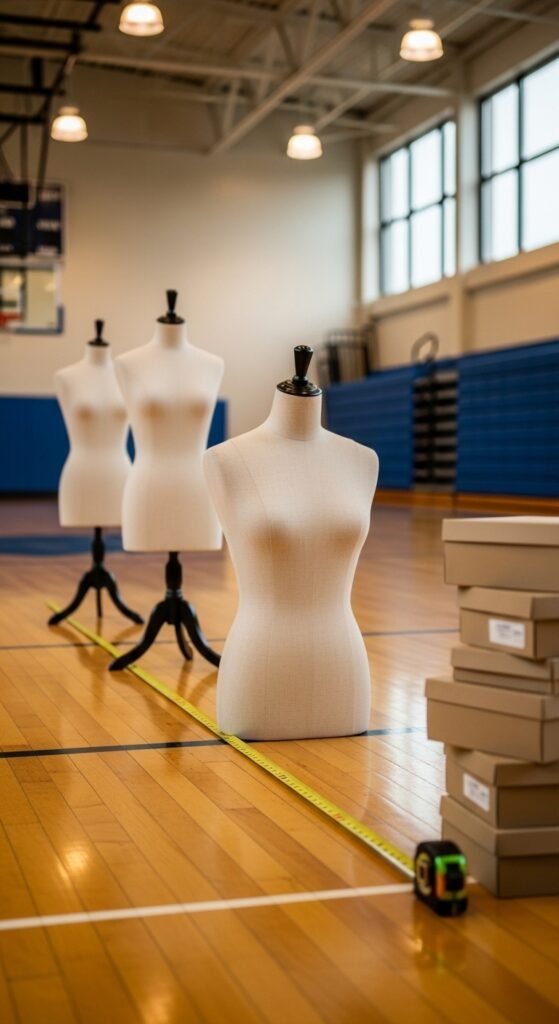
The average American adult is about 5 feet 7 inches tall (per CDC 2022 anthropometric data). Three adults lying head to toe total roughly 16 feet 9 inches. Add one more person from the waist up, and you’re at 20 feet. This isn’t the most elegant comparison, but it’s the one your brain can construct anywhere, anytime, with zero tools.
8. Two Standard Sedans Bumper to Bumper
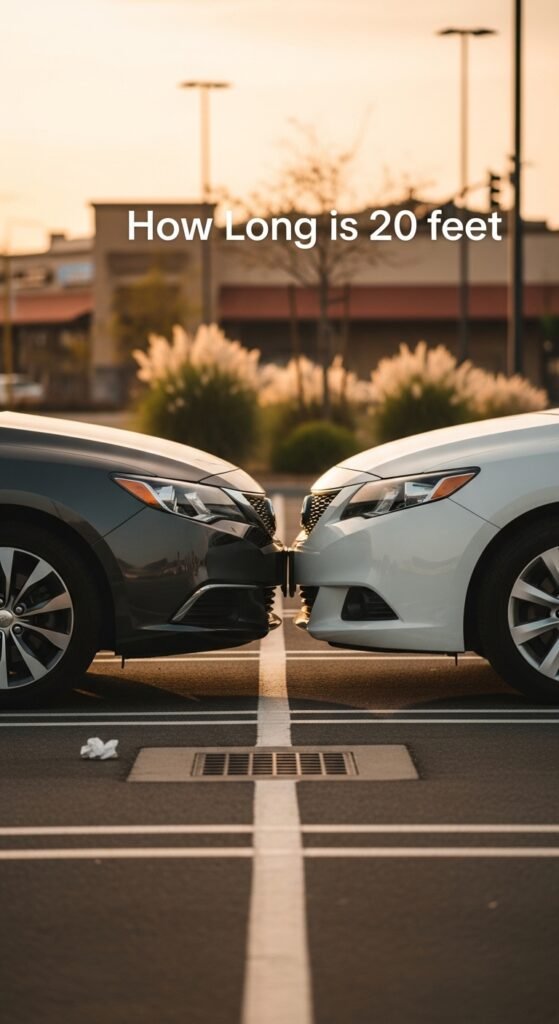
A mid-size sedan (Camry, Accord, Malibu) averages 15 to 16 feet. Two compact cars (Civic, Corolla) parked bumper to bumper hit approximately 18 to 20 feet. Next time you’re in a parking lot, glance at two cars in a row — that line is your 20-foot benchmark.
9. A Small Pontoon Boat
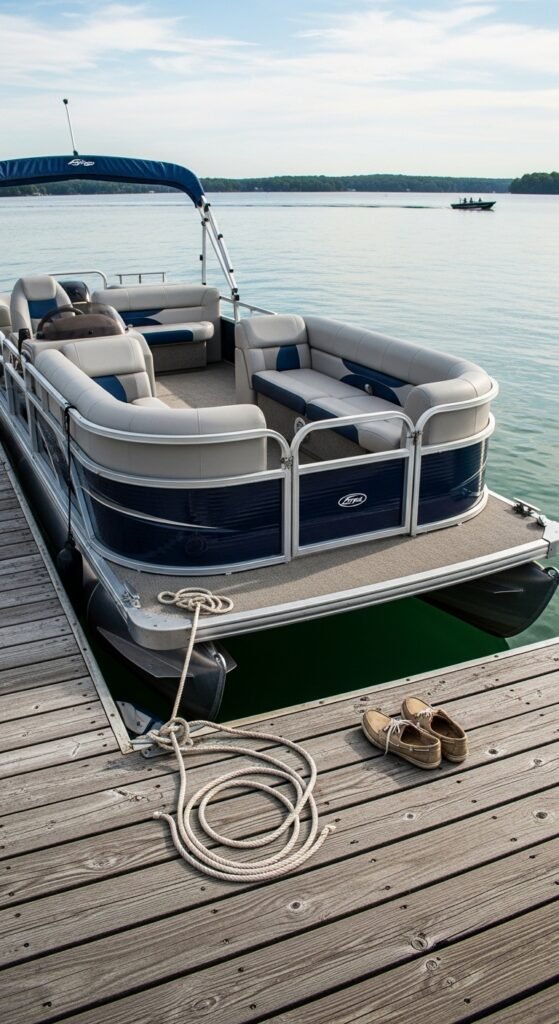
Entry-level pontoon boats from manufacturers like Sun Tracker, Bennington, and Lowe commonly come in 20-foot models. These are the boats you see on lakes across the Midwest and South every summer weekend. From bow to stern, the full deck length gives you an exact floating example of 20 feet.
10. A Full-Size Pickup Truck
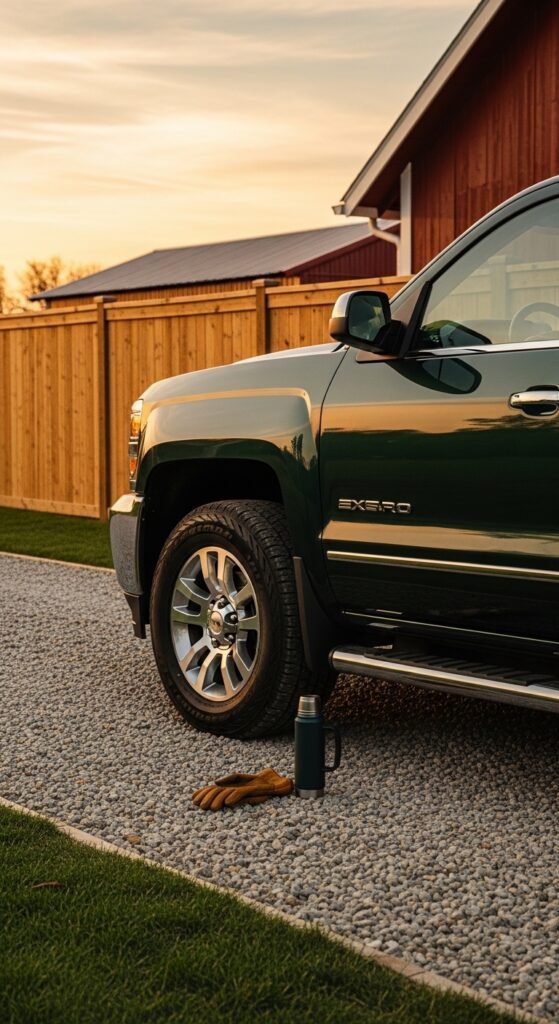
Ford F-150 SuperCrew models measure between 19 and 20 feet in overall length. Chevrolet Silverado and RAM 1500 crew cab versions fall in the same range. Full-size pickup trucks are among the most common vehicles on American roads, making them one of the most accessible 20-foot visual references you can find.
11. Half a Tennis Court Width… Almost

A standard doubles tennis court measures 36 feet wide. Twenty feet covers slightly more than half that width. If you play tennis or walk past public courts, use the center service line as a rough midpoint — the distance from the doubles sideline to just past center is your 20 feet.
12. Eight Adult Walking Steps

The average adult stride measures about 2.5 feet (per biomechanics research from the University of Oklahoma’s gait analysis lab). Count eight natural, relaxed steps forward, and you’ve covered approximately 20 feet. This is the single most practical estimation method because it requires zero tools and works anywhere.
Here’s the key: walk at your normal pace. Don’t stretch your legs or shuffle. Natural stride length stays remarkably consistent for each individual, making this method surprisingly accurate — typically within 6 to 12 inches of the actual distance.
The Step-Count Method: How to Measure 20 Feet Without Tools
This deserves its own section because it’s the skill you’ll actually use in real life.
Step 1: Stand at your starting point with feet together.
Step 2: Walk forward at a relaxed, natural pace. Don’t think about your stride — just walk.
Step 3: Count eight full steps (heel-strike to heel-strike on the same foot = two steps).
Step 4: Stop. You’re standing approximately 20 feet from where you started.
To calibrate your personal stride: Measure a known 20-foot distance with a tape measure. Walk it three times, counting steps each time. Average your count. Some people take 7 steps, others take 9. Knowing your personal number makes future estimates far more reliable.
Pro tip from the field: Landscape contractors and real estate agents use this method daily. One landscape designer I spoke with measures client yards entirely by pacing before pulling out any tools — the step count tells her whether a project is feasible before she spends 20 minutes with a measuring tape.
Think of your stride like a personal unit of measurement — once you calibrate it, you carry a ruler with you everywhere you go.
How Long Is 20 Feet Compared to Common Spaces?
Understanding 20 feet means more when you connect it to spaces you use every day.
| Space | Typical Dimension | Relation to 20 Feet |
|---|---|---|
| One-car garage (depth) | 20–24 ft | Almost exactly 20 ft |
| Large living room (length) | 18–22 ft | Very close to 20 ft |
| Standard parking space (length) | 18–20 ft | Matches 20 ft |
| Bowling lane approach area | 15 ft | 20 ft is 33% longer |
| Two-car garage (width) | 20–24 ft | Matches 20 ft |
| Hotel room (length) | 12–15 ft | 20 ft is significantly longer |
The pattern here reveals something useful: 20 feet is the default planning unit for many residential spaces in the United States. Garages, living rooms, driveways, and parking spaces all cluster around this dimension. Once you internalize it, you start recognizing 20-foot spaces everywhere — because builders and planners have been designing around it for decades.
When Knowing 20 Feet Actually Matters: 5 Real Scenarios
Visualizing 20 feet isn’t just a fun mental exercise. It solves real problems.
Renting a moving truck. The 20-foot truck is the most rented size in the U.S. for apartment moves. If you’re packing a two-bedroom apartment, knowing that 20 feet of cargo space holds roughly 1,000 cubic feet of belongings helps you avoid renting too large (and overpaying) or too small (and making two trips).
Parking and driveway planning. Standard parking spaces are 18 to 20 feet long. If you’re resurfacing your driveway, adding a parking pad, or building a garage, 20 feet is your minimum depth measurement. Get it wrong, and car bumpers hang over sidewalks.
Tree removal and landscaping. A tree that’s “about 20 feet tall” — picture your two-story house — requires specific equipment and fall-zone clearance. Arborists calculate drop distances based on height. Knowing 20 feet helps you communicate accurately with contractors and avoid damage to structures or power lines.
Boat purchasing and dock space. Marina slips are sized in increments, and 20-foot slips are among the most common (and affordable). If you’re shopping for a pontoon or bowrider, knowing whether a boat fits a 20-foot slip saves you marina fees and frustration.
Construction setbacks and zoning. Many municipal building codes require 20-foot setbacks from property lines for certain structures. Understanding this distance visually helps you evaluate whether a deck, shed, or addition fits your lot before you hire a surveyor.
Common Misconceptions About 20 Feet
“Twenty feet is about the length of a school bus.” Not quite. A full-size school bus measures 35 to 40 feet. A short bus (Type A) is closer to 20-25 feet, but the yellow buses most people picture are roughly twice this length. Using a full-size school bus as your mental model will double your actual estimate.
“I can eyeball 20 feet accurately.” Research on spatial estimation suggests most untrained adults overestimate horizontal distances by 10 to 25 percent. You probably think 20 feet is longer than it actually is. The step-count method corrects this bias instantly.
“Twenty feet and 20 square feet are the same thing.” They’re completely different. Twenty feet is a linear measurement — a straight line. Twenty square feet is an area — roughly a 4.5 × 4.5 foot square, about the size of a large closet. Confusing these leads to serious errors in flooring, painting, and material ordering.
Frequently Asked Questions
Q: How many steps is 20 feet?
A: For most adults, 20 feet is approximately eight natural walking steps. The average adult stride covers about 2.5 feet, so dividing 20 by 2.5 gives you eight. Your personal count may vary between 7 and 9 steps depending on your height and gait.
Q: Is 20 feet the same as 20 meters?
A: No — 20 meters is significantly longer. Twenty meters equals about 65.6 feet, more than three times the length of 20 feet. This confusion comes up frequently when switching between imperial and metric systems, especially in international construction and shipping contexts.
Q: How tall is 20 feet compared to a building?
A: Twenty feet matches the height of a standard two-story residential building, measured from ground level to the roofline. Each floor averages 10 feet, including ceiling height and the structural depth of the floor system between stories.
Q: What vehicle is exactly 20 feet long?
A: The closest common match is a 20-foot rental moving truck (U-Haul, Penske, Budget), with cargo boxes measuring 19 to 20 feet. Full-size pickup trucks like the Ford F-150 SuperCrew also fall in the 19-to-20-foot range. Standard 20-foot shipping containers measure 19 feet 10.5 inches externally.
Q: How do I visualize 20 feet indoors?
A: Look at your living room or garage. Many large living rooms measure 18 to 22 feet in one direction, and standard one-car garages are 20 to 24 feet deep. If your space falls in this range, you’re already standing inside a 20-foot reference.
Q: How big is 20 square feet versus 20 feet?
A: Twenty square feet is an area measurement — roughly a 4.5 × 4.5 foot square, about the size of a small bathroom rug. Twenty feet is a linear measurement — a straight line roughly the length of a moving truck. They measure fundamentally different things.
Q: Can I measure 20 feet with household items?
A: Yes. A standard interior door is 6 feet 8 inches tall. Lay three doors end to end, and you get exactly 20 feet. Alternatively, most bath towels are about 5 feet long — four towels in a line equal 20 feet.
Your Quick-Reference 20-Foot Cheat Sheet
| Method | What to Do | Accuracy |
|---|---|---|
| Step count | Walk 8 natural steps | ±1 foot |
| Car comparison | Picture 1.3 mid-size sedans | ±2 feet |
| Room check | Measure your living room or garage | Exact with tape |
| Door method | Lay 3 interior doors end to end | Exact (20 ft) |
| Body count | 3.5 average adults head to toe | ±1 foot |
| Arm span | Average adult arm span ≈ 5.5 ft × 3.6 | ±1.5 feet |
Keep this table bookmarked. The next time someone asks “how long is 20 feet?” — or more importantly, the next time YOU need to know — you’ll have the answer in seconds.
What to Do Next
You now have more than a number — you have a spatial vocabulary for 20 feet. Here’s how to put it to work:
Right now: Walk eight steps across your yard, hallway, or parking lot. That’s your calibrated 20-foot reference, personalized to your stride. Do it once, and you’ll remember it permanently.
This week: The next time you see a shipping container, moving truck, or full-size pickup, pause for two seconds and register the length. You’re building a mental library of 20-foot benchmarks that your brain can recall instantly in any situation.
When it matters: Before your next home project, boat purchase, or truck rental, use the step-count method and the comparison table above to verify that 20 feet fits your space. A five-second mental check prevents expensive mistakes.
Twenty feet isn’t abstract anymore. It’s the truck in your neighbor’s driveway, the flagpole on your street, the giraffe at the zoo, and the eight steps between you and the other side of the room. You’ll never second-guess this measurement again.
