
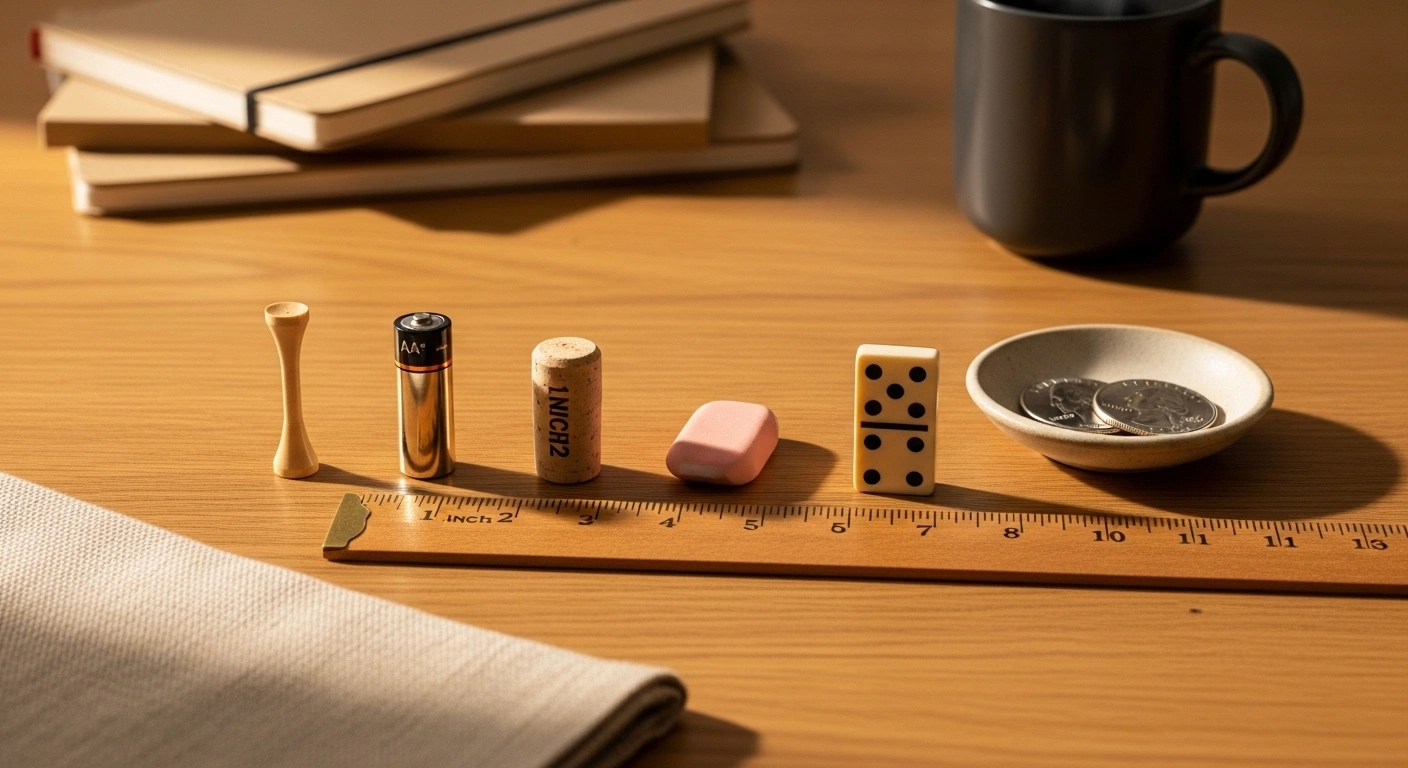

Two inches equals 5.08 centimeters, 50.8 millimeters, or 0.167 feet. On a ruler, it spans from the zero mark to the second full inch line. That length matches an AA battery, a business card’s short side, or two U.S. quarters placed edge to edge.
You’ve seen “2 inches” on a shipping label, a plant tag, or a hardware spec. Still had no idea how long it actually is?
Numbers alone don’t stick. A mental library of real objects fills the gap.
Objects that measure exactly 2 inches make the length visual and instantly recognizable.
This guide gives you twelve of them. It covers conversions, a precision ranking, and the common mistakes that mess up your estimates.
After sifting through dozens of measurement guides, here’s the version that works — no fluff, no invented references.
Two inches equals exactly 50.8 millimeters or 5.08 centimeters under the international inch standard, which the National Institute of Standards and Technology defines as precisely 25.4 millimeters per inch. On a standard 12-inch ruler, this length spans from the zero mark to the second full inch line, covering four half-inch marks or eight quarter-inch marks. A single U.S. quarter measures 0.955 inches across, so two quarters placed edge-to-edge cover 1.91 inches — just under 2 inches. A standard AA battery, defined by IEC 60086-1 at 50.5 millimeters, comes closest to a true 2-inch reference at 1.99 inches. The measurement matters in real applications: standard drywall screws for cabinet installation are 2 inches long, and the U.S. Consumer Product Safety Commission uses a 2.25-inch test cylinder to flag choking hazards for children under three. Reliable 2-inch references share one trait — they come from manufactured objects with tight, published tolerances rather than soft body-part guesses.
What Does 2 Inches Look Like on a Ruler?
On a standard ruler, 2 inches spans from the 0 mark to the number 2 line. It fills roughly one-quarter of the short side of a sheet of printer paper. Held to your hand, it stretches from your thumb tip to just past the first knuckle of your index finger.
Every ruler treats 2 inches the same way. It’s the second big number after zero.
Between those two marks sit four half-inch ticks and eight quarter-inch ticks. Each minor line splits the space evenly.
Grasping the base inch measurement helps ground the reference. Two inches is simply that same mark repeated once.
On a phone screen, 2 inches covers about the top third of most modern smartphone displays. The camera notch usually sits within that band.
Product tags use the measurement in predictable ways. A “2-inch heel” means the shoe’s back adds two inches of height. A “2-inch inseam” adjustment adds that same length inside the pant leg.
Standard shipping labels measure 2 inches on the shortest side. Half of a classic 4×6 index card also matches this exactly.
Reading a ruler correctly matters more than most people admit. Line up your object’s start with the 0 line, not the ruler’s physical edge.
Digital rulers on phone apps also work, but calibrate first. Most apps need a credit card or coin scan to set the true scale.
Physical rulers stay more reliable overall. Pick one with clear black tick marks on a light background for the fastest reads.
2 Inches in Millimeters, Centimeters, Feet, and Meters
Two inches equals 5.08 centimeters, 50.8 millimeters, 0.0508 meters, or 0.1667 feet. Every conversion traces to one fixed relationship — an inch is defined as exactly 25.4 millimeters. To convert 2 inches, multiply 2 by 25.4 for millimeters, or divide by 12 for feet.
That 25.4 mm value was locked into place in 1959. Before then, the U.S., U.K., and Canada each used slightly different inch definitions.
The 1959 International Yard and Pound Agreement standardized the international inch. NIST’s SI length reference page documents the transition and the current U.S. legal definition.
NIST retired the last remaining U.S. survey inch in 2023, per NIST’s survey foot retirement notice. The change ended a 60-year overlap between two nearly identical inches.
Here’s the full conversion table for 2 inches:
| Unit | Value |
|---|---|
| Millimeters | 50.8 mm |
| Centimeters | 5.08 cm |
| Meters | 0.0508 m |
| Feet | 0.1667 ft |
| Yards | 0.0556 yd |
| Kilometers | 0.0000508 km |
For rough mental math, remember that 2 inches ≈ 5 centimeters. The tiny 0.08 cm difference rarely matters outside precision manufacturing.
Big projects need cross-unit context. BIPM’s constants-based SI definitions explain how each unit ties back to fundamental physical constants.
Two inches sits between other useful benchmarks. A close cousin at 2 centimeters measures 0.787 inches — under half of 2 inches.
Fine tolerances matter too. Learning how 2 millimeters look on the same scale helps calibrate small gaps and thicknesses.
For scale up, the full-foot 12-inch mark is exactly six times 2 inches — a useful mental multiplier.
Fractional inches trip people up more than metric conversions. Two inches equals 32/16, 16/8, 8/4, or 2/1 — the same length written different ways.
12 Everyday Objects That Are About 2 Inches Long
Twelve objects give you reliable mental references for 2 inches. Some hit the mark exactly. Others come close enough for quick estimation. Together they form a no-ruler toolkit for spotting this length anywhere.
1. A Standard AA Battery: An AA battery measures 50.5 millimeters, or 1.99 inches — the tightest natural reference for 2 inches in most homes. The IEC 60086-1:2026 primary battery standard locks this dimension globally. Grab one from a remote or flashlight to see the length instantly.
2. The Short Side of a Business Card: Standard U.S. business cards measure 3.5 inches by 2.0 inches. The short edge gives you an exact 2-inch reference every time. European and Asian business cards vary, so check the source before trusting the number.
3. A Jumbo (#1) Paperclip: Straightened out, a standard #1 jumbo paperclip measures about 2 inches. Bent in its usual shape, its outer loop still runs close to 2 inches. It’s the office-drawer version of a pocket ruler.
4. A Standard 2⅛-Inch Golf Tee: The most common golf tee for irons and short woods runs 2⅛ inches (2.125 inches). Legal tees can reach 4 inches, per the USGA equipment rule 6.2 for tees. The classic short tee sits within 6% of a true 2-inch mark.
5. Two U.S. Quarters Side by Side: Line two quarters edge to edge and you get 1.91 inches. That’s 4.5% under 2 inches — close enough for rough estimation. The U.S. Mint’s coin specifications table confirms each quarter runs 0.955 inches across.
6. A Standard Domino Tile: The long edge of a double-six domino measures exactly 2 inches. The short edge is 1 inch — the tile follows a 2:1 ratio. Pull a domino from any game set to check length in seconds.
7. A Post-it Page Marker: Standard Post-it Page Markers measure 2 inches by 1.5 inches. The longer side hits your 2-inch mark exactly. These small color-coded flags live in most desk drawers.
8. A Small Wooden Clothespin: Traditional wooden clothespins run about 2 inches from tip to tip. Modern plastic ones vary more, from 1.75 to 2.5 inches. Stick with the classic wooden design for a reliable reference.
9. A Wine Cork: A natural wine cork measures 1.75 to 2 inches long. The exact length depends on the wine type — sparkling wines use longer corks. For everyday reds and whites, expect the shorter end of that range.
10. A House Key: A typical residential house key runs 2 to 2.25 inches from shoulder to tip. Longer commercial keys hit 3 inches. Your everyday front-door key sits close enough to serve as a pocket-sized stand-in.
11. A USB-A Flash Drive: Slim USB-A flash drives commonly measure right around 2 inches from tip to cap. Compact “nub” drives run shorter, and swivel drives longer. Look for the classic rectangular style for the closest match.
12. A ChapStick Tube Cap: The cap alone on a ChapStick tube measures about 2 inches. The full tube with cap runs closer to 2.75 inches. Pop the cap off, hold it up, and you have a portable size gauge.
How Do You Measure 2 Inches Without a Ruler?
Two inches without a ruler comes down to memorized reference objects. Grab an AA battery, a business card’s short edge, or a stack of two U.S. quarters — each puts you within a hair of the mark. Body-part references like thumbs work in a pinch but drift by 30-40% between people.
The most reliable method is item substitution. Keep three or four accurate references in your everyday carry — wallet, backpack, or key ring — and you’ll have a mental measuring tool everywhere.
Business cards win the wallet test. The short edge is exactly 2 inches, always. Slide it against the object you’re measuring and match the ends.
To measure 2 inches without a ruler, use one of five verified references: a standard AA battery (1.99 inches), the short edge of a U.S. business card (2.0 inches), a standard #1 jumbo paperclip when straightened (2.0 inches), two U.S. quarters placed edge to edge (1.91 inches), or a standard domino tile’s long edge (2.0 inches). Each is manufactured to tight tolerances defined by industry standards, so the length stays consistent from unit to unit. The reason manufactured references beat body parts is standardization — an AA battery is defined by IEC 60086-1 at a fixed 50.5 mm across every brand worldwide, while a thumb has no reference authority. Body-part methods carry more error, since an average adult thumb width sits at 0.75 to 1 inch, meaning it takes two to three thumb widths to reach 2 inches, with variability of 15-25% between people. For most estimation, an AA battery gives you the closest match at 99.4% accuracy.
Digital tools help when references aren’t handy. Some phone apps use the camera to measure real objects within a few percent. Calibrate them with a coin first for best results.
Fold-and-check is another trick. Fold a dollar bill in half along its length. That gives you about 3.06 inches — a rough reference to work back from.
The 2-Inch Precision Ladder: Which Reference to Trust
Not every reference object hits 2 inches. Some manufacturers guarantee tight tolerances; others let dimensions drift by 10-20%. Ranking your options by real-world accuracy protects you from crafting or fitting errors.
The 2-Inch Precision Ladder ranks common references into three accuracy tiers, based on their published manufacturing tolerance:
| Tier | Reference | Actual Length | Deviation from 2″ |
|---|---|---|---|
| Tier 1 (Precision) | AA battery | 1.99″ | 0.5% |
| Tier 1 (Precision) | Business card short edge | 2.00″ | 0% |
| Tier 1 (Precision) | Jumbo paperclip (straight) | 2.00″ | 0% |
| Tier 1 (Precision) | Domino tile long edge | 2.00″ | 0% |
| Tier 2 (Close) | Two U.S. quarters | 1.91″ | 4.5% |
| Tier 2 (Close) | Standard golf tee | 2.125″ | 6.25% |
| Tier 2 (Close) | House key | 2.0–2.25″ | 0–12.5% |
| Tier 3 (Rough) | Wine cork | 1.75–2.0″ | 0–12.5% |
| Tier 3 (Rough) | ChapStick cap | ~2.0″ | ±10% |
| Tier 3 (Rough) | Two thumb widths | 1.5–2.0″ | 0–25% |
Match the tier to the job. Precision-critical measurements — a phone mount hole, a serving-size portion, a plant spacing chart — need Tier 1 objects.
General estimation, like eyeballing a package size, works fine with Tier 2 or 3.
Think of the Ladder like tire pressure gauges — a stick gauge gets you in the ballpark, but a digital gauge gives you the exact PSI. Same principle for 2-inch references.
Tier 1 references share a common feature — their dimensions are locked by an industry standard. IEC 60086-1 defines AA battery length.
ANSI standards fix U.S. business card dimensions. That kind of enforcement removes brand variability.
Tier 2 references still measure reliably but drift slightly. A golf tee’s 2.125-inch length exceeds 2 inches by 3 millimeters — meaningful for framing a photo, negligible for estimating counter space.
Tier 3 references drift by 10-25%. Body parts and organic objects lead this group.
Use them only when nothing else is handy, and adjust your estimate mentally.
The Ladder replaces the “grab any 2-inch object” habit with tiered confidence. For measurements one step larger, one inch bigger at 3 inches follows the same tiered logic.
But here’s what most guides miss — even reliable references have limits. That includes the body-part shortcuts most people default to when nothing else is around.
Why Isn’t Your Thumb a Reliable 2-Inch Guide?
The thumb-width-equals-one-inch rule fails more often than most guides admit. Adult thumb widths vary from 0.6 to 1.1 inches — a range of nearly two-to-one. Estimating 2 inches from thumbs introduces error most people can’t feel.
Anthropologists and ergonomic researchers have measured thumb widths across large populations. The average adult male thumb runs about 0.9 to 1 inch across at the widest point.
Adult female thumbs average 0.75 to 0.85 inches.
Those averages hide the tails. About 10% of adults have thumbs under 0.7 inches wide.
Another 10% run over 1.05 inches. Neither group can estimate 2 inches accurately by doubling their thumb.
Kids’ thumbs skew the problem further. A 10-year-old’s thumb averages 0.6 inches wide.
Three thumb widths get closer to 2 inches for a child than two. By then you’ve stacked three sources of imprecision.
The index-finger-joint method has similar flaws. The distance from your fingertip to the first knuckle typically runs 0.9 to 1.2 inches.
Two of those spans can equal anywhere from 1.8 to 2.4 inches — a 30% error range.
For quick rough estimates on the go, thumbs still beat guessing. But if the measurement matters, upgrade to the six-inch benchmark reference logic and use a manufactured object instead.
The credit-card-in-your-wallet trick fixes this. Every business card, credit card, and driver’s license has fixed dimensions defined by ISO/IEC 7810 ID-1.
That standard locks card size at 3.375 by 2.125 inches for the ID-1 format most wallets carry.
Where 2 Inches Actually Matters in Real Life
Two inches isn’t just a curiosity — it drives real safety, legal, and design decisions across daily life. Understanding where the number matters helps you spot it and use it correctly.
Child safety flags the measurement first. The Consumer Product Safety Commission’s small parts rule defines a specific test cylinder.
It measures 2.25 inches long by 1.25 inches wide. Any part that fits fully inside is banned from children’s products for kids under three. The CPSC’s small parts regulation under 16 CFR Part 1501 sets the standard.
That 2.25-inch cylinder is why toy manufacturers avoid parts under about 2 inches long. If you’re checking a hand-me-down toy for a toddler, a 2-inch reference tells you when to be cautious.
Home construction uses the measurement constantly. Standard drywall screws for cabinet installation are 2 inches long.
Deck screws for 5/4 boards commonly run 2 to 2.5 inches. Interior trim finishing nails often measure 2 inches.
Plant care tags reference 2 inches for seedling spacing. Radish thinning happens at 2-inch intervals.
Basil transplants prefer 2-inch pot depth before moving to garden beds.
Kitchen guidance appears often too. Many roasting recipes call for a 2-inch minimum meat thickness to preserve moisture.
Pizza dough recipes often specify a 2-inch dough ball.
Photography and framing lean on 2 inches heavily. A 4×6 print with a 2-inch matte border remains the standard for gallery-style hanging.
Passport photos measure 2 inches by 2 inches in the U.S., per State Department requirements.
For a step up in reference size, the four-inch reference guide covers dinnerware, hardware, and body-part comparisons at double the length.
Common Mistakes When Estimating 2 Inches
Most estimation errors come from three specific mistakes. Fix these and your 2-inch guesses land inside a 5% error range instead of drifting by 30% or more.
Mistake 1: Bottle caps aren’t 2 inches across.
Standard soda bottle caps measure about 1 inch across — half of what you want. Even the widest Gatorade or beverage caps top out under 1.7 inches.
Watch for this in DIY tutorials that treat bottle caps as universal size gauges. Match the cap to the drink brand for a true value, then adjust upward.
Mistake 2: The “2×2 LEGO brick” myth.
A 2×2 LEGO brick measures 16 millimeters on each side — just 0.63 inches. The myth appears in dozens of measurement guides that copy each other without checking.
For a genuine LEGO reference, you’d need eight studs in a row. That measures about 2.5 inches — still not 2.
Mistake 3: Hockey pucks aren’t 2 inches either.
A regulation NHL hockey puck is 3 inches wide and 1 inch thick. Neither dimension matches 2 inches.
Puck references pop up in size-comparison articles that never actually check specs. When in doubt, look up the manufacturer’s dimensions.
Mistake 4: Thumb widths vary too much.
Adult thumbs span 0.6 to 1.1 inches wide — nearly a 2× range. Three stacked can measure anywhere from 1.8 to 3.3 inches.
Every trustworthy 2-inch guide starts with a manufactured object, not a body part.
Mistake 5: Confusing 2 inches with 2 centimeters.
Two centimeters is 0.787 inches, under half of 2 inches. Product listings on international marketplaces sometimes mislabel these.
A 2 cm ring guard is not a 2 inch ring guard. Always check the unit before ordering.
Every mistake shares a root cause — substituting familiarity for accuracy. Two inches is a specific number, not a rough zone.
Guessing from objects that “seem” 2 inches leads to error every time.
For a look at what changes across bigger scales, scale up to 10 inches covers larger objects. The same precision tiers apply there too.
Frequently Asked Questions
How long is 2 inches on a ruler?
Two inches on a ruler spans from the 0 mark to the number 2 line. Between them sit four half-inch marks and eight quarter-inch marks. On a phone screen, that’s roughly the top third of most modern displays. On a sheet of printer paper, it covers a quarter of the short side. Line up your object with the 0 mark, not the ruler edge, for the most accurate reading.
Is 2 inches bigger than a quarter?
Yes, by a wide margin. A single U.S. quarter measures 0.955 inches across, so 2 inches is more than double a single quarter. Two quarters lined up edge to edge reach 1.91 inches — still about 0.09 inches short of a true 2-inch mark. For everyday estimation, the two-quarter method gets you very close.
How many centimeters is 2 inches?
Two inches equals 5.08 centimeters exactly. The conversion comes from the fixed 25.4 mm-per-inch definition set by the 1959 International Yard and Pound Agreement. For quick mental math, remember 2 inches ≈ 5 cm — the 0.08 cm difference rarely matters outside precision work. In millimeters, 2 inches is exactly 50.8 mm.
What household items are 2 inches long?
A standard AA battery, a business card’s short edge, a jumbo paperclip, a domino tile’s long edge, a wine cork, and a small clothespin all measure at or near 2 inches. The most reliable references share tight industry-standard tolerances defined by ANSI, IEC, or manufacturing specs. USB flash drives, house keys, and ChapStick caps sit close but vary by brand.
What’s the difference between 2 inches and 2 centimeters?
Two inches equals 5.08 cm, so 2 inches is about 2.5 times longer than 2 cm. Mixing them up is a common shopping error, especially on international marketplaces that list dimensions in metric. Always check the unit label — a “2 cm” label doesn’t mean 2 inches.
Can I estimate 2 inches with my hand?
Yes, but with meaningful error. Two thumb widths average about 1.75 inches for most adults, and three thumbs run about 2.6 inches. For anything precision-sensitive, use an AA battery or business card instead. Body-part estimates drift 15-25% between people. That’s a bigger gap than most casual measurements can absorb.
Why is 2 inches used for passport photos?
The U.S. State Department requires 2-inch by 2-inch photos so faces fall inside a fixed head-size range. The dimension makes machine-scanning consistent across every passport office. Other countries use different sizes — a UK passport photo is 45×35 mm. The 2-inch standard has been in place in the U.S. since photo requirements were digitized.
The Bottom-Line Takeaway
The next time “2 inches” appears on a spec sheet or plant tag, you can picture it instantly. Real objects beat abstract numbers every time.
Grab an AA battery, flip a business card, or line up two quarters. Each puts you within a hair of the mark.
The 2-Inch Precision Ladder gives you a decision framework. Tier 1 objects handle precision work.
Tier 2 fits general estimation. Tier 3 is a last resort — use those only when nothing else is handy.
Skip body-part references for anything that matters.
Three next steps make the measurement stick:
- Pull out an AA battery right now and hold it flat in your palm. That’s 1.99 inches — your gold-standard reference.
- Slide a business card from your wallet. The short edge is exactly 2 inches, always.
- Note where 2 inches shows up around you today — screw lengths, plant spacings, screen strips, food portions. Awareness locks the reference in permanently.
Two inches is small enough to overlook and important enough to know cold. Master the reference tiers, and you’ll never guess wrong again.
