
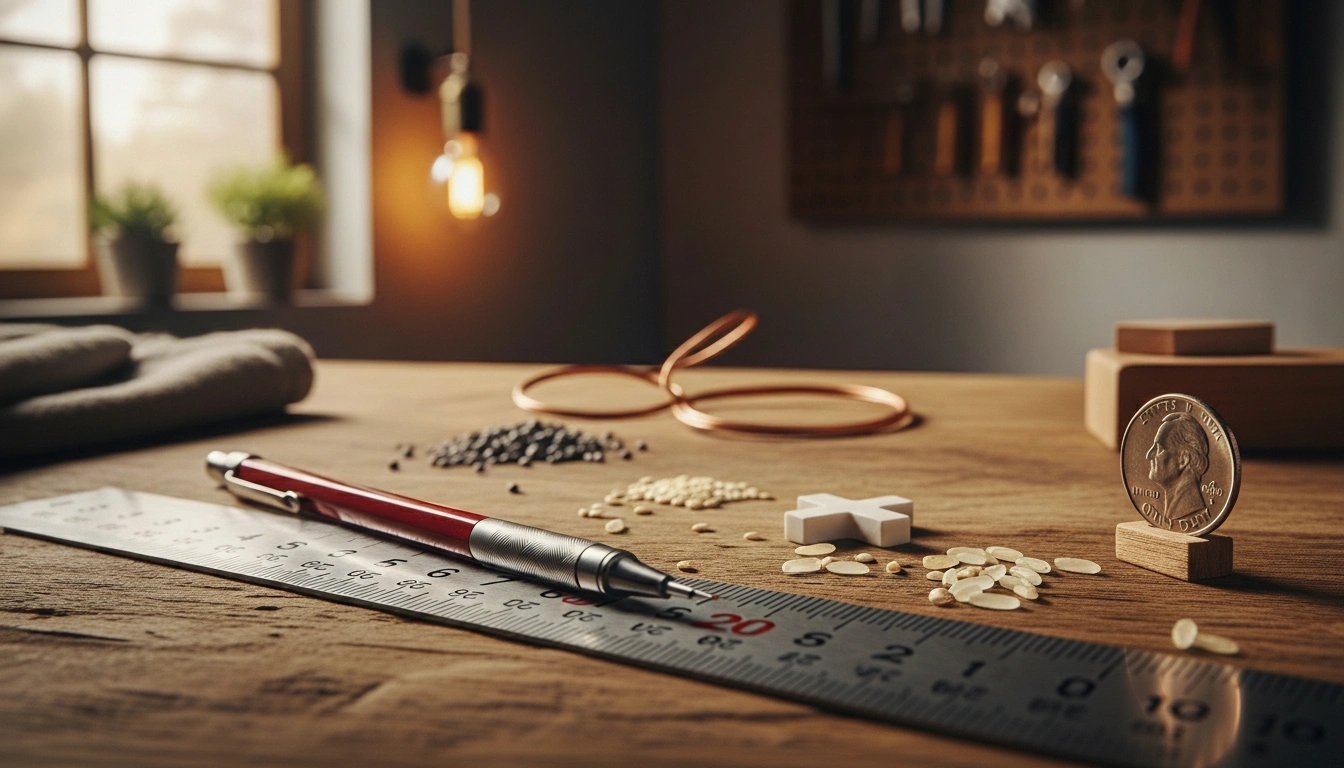

Two millimeters equals about 0.079 inches, or roughly 1/16 of an inch. That’s the thickness of a US nickel edge, which the US Mint sets at 1.95mm. Small enough to slip past your eye, but big enough to matter in jewelry, tile work, and medical scans.
You saw “2mm” on a product listing, a doctor’s report, or a jewelry spec. Your brain came up blank, and most people overestimate 2mm and order the wrong thing.
After years of turning abstract numbers into pictures for readers, here’s what actually helps. Real objects you already own, ranked by how close they get to true 2mm.
Two millimeters (2mm) is a metric-system length equal to 0.2 centimeters, 0.079 inches, or approximately 1/16 of an inch. On a standard metric ruler, it sits at exactly two of the smallest tick marks from any centimeter line. The closest single-object match in most American wallets is the edge of a US nickel, which the United States Mint specifies at 1.95mm — a deviation of just 0.05mm from true 2mm. Common industry standards that hit exactly 2mm include HB mechanical pencil lead, seed beads used in jewelry making, and tile spacers sold at any hardware store. In electrical work, 12 AWG solid copper wire measures 2.053mm in diameter, which is why electricians and hobbyists routinely call it “2mm wire.” The measurement shows up as a threshold in kidney stone diagnosis reports, tattoo needle gauges, wedding ring widths, and screen pixel-density specs — small enough to overlook, precise enough to change what you buy or how a doctor treats you.
What Does 2mm Look Like in Everyday Objects?
2mm equals the edge of a US nickel or the width of a long-grain rice grain. A 2mm mechanical pencil lead is an exact match. Visible to the naked eye, but easy to miss without a real object beside it.
Here are 11 items you probably already own that measure right around 2mm:
1. US Nickel Edge (1.95mm) The closest coin-match to 2mm. Look at any nickel from the side — the edge is your best real-world reference at just 0.05mm off.
2. HB Mechanical Pencil Lead (2mm) Sold to exactly 2mm diameter for drafting pencils. Pop one out of a lead holder and you’re seeing spec-accurate 2mm.
3. Long-Grain Rice Grain Width (1.8–2.2mm) Basmati or jasmine rice runs 6–8mm long and 1.8–2.2mm wide. The short axis of a grain is your 2mm.
4. Sesame Seed (~2mm) Standard sesame seeds from a burger bun or bagel measure about 2mm across. Less consistent than manufactured references, but always in your pantry.
5. Twenty Sheets of Printer Paper (~2mm) A stack of twenty 20-lb printer sheets pressed flat measures right around 2mm. Fast to test at any desk.
6. 2mm Tile Spacer Tile spacers ship in exact millimeter sizes at every hardware store. The 2mm plastic version is one of the cheapest ways to see true 2mm.
7. 12 AWG Copper Wire (2.053mm) Standard household 12-gauge electrical wire is 2.053mm in diameter. Electricians and hobbyists commonly call it “2mm wire” for a reason.
8. Wooden Matchstick Diameter (~2mm) The square cross-section of a standard safety match measures about 2mm per side. Grab one from a kitchen drawer.
9. 2mm Seed Bead (Size 11/0) Jewelry-grade seed beads sold as size 11/0 measure roughly 2mm across. Beaders memorize this the way carpenters memorize a 2×4.
10. 12-Gauge Body Jewelry Post (2.0mm) Standard earring posts run 0.8–1.0mm, but 12-gauge body-jewelry posts hit 2mm exactly. A 14-gauge post is 1.6mm — one gauge thinner.
11. Small Mustard Seed (1.5–2mm) Yellow mustard seeds run 1.5–2mm across. Close enough for a quick spice-cabinet check.
For a bigger jump on the same metric scale, look at how 2 centimeters compares in everyday items. That’s exactly 10 times larger than 2mm.
2mm in Inches, Centimeters, and Other Units
Two millimeters converts to 0.078740 inches, 0.2 centimeters, 78.74 mils, or about 5.67 points in typography. In fractional inches, 2mm sits closest to 5/64 inch.
The measurement is slightly larger than 1/16 inch. That fraction equals 1.5875mm — a common source of confusion when reading shopping charts.
Here’s the full conversion in one place:
| Unit | 2mm Equals |
|---|---|
| Centimeters | 0.2 cm |
| Inches (decimal) | 0.078740 in |
| Fractional inch (nearest) | 5/64 in |
| Mils (thousandths of an inch) | 78.74 mils |
| Micrometers (microns) | 2,000 μm |
| Meters | 0.002 m |
| Points (typography) | ~5.67 pt |
| Pixels at 96 DPI | ~7.56 px |
Every mm-to-inch chart rounds a bit differently. The millimeter-to-inch conversion chart from Chandelier Parts lists 2mm as “1/16 inch” for shopping simplicity.
That’s practical rounding. The exact math puts 2mm at about 5/64 inch — a smidge bigger than 1/16.
The gap matters when you’re buying tile spacers or drill bits. A 1/16-inch spacer is 0.4mm thinner than a 2mm spacer.
In grout lines, that’s the difference between a hairline and a fingernail catch. Small numbers still add up.
For a bigger inch you might need to picture next, walk through a full inch broken down into real objects.
Two millimeters is exactly one-fifth of a centimeter. So if you can picture 1 cm (about the width of a fingernail), then 2mm is one-fifth of that space.
The 2mm Accuracy Ladder: Which References Are Actually Closest?
Every guide to “things that are 2mm” mixes exact-spec objects with rough approximations, then treats them as equal. They aren’t.
Some references are off by 0.05mm. Others miss by 0.7mm or more. Here’s the ranked accuracy ladder from tightest to loosest match, using measured specifications:
| Reference Object | Actual Size | Deviation from 2mm | Best Used When |
|---|---|---|---|
| HB mechanical pencil lead | 2.00mm | 0.00mm | You need an exact match at your desk |
| 2mm tile spacer | 2.00mm | 0.00mm | You’re in a hardware store |
| Size 11/0 seed bead | 2.00mm | 0.00mm | You’re shopping for jewelry supplies |
| 12 AWG copper wire | 2.053mm | +0.053mm | You’re in a garage or workshop |
| US nickel edge | 1.95mm | −0.05mm | You have coins on you |
| Sesame seed | ~2.00mm | ±0.15mm | You’re in a kitchen |
| Long-grain rice (width) | 1.8–2.2mm | ±0.20mm | You’re cooking |
| 20 sheets printer paper | ~2.00mm | ±0.20mm | You’re at an office desk |
| Wooden matchstick | ~2.00mm | ±0.25mm | You’re near a stove or fireplace |
| Two stacked credit cards | 1.52mm | −0.48mm | Only if nothing else is available |
| Two stacked dimes | 2.70mm | +0.70mm | Only as a rough upper bound |
Two big surprises live in the bottom half. Two stacked credit cards do not equal 2mm.
ISO/IEC 7810 sets credit card thickness at 0.76mm. That means a two-card stack lands at 1.52mm — nearly half a millimeter short of true 2mm.
Stacked dimes overshoot the other way. Each dime is 1.35mm thick, so a two-coin stack hits 2.70mm — closer to 3mm than 2mm.
Use the ladder like a decision tree. At your desk, grab pencil lead.
In the kitchen, use a rice grain. On the go, look at a nickel edge.
Ignore the credit-card and dime tricks unless nothing else is within reach.
How Do You Find 2mm on a Metric Ruler?
Find any centimeter line on a metric ruler. Count two of the smallest tick marks to the right — that’s 2mm.
Each small tick equals 1mm, and there are ten of them between each centimeter mark. So 2mm is the second tick, or one-fifth of the way to the next centimeter.
Two millimeters on a standard 30-cm metric ruler appears as the second small division after zero. It sits between the 1mm mark and the 3mm mark, exactly. Each centimeter contains 10 equal 1mm divisions. So 2mm is 20% of the distance from one centimeter line to the next. On a dual-scale ruler with inches on one edge, 2mm falls just before the first 1/16-inch mark. That mark sits on the imperial side of the ruler. The reason: 1/16 inch equals 1.5875mm — a touch shorter than true 2mm. The measurement is best read by holding the ruler flat against the object being measured. View the tick marks straight down to avoid parallax error, which is a common source of 1mm reading mistakes. Start counting from a printed centimeter line, not the ruler’s edge. Edges often add a phantom millimeter of margin.
Here are two rules for reading small millimeter marks accurately. First, always start counting from a centimeter line, not the ruler’s edge.
Second, use good light and hold the ruler at eye level. Small tick marks blur under a shadow.
If your ruler only has inch markings, 2mm is just under the first 1/16-inch line. Not the same, but close enough for casual work.
Where 2mm Shows Up as a Real-World Spec
Two millimeters is a standard-issue measurement across trades that need precision without bulk. It shows up as an exact spec more often than most people realize:
Electrical wiring. According to the American Wire Gauge system, 12 AWG copper wire measures 2.053mm in diameter. That’s why electricians and hobbyists routinely call 12-gauge “2mm wire” in shorthand.
Jewelry and beading. Size 11/0 seed beads are manufactured at 2mm. Body-jewelry posts jump from 14-gauge (1.6mm) to 12-gauge (2.0mm), so 2mm marks a step up in weight and hold.
Tile installation. Grout-line spacers ship in exact millimeter sizes. A 2mm spacer sits between the tight-set 1.5mm and the more forgiving 3mm. It’s a common choice for polished porcelain and glass mosaics.
Firearms history. The Kolibri, patented in 1910, was the world’s smallest commercially made centerfire cartridge at 2.7mm bullet diameter. Its name still puts “2mm” in the ammunition record books.
Model railways. In British 2mm finescale railway modeling, the standard scale is 2mm to 1 foot, or 1:152.4. That’s why the community calls itself “2mm” — every foot on the real train becomes exactly 2mm on the model.
Mechanical pencils. Drafting-grade lead holders take 2mm leads as a standard, sold under HB, 2H, and softer grades. The 2mm size is thick enough to survive pressure without snapping.
For measurements much smaller than this, see how fine 50 microns really is. That’s 40 times smaller than 2mm.
Two millimeters lands in a sweet spot for design. Big enough to hold shape and take force, small enough to fit tight spaces without adding visible bulk.
Is 2mm Big or Small? Depends What You’re Measuring
Two millimeters is tiny in most human-scale contexts but huge in others. The answer swings entirely on the field.
In cooking, 2mm is barely there — one grain of rice wide. In tile work, 2mm is a full grout line you can catch your fingernail on.
Micro-electronics tells a different story — 2mm is enormous there. Modern CPU transistors measure under 5 nanometers, which is 400,000 times smaller than 2mm.
For a sense of the other end of the spectrum, compare 2mm to how 2 inches looks in real objects. Two inches is about 50.8mm — roughly 25 times bigger than 2mm.
Here’s a rough rule for judging small measurements. If the field is medical, industrial, or precision-manufacturing, 2mm is meaningful.
A 2mm kidney stone in a scan often passes naturally. A 2mm tumor growth may still be watch-and-wait.
But if the field is furniture, construction, or clothing, 2mm is background noise. Your kitchen counter can be 2mm off level and you’d never notice.
A door frame can be 2mm out of square and still hang perfectly. The trick is knowing which field you’re standing in when the number shows up.
What a 2mm Ring, Mole, or Kidney Stone Really Looks Like
In shopping and medical language, 2mm appears constantly, and the same number carries very different weight in each context. A 2mm wedding band is a thin, delicate width.
Meanwhile, a 2mm mole is small but worth monitoring. And a 2mm kidney stone is a lucky diagnosis.
Two-millimeter measurements appear in three high-search medical and consumer contexts. Each carries different meaning. A 2mm ring band is the narrowest common width for wedding bands and stacking rings. The Larson Jewelers visual guide shows 2mm ring widths on real hands. That’s about the width of a nickel edge on the finger. A 2mm skin mole falls in the small category. The American Academy of Dermatology’s ABCDE guidelines flag concern at diameters over 6mm. So 2mm falls well under that threshold. Any mole should still be watched for change in color, border, or shape. A 2mm kidney stone is on the smallest end of the diagnostic scale. As of 2026, clinical guidance from urologists indicates that stones under 4mm pass naturally in about 80% of cases with hydration alone. In each context, 2mm is small — but “small” carries a different action in each field.
For ring shoppers, 2mm is the thinnest width most jewelers stock. It reads as feminine, minimalist, and easy to stack under an engagement ring.
Anything narrower usually skips to 1.5mm and starts feeling flimsy on the finger.
On skin, a 2mm mole is roughly the width of a sharp pencil tip. Not alarming on its own, but worth a photo for comparison in six months.
With kidney stones, 2mm is the size that makes most doctors send you home with water and painkillers. Any diagnosis should be discussed with a licensed physician for actual guidance.
For a size at the opposite end of the medical scale, see how 3 inches looks in everyday objects. That length is roughly 38 times bigger than a 2mm stone.
This section is for general understanding only and not a substitute for medical advice.
How Do You Estimate 2mm Without a Ruler?
You can nail 2mm without a ruler using three body-based tricks. None are perfect.
Each trick gets you within 0.5mm. That’s good enough for shopping decisions or a quick sanity check.
Fingernail edge. The very edge of an average adult fingernail measures 0.5–1mm thick. Stack two fingernail thicknesses in your head — that’s roughly 2mm.
Coin edge. A US nickel edge is 1.95mm. A US penny edge is 1.52mm — somewhere between the two sits true 2mm.
Pen tip. A standard ballpoint pen tip is 1.0mm wide, so two side by side make about 2mm. Fine-tip pens run 0.5mm — four in a row cover the same span.
Practice these once with a real ruler and your brain will lock in the size. Most people overshoot 2mm on their first guess, then dial in fast after seeing a reference.
For a longer anchor at the other end of the scale, see the 10-inch measurement guide. Anchoring your eye at both ends sharpens small-number accuracy.
One more calibration trick worth knowing. Hold your thumb and forefinger together at what feels like a 2mm gap, then measure it.
Most first-timers land at 3–5mm. That’s normal — human eyes aren’t wired for millimeter accuracy.
Real-object references beat mental estimation every time.
FAQ
Is 2mm the same as 1/16 inch? Not exactly. 1/16 inch equals 1.5875mm, so 2mm is slightly larger — closer to 5/64 inch (1.984mm). Most conversion charts round 2mm to 1/16 inch for practical shopping.
Can you see 2mm with the naked eye? Yes, two millimeters is well within visible range for normal vision. Small enough to overlook if you aren’t focused on it, but never truly invisible.
Is a 2mm mole considered big? No. A 2mm mole is small — the American Academy of Dermatology’s ABCDE guidelines flag concern at diameters over 6mm. Any mole should still be watched for changes in color, border, or shape.
What is 2mm on a metric ruler? Two of the smallest tick marks from any centimeter line. Each small tick is 1mm, and 10 ticks fit between each cm mark, so 2mm is the second tick over.
Is 2mm bigger or smaller than 0.1 inch? Smaller. 0.1 inch equals 2.54mm, so 2mm is 0.54mm shorter. Roughly the difference between a fine and medium pencil lead.
How thick is a 2mm ring band? A 2mm ring is the narrowest common wedding-band width. It reads as thin, minimalist, and easy to stack — about the thickness of a US nickel viewed edge-on.
Will a 2mm kidney stone pass on its own? Usually, yes. Urology guidance indicates stones under 4mm pass naturally in most cases with plenty of water. Pain and location can vary, so any diagnosis should be discussed with a doctor.
The Practical Next Step
Grab a nickel from your pocket and look at the edge. That’s 2mm minus a hair.
Now stack two dimes — that’s 2mm plus a hair. True 2mm sits between them.
Once you’ve seen both, your eye locks in the size for good. Do this once and small numbers stop being abstract.
Next time you see 2mm on a listing, pull out a nickel. Or a pencil lead, or a grain of rice.
You already own the ruler you need.
