


Two millimeters sits in a strange perceptual gap — large enough to see, small enough to misjudge. If you’re trying to figure out how big 2mm actually is, you’re probably staring at a ruler right now, squinting at the tiny lines between centimeters, and still not feeling confident.
Here’s your anchor: 2mm equals 0.0787 inches — roughly the thickness of a single US nickel coin. Pull one from your pocket, turn it on its edge, and you’re looking at almost exactly 2 millimeters. That coin-edge reference is more reliable than any ruler squint, and after working with precision measurements in manufacturing, electronics repair, and home improvement projects for years, it’s still the comparison I reach for first.
This guide gives you 11 tangible objects to reference, a unit conversion chart, a no-tools measurement method, and the specific contexts where getting 2mm wrong actually costs you money or ruins a project.
What Exactly Is 2mm? The Quick Definition
Two millimeters (2mm) is a metric length equal to 0.2 centimeters, 0.0787 inches, or approximately 2,000 micrometers. It represents two of the smallest divisions visible on a standard metric ruler. In the imperial system, 2mm falls just under one-twelfth of an inch.
That definition satisfies a textbook. Real understanding requires something you can touch. Here’s why most people search this: they’re holding a component, reading a spec sheet, shopping for jewelry, or choosing tile spacers — and the number “2mm” means nothing until they can see it and feel it.
The rest of this article closes that gap.
2mm Unit Conversion Chart
Before the visual comparisons, here’s every conversion you might need in one place. Bookmark this — it saves repeat searches.
| Unit | 2mm Equivalent |
|---|---|
| Inches | 0.0787 in |
| Centimeters | 0.2 cm |
| Meters | 0.002 m |
| Feet | 0.00656 ft |
| Yards | 0.00219 yd |
| Micrometers (µm) | 2,000 µm |
| Mils (thousandths of an inch) | 78.7 mil |
The conversion that matters most in daily life: 2mm ≈ 5/64 of an inch. If you work with imperial drill bits, socket sets, or hardware store measurements, that fraction is the one to remember.
How Big Is 2mm? 11 Everyday Objects for Instant Reference
Most “how big is 2mm” articles list the same five items. The problem? Half of them require you to already own specialized items. The comparisons below are organized by how likely you are to have them within arm’s reach right now — starting with objects in nearly every pocket, drawer, or kitchen.
1. A US Nickel (Edge Thickness)
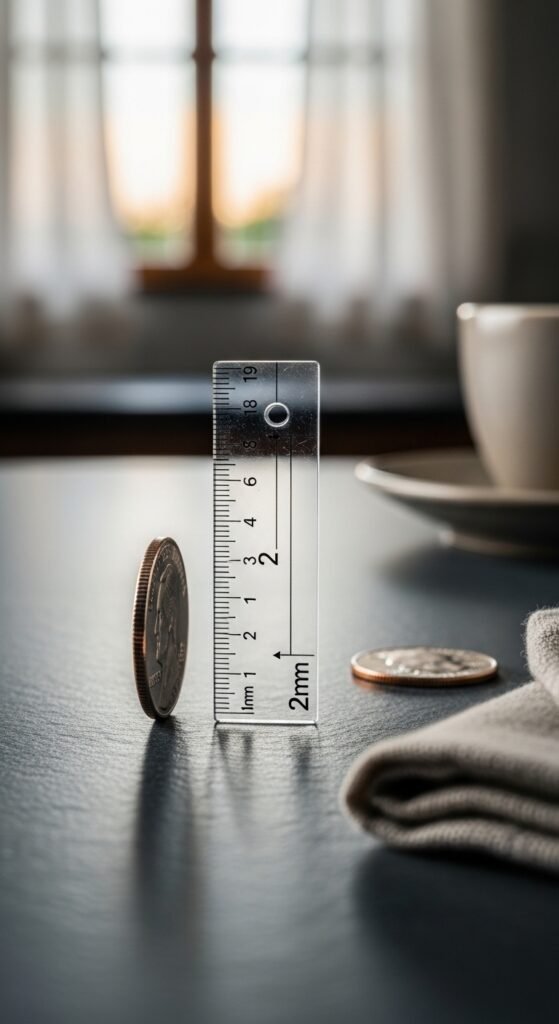
The single best reference object. A US nickel measures 1.95mm thick according to the United States Mint specifications. That’s 97.5% of exactly 2mm — close enough that the difference is invisible to the naked eye.
How to use it: Hold the nickel on its edge between your thumb and forefinger. That sliver of metal you feel? That’s 2mm. No stacking, no math, no guessing.
2. Two Stacked Credit Cards
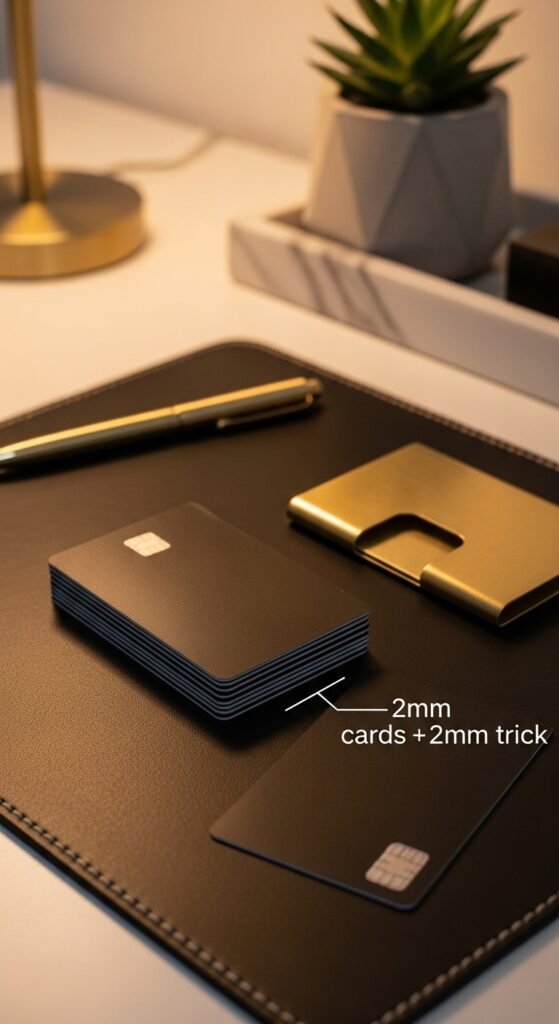
A standard ISO/IEC 7810 credit card measures 0.76mm thick. Stack three together and you get 2.28mm — slightly over 2mm. Two cards give you 1.52mm, which is noticeably thinner.
The practical trick: Stack two cards, then add a standard business card (approximately 0.3-0.5mm). The combined thickness lands right around 2mm. This wallet-based hack works anywhere.
3. A 2mm Mechanical Pencil Lead

Drafting pencils using 2mm lead refills provide an exact match. Brands like Staedtler, Pentel, and Koh-I-Noor sell 2mm lead holders that architects, engineers, and artists have used as an industry standard for decades.
What most people miss: Standard mechanical pencil lead (the common kind students use) is 0.5mm or 0.7mm — not 2mm. The 2mm variety is a specialized drafting tool, thicker and sturdier. Don’t confuse the two.
4. Twenty Sheets of Printer Paper
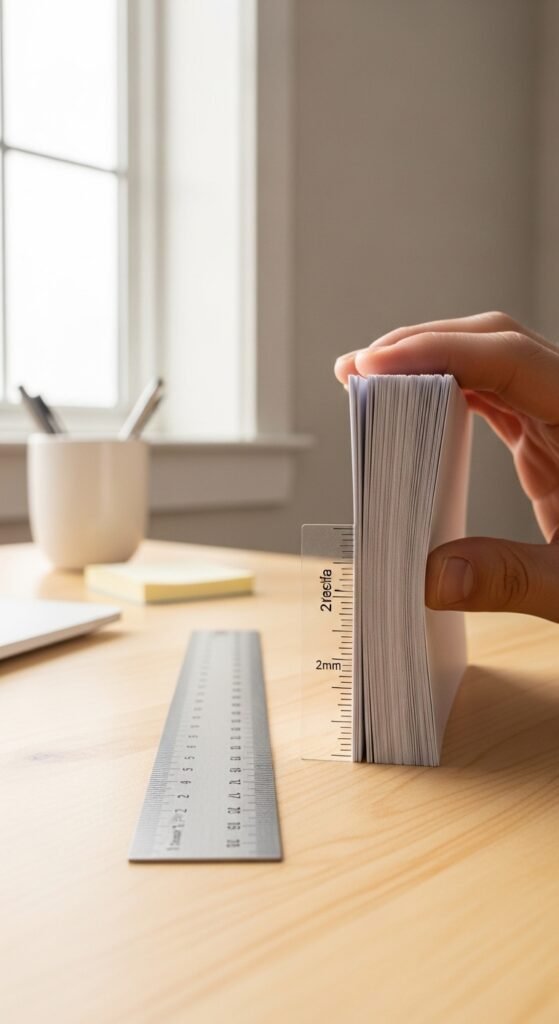
Standard 80 gsm printer paper measures approximately 0.1mm per sheet. Stack 20 sheets and you’ve built a 2mm reference from the most common office supply on Earth.
Why this works better than you’d expect: You can count sheets precisely, making this the most accurate DIY measurement method on this list. Need 1mm? Count 10 sheets. Need 3mm? Count 30. The paper-stack method scales perfectly.
5. A Grain of Long-Grain Rice (Width)
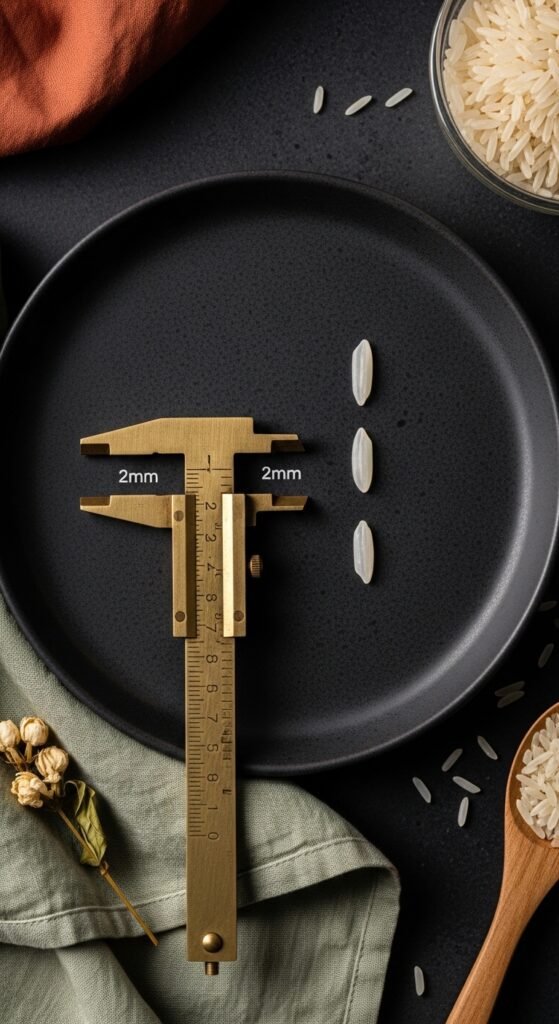
The width — not the length — of uncooked basmati or jasmine rice measures approximately 1.5 to 2mm. This makes it a useful kitchen reference when you’re reading a recipe that specifies millimeter-thin slicing or working with pastry thickness.
Pick up a single grain and look at its narrow side. That dimension is your 2mm reference, give or take half a millimeter.
6. A Small Tile Spacer
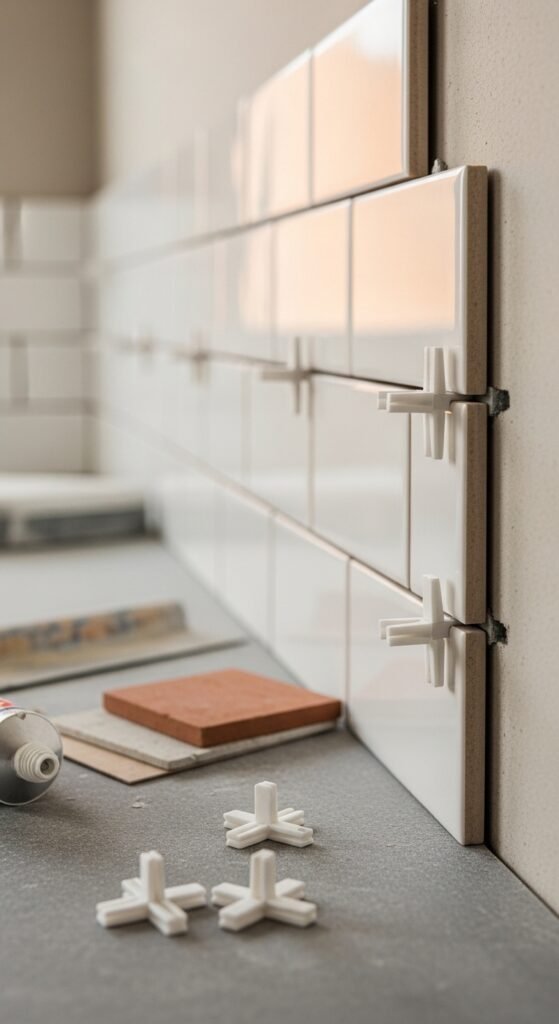
If you’ve tiled a bathroom or kitchen — or watched someone do it — those small cross-shaped plastic pieces inserted between tiles come in 2mm as one of the most common sizes. The 2mm spacer creates a tight, modern grout line that’s become the standard look in contemporary home design.
Where 2mm precision matters here: Using a 3mm spacer instead of a 2mm spacer across a full bathroom wall can shift your final tile by a full centimeter or more over 10 rows. That’s the difference between tiles aligning with your fixtures or not.
7. A Thin Earring Post or Ring Band

Minimalist jewelry frequently uses 2mm wire gauge for earring posts and thin ring bands. If you wear stud earrings, the post running through your earlobe is often right around this thickness.
Shopping context: When browsing jewelry online, “2mm band width” describes a delicate, barely-there ring. For comparison, 4mm looks substantial, and 6mm is a clearly visible statement band. Knowing these benchmarks prevents expensive sizing mistakes.
8. A Standard Matchstick (Diameter)

The wooden shaft of a common kitchen match measures approximately 2mm in diameter. Pick one up and roll it between your fingers — that cylindrical thickness is your reference.
9. Copper Electrical Wire (14 AWG Core)
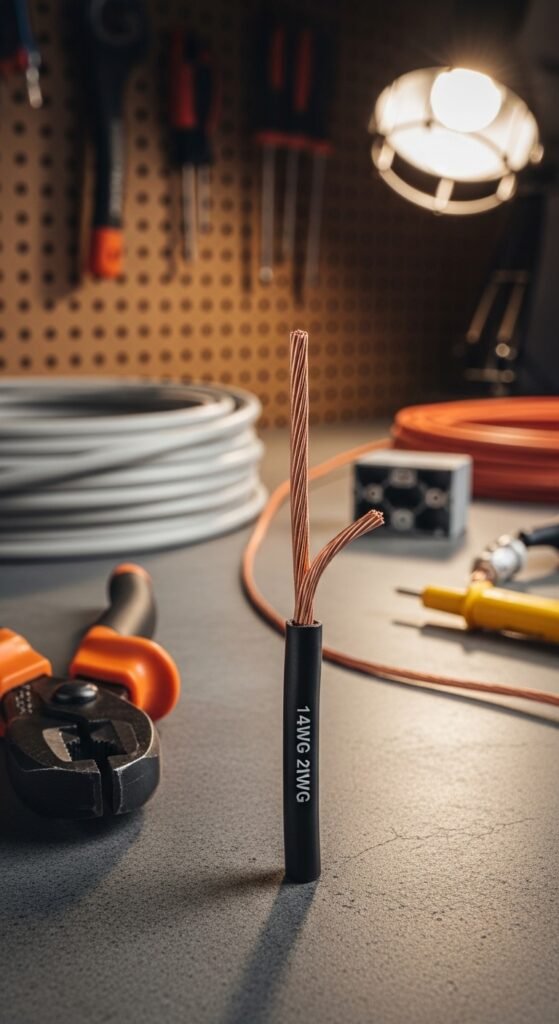
For anyone working with home electrical wiring, 14 AWG solid copper wire has a conductor diameter of approximately 1.63mm. Not exactly 2mm, but close enough to visualize, and it’s a reference electricians encounter daily.
The broader point: In electrical work, wire gauge differences of less than 1mm determine whether a circuit handles 15 amps or 20 amps safely. This is one of many fields where 2mm isn’t trivial — it’s a safety boundary.
10. A Sesame Seed

Sesame seeds measure roughly 2-3mm in length. They’re smaller than a grain of rice but still visible, and nearly every kitchen has them. The next time you see one on a hamburger bun, you’re looking at approximately 2mm.
11. A 2mm Seed Bead

In the beading and jewelry-making world, size 11/0 seed beads measure close to 2mm in diameter. Craft stores sell them by the thousands, and they’re the most popular size for detailed beadwork. If you’ve ever seen an intricate beaded bracelet, those individual beads are right around 2mm each.
How to Measure 2mm Without Any Tools
Here’s a method that doesn’t require a ruler, coin, or any specific object — just your own body.
The fingernail edge method: The free edge of an average adult fingernail (the white part that extends past the fingertip) typically measures between 1-3mm. If you keep your nails trimmed short, that visible white edge is roughly 1mm. Slightly longer? About 2mm.
This isn’t precise enough for engineering work, but for quick estimations — like checking whether a gap in your flooring is 2mm or 5mm — it works well.
A better body-based reference: The thickness of a standard ballpoint pen’s ink tube (the inner refill, not the outer barrel) typically runs close to 2-3mm in diameter. Most people have a pen within reach.
Where Getting 2mm Wrong Actually Matters
Most articles about 2mm treat it as a curiosity — interesting trivia about mustard seeds and ants. But there are real scenarios where misjudging 2mm creates problems:
3D Printing Tolerances. A 2mm dimensional error in a 3D-printed part means the piece doesn’t fit its assembly. In FDM printing, layer heights of 0.2mm mean that 2mm equals exactly 10 layers — a useful mental model for print planning.
Jewelry Sizing. Ring band widths are measured in millimeters, and online shoppers frequently misjudge how 2mm, 4mm, and 6mm bands look on their finger. A 2mm band looks elegant but fragile; many buyers expecting a “standard” ring are surprised by how slim 2mm appears in person.
Medical Contexts. Kidney stones, skin lesions, and dental measurements are frequently described in millimeters. When a doctor says “2mm nodule,” understanding that scale reduces anxiety — 2mm is smaller than a grain of rice. Conversely, a 2mm shift in a dental crown fit means redoing the work.
Tile and Flooring Installation. As mentioned above, choosing between 2mm and 3mm tile spacers has cumulative effects across an entire wall or floor. Professional tilers select spacer size deliberately, not randomly.
PCB and Electronics Design. Component spacing on printed circuit boards is measured in millimeters. A 2mm pitch (distance between component pins) is a common specification, and getting it wrong means components won’t seat into the board.
How Big Is 2mm Compared to Other Small Measurements?
Context helps. Here’s how 2mm stacks up against its neighbors:
| Measurement | Real-World Example | Relative to 2mm |
|---|---|---|
| 0.5mm | Mechanical pencil lead (standard) | 4x smaller |
| 1mm | Thickness of a credit card + business card | Half of 2mm |
| 2mm | US nickel edge thickness | — |
| 3mm | Thick paperboard / cardstock | 1.5x larger |
| 5mm | Pencil diameter (standard #2 wood pencil) | 2.5x larger |
| 10mm (1cm) | Width of your pinky fingernail | 5x larger |
This table does something none of the competitor articles provide: it positions 2mm within a spectrum so you can calibrate your sense of small measurements generally, not just memorize one data point.
Can You See 2mm With the Naked Eye?
Yes — clearly. Two millimeters is well above the threshold of human visual acuity, which can detect objects as small as 0.1mm under good lighting conditions. You won’t need a magnifying glass.
That said, accurately estimating 2mm by eye is much harder than seeing it. Research in perceptual psychology shows that humans consistently overestimate small distances below 5mm. This is why physical reference objects (like the nickel trick) outperform visual guessing every time.
Frequently Asked Questions
Q: How big is 2mm on a ruler?
A: Two millimeters spans exactly two of the smallest tick marks on a metric ruler. On a centimeter scale, it’s the gap between the main centimeter line and the second tiny line after it. If your ruler only shows centimeters without millimeter divisions, 2mm is one-fifth of the distance to the next centimeter mark.
Q: Is 2mm the same as 2 centimeters?
A: No — this is the most common confusion. Two millimeters (2mm) is ten times smaller than 2 centimeters (2cm). There are 10 millimeters in every centimeter, so 2mm equals 0.2cm. If a measurement says “2cm,” that’s about the width of a US nickel coin’s face — significantly larger than its 2mm edge thickness.
Q: What does 2mm look like in inches?
A: Two millimeters equals 0.0787 inches, or roughly 5/64 of an inch. If you’re looking at an imperial ruler, it falls just past the first 1/16-inch mark. It’s less than one-tenth of an inch — visible but very small.
Q: How big is a 2mm kidney stone?
A: A 2mm kidney stone is smaller than a grain of rice. According to the American Urological Association (2024 clinical guidelines), stones under 5mm frequently pass on their own without surgical intervention. A 2mm stone, while uncomfortable, falls well within the range that most patients pass naturally.
Q: Is 2mm thick or thin?
A: It depends entirely on context. For smartphone screen glass, 2mm is relatively thick and durable. For a steel plate, 2mm is thin sheet metal. For a ring band, 2mm is delicate and minimalist. The number is meaningless without knowing what material and application you’re evaluating.
Q: How many sheets of paper equal 2mm?
A: Approximately 20 sheets of standard 80 gsm copy paper stacked together equal 2mm in total thickness. Each sheet measures roughly 0.1mm thick.
Q: What coin is closest to 2mm thick?
A: The US nickel is the closest common coin at 1.95mm thick. A US penny measures 1.52mm, and a US quarter measures 1.75mm. The nickel is within 0.05mm of the target — essentially indistinguishable from 2mm without precision instruments.
What to Do Next
You now have a calibrated sense of how big 2mm is — not as an abstract number, but as a physical reality you can see and feel. Here are three concrete next steps:
- Grab a US nickel and commit its edge-thickness to muscle memory. Once your fingers know 2mm, you’ll estimate small measurements faster than reaching for a ruler.
- Use the paper-stack method next time you need to verify a gap, thickness, or clearance without tools. Count 20 sheets for 2mm, 10 for 1mm. Simple and surprisingly accurate.
- Save the conversion chart above for the next time a spec sheet, medical report, or product listing throws millimeter measurements at you.
