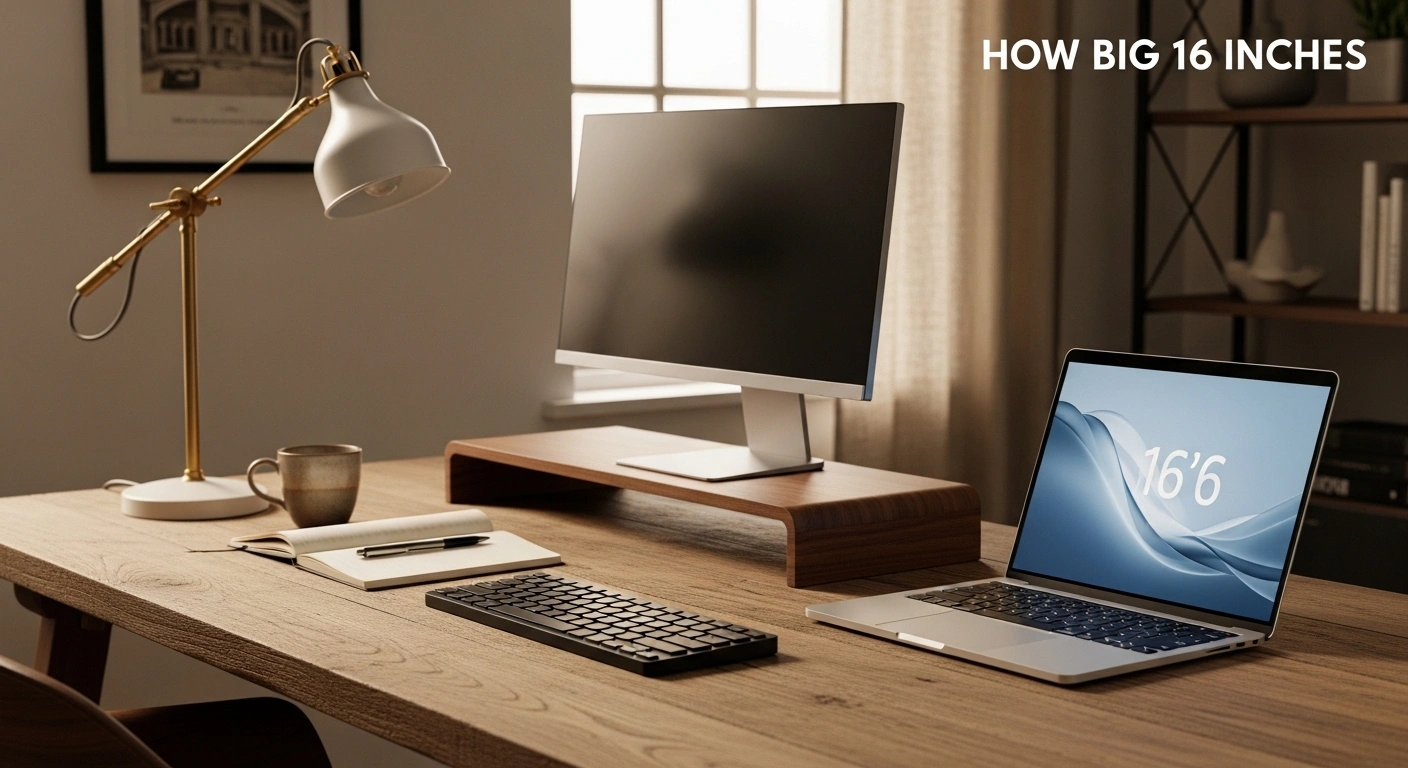

You’re staring at a product listing that says “16 inches,” and you have no idea whether that’s going to fit your desk, your bag, or your wall. Numbers on a screen mean nothing without context — and that’s exactly what this guide gives you.
At BusinessComputingWorld, we deal with hardware dimensions daily — from laptop screens to server rack widths. Sixteen inches is a measurement we encounter constantly in tech, furniture, and workspace planning. This guide translates that abstract number into objects you can see, touch, and hold right now.
Sixteen inches equals 40.64 centimeters, 1.33 feet, or 406.4 millimeters. It’s exactly one foot and four inches — picture a standard 12-inch ruler, then add a credit card’s length beyond it. That four-inch overshoot makes 16 inches one of the most common dimensions in laptops, kitchen tools, and home furnishings.
Quick Conversion Table: 16 Inches in Every Unit
Before we get into real-world comparisons, here’s every conversion you might need:
| Unit | 16 Inches Equals |
|---|---|
| Centimeters | 40.64 cm |
| Millimeters | 406.4 mm |
| Feet | 1.333 ft |
| Yards | 0.444 yd |
| Meters | 0.4064 m |
| Hands (equine measurement) | 4 hands |
This table covers the conversions that online shoppers, DIYers, and international buyers search for most. Bookmark it — you’ll use it more than you think.
How Big Is 16 Inches? 5 Body-Based Ways to Measure Without Tools
Your body is a surprisingly accurate measuring device. Here are five ways to estimate 16 inches using nothing but yourself:
Your forearm. Extend your arm and measure from the crease of your elbow to your fingertips. For most adults, this distance falls between 15.5 and 18 inches. If you’re of average height (5’7″ to 5’10”), your forearm is remarkably close to 16 inches.
Your hand span, doubled. Spread your fingers wide from thumb tip to pinky tip. The average adult hand span measures about 7.5 to 8.5 inches. Two full hand spans placed end-to-end approximate 16 inches.
A shoe length plus a fist. Men’s size 10 shoes run about 11.5 inches long. Place your fist (roughly 4 inches across) next to your shoe, and you’re in the 16-inch zone.
Four finger widths repeated four times. Four fingers held together measure roughly 3 to 4 inches across. Repeat that measurement four times along a surface.
The width of a standard pillow. Most people have a 16-inch throw pillow within arm’s reach on their couch. Pick it up — that’s your reference.
Here’s what most people miss: body-based measurements shift based on your height and build. A 5’2″ person’s forearm is closer to 14 inches, while a 6’2″ person’s exceeds 18 inches. Know your own proportions, and you’ll never need a tape measure for rough estimates again.
16-Inch Objects You Already Own (Organized by Room)
Most “how big is 16 inches” guides just list random objects. That’s not helpful when you’re standing in your kitchen trying to figure out if a new cutting board will fit. Here’s every common 16-inch item, organized by where you’ll actually find it.
On Your Desk
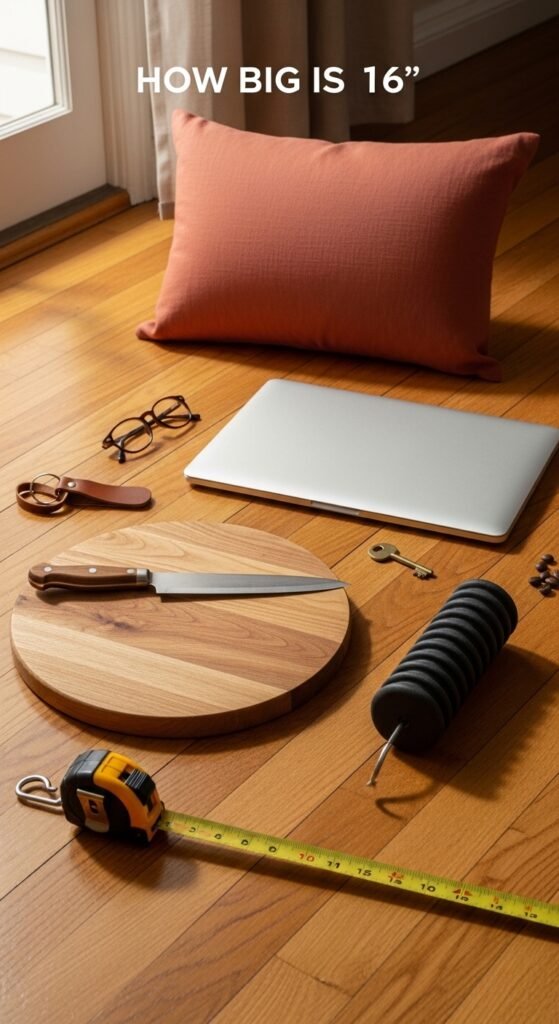
A 16-inch laptop (measured diagonally). Apple’s MacBook Pro 16 and Dell’s XPS 16 both use this screen size. The diagonal measurement from one corner of the screen to the opposite corner hits exactly 16 inches. The physical width of these laptops runs about 14 inches — the diagonal is always longer than the width.
A full-size keyboard. Most standalone keyboards measure between 15.5 and 17 inches across. The standard layout — with number pad included — sits right at 16 inches for many models.
A compact monitor stand. Desk risers and monitor stands frequently use 16-inch platforms to accommodate screens up to 24 inches.
In Your Kitchen
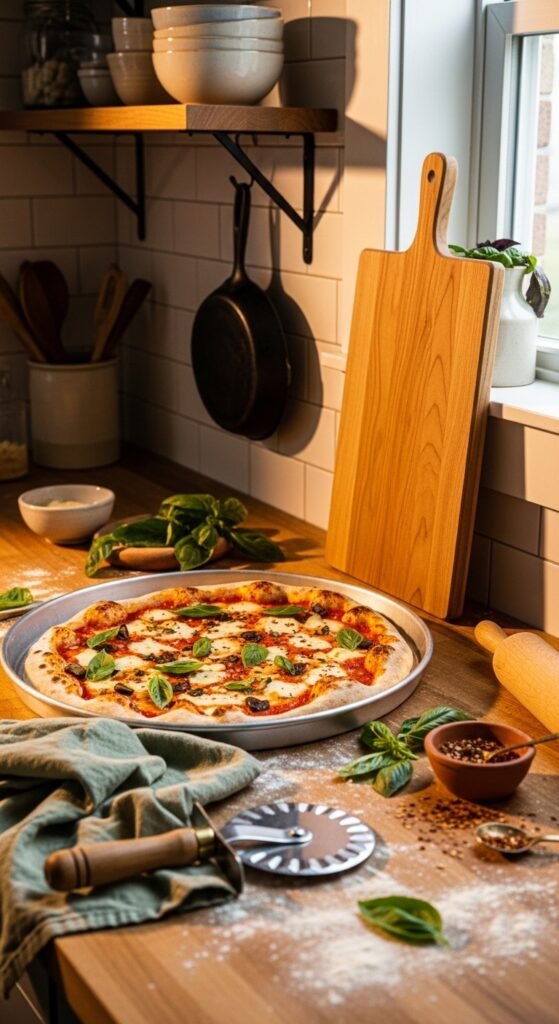
An extra-large pizza. Major chains like Domino’s and Papa John’s sell their extra-large pizzas at 16 inches in diameter. That’s enough to feed four to six people, and it’s one of the most universally recognizable 16-inch objects.
Think of it this way: a 16-inch pizza has roughly 201 square inches of surface area. A 12-inch pizza? Just 113. That four-inch diameter increase nearly doubles the eating surface. This is why pizza shops charge significantly more — you’re not getting 33% more pizza, you’re getting 78% more.
A large cutting board. Professional-grade cutting boards from brands like John Boos commonly measure 16 × 12 inches. This size provides enough workspace for meal prep without overwhelming a standard countertop.
A baking sheet (half-sheet pan). Standard half-sheet pans measure 18 × 13 inches, but many “small” or “quarter” baking sheets come in at 16 × 11 inches — perfect for toaster ovens and compact kitchens.
In Your Living Room
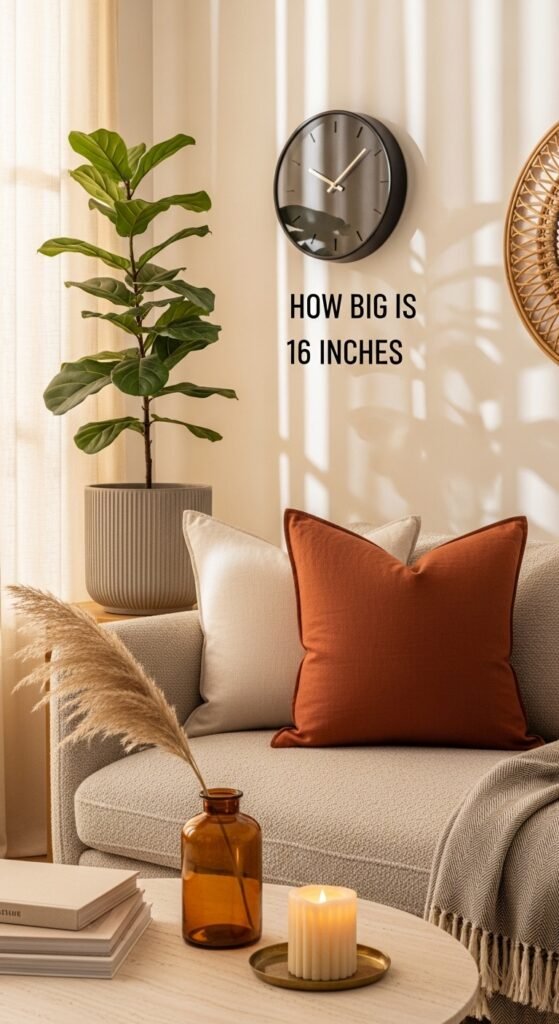
A standard throw pillow. The most popular decorative pillow size in the United States is 16 × 16 inches. Interior designer Emily Henderson noted in her 2024 styling guide that 16-inch pillows work on virtually every sofa width without looking oversized or lost.
A medium wall clock. Clocks in the 14-to-16-inch diameter range dominate home décor bestseller lists on Amazon. At 16 inches, a clock is readable from across a standard 12-foot living room.
In Your Garage and Workshop
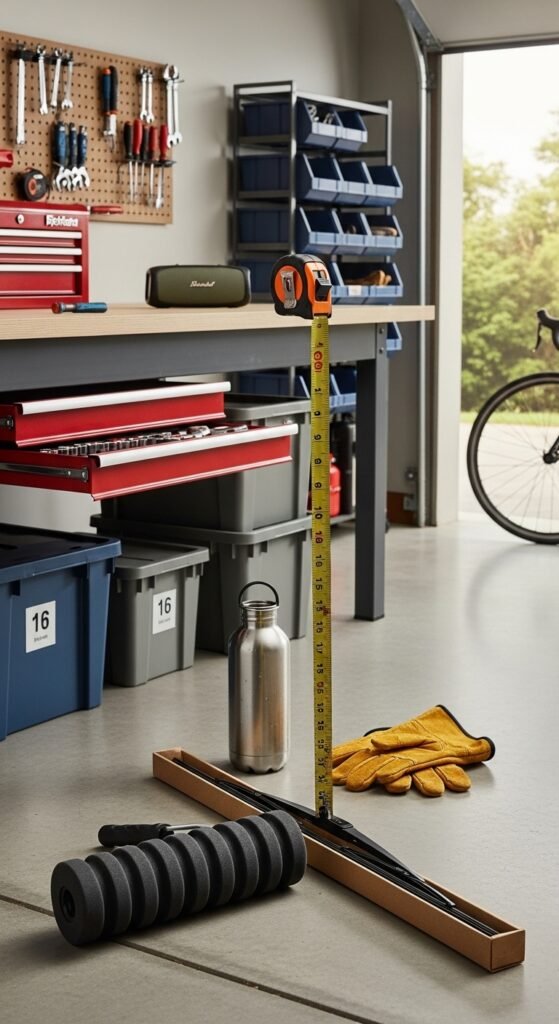
A car windshield wiper blade. Many compact and midsize vehicles use 16-inch wiper blades on the passenger side. Brands like Bosch and Rain-X list 16 inches as one of their top-selling blade lengths.
A foam roller. Compact foam rollers designed for travel and targeted muscle work measure 12 to 18 inches, with 16 inches being the most popular “half-size” option from manufacturers like TriggerPoint.
Why 16 Inches Matters in Construction and Framing
Here’s something most measurement guides never explain: 16 inches isn’t just a random size. It’s a structural standard.
In residential construction across North America, wall studs are spaced 16 inches apart “on center” (measured from the center of one stud to the center of the next). This spacing — codified in the International Residential Code (IRC) — provides the optimal balance between structural strength and material cost.
Why 16? Because standard 4-foot (48-inch) and 8-foot (96-inch) sheet materials — plywood, drywall, OSB — divide evenly by 16. A 48-inch sheet of drywall lands perfectly on three studs spaced 16 inches apart. Change that spacing to 15 or 17 inches, and you’re cutting sheets on every install, wasting material and labor.
This single standard cascades through the entire building industry. Insulation batts come in 15-inch widths (to fit snugly between 16-inch-on-center studs minus the stud width). Electrical boxes are designed to mount at 16-inch intervals. When someone says “find a stud,” they’re essentially saying “measure 16 inches from the last one.”
Practical takeaway: If you’re hanging shelves, mounting a TV, or installing anything on a wall, start at a corner and mark every 16 inches. You’ll hit a stud almost every time, saving you from the frustration of drywall anchors and wobbly mounts.
16 Inches in Tech: Screens, Devices, and Display Sizing
The tech industry’s relationship with 16 inches shifted dramatically in 2019, when Apple launched the MacBook Pro 16-inch to replace the long-running 15-inch model. That one-inch increase wasn’t just marketing — it came from shrinking the bezels around the display, delivering more screen in roughly the same physical footprint.
Since then, 16-inch laptops have become the standard for creative professionals. Dell, Lenovo, ASUS, and HP all offer premium 16-inch models targeting video editors, developers, and data analysts who need screen real estate without carrying a desktop monitor.
One misconception worth clearing up: A “16-inch laptop” doesn’t mean the laptop is 16 inches wide. The 16-inch measurement is the diagonal of the screen — corner to corner. The actual width of the device is closer to 14 inches, and the depth is around 9.5 to 10 inches. If you’re buying a laptop bag or measuring desk space, use the device dimensions, not the screen size.
| Laptop Model (2025) | Screen Size | Actual Width | Actual Depth | Weight |
|---|---|---|---|---|
| MacBook Pro 16″ M4 | 16.2″ | 14.01″ | 9.77″ | 4.7 lbs |
| Dell XPS 16 | 16.0″ | 13.58″ | 9.21″ | 4.6 lbs |
| Lenovo ThinkPad T16 | 16.0″ | 14.19″ | 10.05″ | 4.3 lbs |
How 16 Inches Compares to Nearby Measurements
Context makes measurements stick. Here’s how 16 inches stacks up against lengths people frequently confuse:
| Measurement | Inches | Difference from 16″ | Real-World Example |
|---|---|---|---|
| Standard ruler | 12″ | 4″ shorter | School/office ruler |
| Legal paper length | 14″ | 2″ shorter | Legal documents |
| 16 inches | 16″ | — | Extra-large pizza diameter |
| Standard paper (long edge) | 17″ | 1″ longer | Letter-size paper held sideways is 11″; legal is 14″ |
| Small carry-on width | 18″ | 2″ longer | Airline personal item |
The jump from 12 inches (a ruler) to 16 inches feels small on paper — just four inches. But visually, 16 inches is 33% longer. Hold a ruler, then try to picture adding a third of its length. That gap is bigger than most people expect.
Practical Scenarios: When Knowing 16 Inches Saves You Money
Understanding how big 16 inches is prevents expensive mistakes. Here are three scenarios where this knowledge directly saves money or frustration:
Buying a laptop bag online. You order a sleeve labeled “fits up to 15.6 inches” for your 16-inch MacBook Pro. It arrives. It doesn’t fit. The return costs you time, shipping, and a restocking fee. Knowing that your 14-inch-wide laptop needs a sleeve designed for 16-inch devices — not 15.6 — avoids this entirely.
Choosing pizza for a party. You’re feeding eight people and debating between two 12-inch pizzas ($12 each) or one 16-inch pizza ($18). The math: two 12-inch pizzas give you 226 square inches total. One 16-inch pizza gives you 201 square inches for $6 less. Add a second 16-inch ($36 total) and you get 402 square inches — 78% more food than two 12-inch pizzas for 50% more money. [CONTENT UPGRADE: Download our free Pizza Size Calculator spreadsheet — compare cost-per-square-inch across any sizes]
Installing floating shelves. You buy 16-inch shelves to span two wall studs. Because studs sit 16 inches on center, you drill directly into solid wood on both ends. No anchors. No wobble. No shelf collapse at 3 AM scattering your book collection across the floor.
How to Measure 16 Inches Accurately (When Precision Matters)
For rough estimates, use the body-based methods above. When precision matters — cutting fabric, spacing shelves, fitting furniture — use these approaches:
Use a tape measure, not a ruler. Standard rulers stop at 12 inches. Tape measures handle 16 inches in a single pull. Extend to the 16-inch mark, lock the tape, and you’ve got a rigid reference.
The two-dollar-bill trick. A U.S. dollar bill measures 6.14 inches long. Two bills and a credit card (3.37 inches) end-to-end total 15.65 inches — close enough for quick checks when you don’t have a tape measure.
Use your phone. Measure apps on both iOS (built-in Measure app using ARKit) and Android (Google Measure) can gauge distances with reasonable accuracy for objects on flat surfaces. They’re not perfect, but they’ll confirm whether something is closer to 14 or 18 inches.
Reflection Questions
Before you leave, consider these:
- What 16-inch object in your home could serve as your go-to size reference?
- If you’re shopping for something that “needs to fit,” have you measured the actual device dimensions — not just the screen size?
- For your next DIY project, could stud spacing (16 inches on center) eliminate the need for drywall anchors?
FAQ: How Big Is 16 Inches
Q: Is 16 inches the same as 16 feet?
A: No. Sixteen inches is 1.33 feet — roughly the length of your forearm. Sixteen feet is 192 inches, roughly the length of a mid-size car. The difference is a factor of twelve.
Q: How many centimeters is 16 inches exactly?
A: Sixteen inches equals exactly 40.64 centimeters. Multiply any inch value by 2.54 to convert to centimeters.
Q: What’s bigger, a 16-inch pizza or two 12-inch pizzas?
A: Two 12-inch pizzas provide about 226 square inches of pizza. One 16-inch pizza provides about 201 square inches. So two 12-inch pizzas give you slightly more total food — but check the price difference, because one 16-inch pizza is almost always cheaper per square inch.
Q: How do I know if my laptop is 16 inches?
A: Measure the screen diagonally from the bottom-left corner to the top-right corner. Do not include the bezel (the frame around the screen). The screen measurement is always the diagonal, not the width.
Q: Why are wall studs spaced 16 inches apart?
A: Standard 4-foot and 8-foot building materials (drywall, plywood, OSB) divide evenly by 16 inches. This spacing, set by the International Residential Code, maximizes structural strength while minimizing material waste.
Q: Can I use my phone to measure 16 inches?
A: Yes. Both iPhone (Measure app) and Android (Google Measure) include AR-based measurement tools. They work best on flat surfaces with good lighting and are accurate to within about half an inch for short distances.
Q: What common objects are exactly 16 inches?
A: The most universally recognized 16-inch objects include extra-large pizza pans, 16×16 throw pillows, MacBook Pro 16-inch screen diagonals, kids’ bicycle wheel diameters, and compact foam rollers.
What to Do Next
You now know how big 16 inches is — not as an abstract number, but as a forearm, a pizza, a laptop screen, and the invisible architecture behind your walls.
Put this knowledge to work: grab the nearest throw pillow, measure your forearm, or open the Measure app on your phone. Lock in a personal 16-inch reference object that you’ll remember next time you’re reading product dimensions online.