
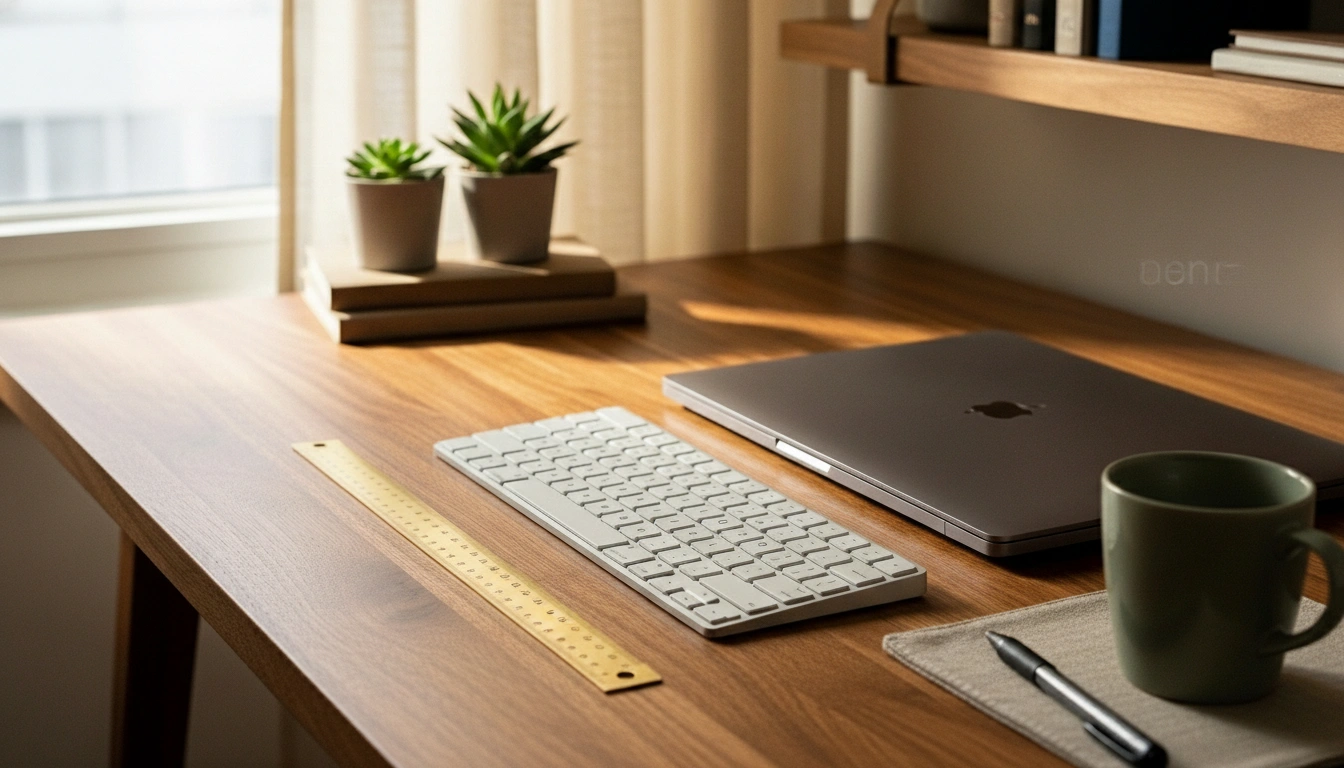

How big is 17 inches? It equals 43.18 centimeters or about 1.42 feet — one full ruler plus five extra inches. For a quick mental picture, imagine a full-size computer keyboard end to end. Or a 17-inch laptop screen measured diagonally. Or the short side of a large pizza box. That’s longer than letter paper but shorter than a yardstick.
You’re about to buy something listed as 17 inches, and the number alone tells you nothing. Is that too big for your desk? Small enough for your laptop bag? Big enough to hang on a wall? Spec sheet numbers don’t help until you can match them to something you already own. This guide fixes that.
The inch is defined by the National Institute of Standards and Technology (NIST) as exactly 2.54 centimeters, a value fixed by the 1959 International Yard and Pound Agreement. That means 17 inches converts precisely to 43.18 centimeters, 1.4167 feet, or 431.8 millimeters — no rounding, no approximation. Seventeen inches sits in what most people call the medium-large everyday range: bigger than typical handheld objects but well short of furniture-scale dimensions. This length appears most often in three product categories. Full-size computer keyboards typically span 17 to 18 inches wide because standard 104-key layouts need that room for keys, function rows, and number pads. Laptop screens marketed as 17-inch measure diagonally corner to corner, not straight across the top. Personal-item luggage on United Airlines caps at 17 x 13 x 6 inches, making 17 inches the maximum length for a bag that fits under the seat in front of you.
What Does 17 Inches Actually Measure?
How big is 17 inches in every unit that matters? It’s 43.18 centimeters, 1.4167 feet, 431.8 millimeters, or 1 foot 5 inches in mixed units. Every conversion locks to one base ratio: 1 inch equals exactly 2.54 centimeters. That single number handles every 17-inch conversion you’ll ever run into.
Here’s the quick lookup table:
| Unit | Exact Value |
|---|---|
| Centimeters | 43.18 cm |
| Millimeters | 431.8 mm |
| Feet | 1.4167 ft |
| Feet + inches | 1 ft 5 in |
| Yards | 0.4722 yd |
| Meters | 0.4318 m |
The mental math trick works both ways. Going from inches to centimeters, multiply by 2.5 for a fast estimate — 17 × 2.5 = 42.5 cm, close enough for shopping and shipping. Going from inches to feet, divide by 12. Anything left over stays as inches.
For scale, one-inch reference points like a US quarter’s diameter or the width of your thumb tip help you count up in small steps. A standard 12-inch ruler covers most of the distance, and five extra inches — roughly the width of a smartphone — finishes it off. That’s the whole trick behind picturing 17 inches without a tape measure.
17 Everyday Objects That Are About 17 Inches Long
Seventeen inches shows up in more common objects than most people realize. Rather than list a dozen random items, this table groups them by where you’ll find them, so you can pick the reference closest to what you can actually see right now.
| Category | Object | Why it’s about 17 inches |
|---|---|---|
| Tech | 17-inch laptop screen | Diagonal corner to corner |
| Tech | Full-size 104-key keyboard | End to end, including numpad |
| Tech | Windshield wiper blade (large) | Common driver-side blade length |
| Kitchen | Medium pizza box (short side) | Standard 16–17 in pizza box |
| Kitchen | Large wooden cutting board | Length for carving meat or rolling dough |
| Kitchen | Baking sheet (compact) | Fits inside a 24-inch oven with room |
| Home | Standard bed pillow (long side) | Queen sleeping pillow, unfluffed |
| Home | Medium picture frame side | Common 17 x 22 poster frame |
| Home | Table lamp (base to shade top) | Small nightstand lamp height |
| Personal | Medium backpack height | Adult daypack, not a school bag |
| Personal | Laptop sleeve length | Fits 15–16 inch laptops |
| Personal | Under-seat carry-on length | Max for United Airlines personal item |
| Body | Adult male forearm (elbow to fingertip) | Average adult reach |
| Body | Standard newborn baby length | Average full-term birth length |
| Music | Ukulele body length | Concert ukulele, not soprano |
Because these objects come from different rooms, you’re rarely more than an arm’s length from a solid 17-inch reference. That’s the point.
How Tall Is 17 Inches on Your Body?
How tall is 17 inches when you compare it to a human? It’s about the length of an average adult forearm from the point of your elbow to the tip of your middle finger. That single reference works because most people can bend an arm and eyeball the length in seconds.
A few more body-based checkpoints help. The average newborn baby is around 17 to 20 inches long at birth, so anything described as 17 inches tall is roughly the size of a newborn lying flat. A standard men’s US size 22 basketball shoe is a good chunk shorter than 17 inches, but the box it ships in usually hits that number.
For height on furniture, 17 inches is common for the seat height of a dining chair. It’s why 17 inches sits at “not small, not huge” on the body scale. You’d notice it, but you wouldn’t call it big.
Adult hand span helps too. Most adult hands measure 7.5 to 9 inches from thumb tip to pinky tip when fully spread. Two hand spans, thumbs touching, land close to 17 inches. That’s a fast trick when you’re standing in a store aisle without a ruler.
One more reference: a pocket square is typically 12 or 16 inches per side. Add an extra inch of fold to a 16-inch pocket square and you’re at 17. Useful if you happen to be near a menswear counter.
Why Isn’t a 17-Inch Laptop Actually 17 Inches Wide?
Because 17 inches is the diagonal screen measurement, not the laptop’s physical width. This is where most 17-inch guides quietly skip the truth. A “17-inch laptop” refers only to the screen, corner to opposite corner. The chassis around it — the keyboard deck, the bezels, the hinge — makes the whole machine larger than 17 inches wide and deep.
A standard 17.3-inch laptop screen is typically 15 inches wide and 8.4 inches tall (using a 16:9 aspect ratio). Add bezels and the outer chassis, and the actual laptop measures about 16 inches wide, 11 inches deep, and 1 inch thick. That’s the number that matters when you’re buying a bag or measuring your desk. Screens marketed at 17.3 inches share a category with true 17-inch panels because most retailers round both to “17-class” — a difference of 0.3 inches barely changes daily use, but it changes bag fit. The Mordor Intelligence 2025 laptop market report projects displays above 17 inches to grow at 9.04% CAGR through 2031, while the 13–15 inch bracket held 41.24% of 2025 revenue. So 17-inch machines stay a niche pick for gamers, content creators, and desk-first users.
This is why a lot of buyers get burned. They see “17 inches” on the box, order a laptop bag rated for 17-inch machines, and find their new laptop won’t fit — because the bag maker built for a screen size, not a full chassis. Larger displays account for about 12% of the global laptop market as of 2026, so bag makers optimize for the 15-inch middle instead.
If you’re comparing sizes across screens, our 13-inch laptop comparison walks through where 13-inch models fit — a 4-inch diagonal difference sounds small but translates to a much lighter bag.
17 Inches in Your Kitchen and Home
Seventeen inches shows up all over a well-stocked kitchen. A medium pizza box measures about 17 inches on the short side, sized to hold a 16-inch pizza with a little wiggle room. A large wood cutting board — the kind meant for carving a whole chicken or rolling out pie dough — typically runs 17 to 18 inches long. A compact half-sheet baking pan lands close to the same number.
Around the house, 17 inches marks the height of a small nightstand table lamp from base to the top of the shade. It’s also a common width for a medium picture frame’s short side — 17 x 22 poster frames are a standard size at most home stores. Bed pillows measure roughly 17 to 20 inches long when laid flat and unfluffed. A queen-size bed pillow starts right around 17 inches on its shorter edge.
Storage containers land in this range too. A medium plastic bin for closet organizing usually measures 17 inches on its longest side, chosen to fit standard closet shelf depth. Same story for kitchen drawer organizers — 17 inches lets them span most drawers without wasted space.
Here’s why that matters when you’re shopping: knowing that so many everyday items live near this length means you can walk into a store with an idea of what 17 inches looks like, without a tape measure in hand. If you can picture the pizza box or the pillow, you can picture the size.
Compared with the reference points in how big is 15 inches, the extra two inches of 17 inches lands you clearly outside the “small kitchen tool” category and into the “counter-taking, drawer-filling” range.
The 17-Inch Context Matrix
Most size guides list objects and leave you to sort out which comparison actually fits your situation. That’s a problem because 17 inches means different things depending on which direction you’re measuring. This matrix pairs each direction with the right reference so you match the object to your actual use case, not just the number.
| If you’re measuring… | 17-inch example | Watch out for |
|---|---|---|
| Diagonal | Laptop or monitor screen | Chassis is bigger than screen |
| Width (horizontal) | Full computer keyboard | Includes number pad on right |
| Length (long side) | Large cutting board, personal-item bag | Depth and width can be much smaller |
| Height (vertical) | Small table lamp, dining chair seat | Height often stated without base |
| Side (single edge) | Medium pizza box, 17 x 22 poster frame | Other side is different |
| Circumference | Small basketball or soft ball hoop hole | Very rare use — usually diameter |
The rule underneath the matrix: always confirm which direction 17 inches applies to before you commit to a purchase. A 17-inch monitor sits on a much smaller footprint than a 17-inch wide keyboard. A 17-inch tall lamp casts light from a specific height. A 17-inch bag has a length that may or may not be its longest side.
Combine this matrix with two-reference checking. Pick one object you can see nearby that matches the direction you care about. Then pick a second object as a sanity check. When both agree the size feels right, you can trust the estimate. Single-object estimates can be off by two or three inches depending on the specific product — most bed pillows range from 16 to 22 inches, for instance — so cross-checking cuts the error in half.
How 17 Inches Stacks Up Against Nearby Sizes
Seventeen inches sits between two very common measurements, and knowing the neighbors helps you place it fast. It’s five inches longer than a standard 12-inch ruler and one inch shorter than a standard schoolbook shelf, which usually clears at 18 inches.
Here’s the comparison at a glance:
| Size | Real-world reference | Difference from 17 inches |
|---|---|---|
| 11 inches | US letter paper long side | 6 inches shorter |
| 12 inches | Standard ruler, one foot | 5 inches shorter |
| 15 inches | 15-inch laptop screen | 2 inches shorter |
| 16 inches | Bowling pin height | 1 inch shorter |
| 17 inches | This guide | — |
| 18 inches | Standard skateboard deck width | 1 inch longer |
| 20 inches | Carry-on suitcase depth | 3 inches longer |
| 24 inches | Two rulers end to end | 7 inches longer |
The one-inch gaps between 16, 17, and 18 look small on paper, but they land you in different product categories. A 16-inch laptop, a 17-inch laptop, and an 18-inch laptop each need different bags, different desk footprints, and different lap positions. Same story for pizza boxes, cutting boards, and monitors.
Curious how much how big 20 inches is changes the feel? Three inches doesn’t sound like much, but it’s the difference between a carry-on that fits under a seat and one that needs the overhead bin.
Where 17 Inches Actually Matters for a Buying Decision
Knowing 17 inches equals 43.18 cm is one thing. Using it to make a purchase is another. Several common buying decisions land right at the 17-inch mark, and getting the wrong side of that number costs real money.
United Airlines caps personal items at 17 x 13 x 6 inches — one of the tighter personal-item limits among major U.S. carriers, confirmed for 2026. American Airlines allows a larger 18 x 14 x 8 inches for personal items, and Southwest allows 16.25 x 13.5 x 8 inches. If you buy a bag rated for one airline and fly a different one, 17 inches becomes either your best friend or your worst gate-check surprise. A 17-inch bag length is safe on nearly every carrier as a personal item, but only when the depth stays below six inches too — most gate rejections happen on depth, not length.
Wall art sits in a similar trap. A 17-inch wide print looks small on a wall above a queen bed (60 inches wide) but proportional above a 30-inch nightstand. Interior designers use a rule of two-thirds: your art should span about two-thirds the width of the furniture below it. A 17-inch piece works over a 25-inch table, not a 6-foot couch.
Monitor buyers get the third common trap. A 17-inch monitor sounds like a decent upgrade from a laptop screen, but its actual viewable area is smaller than most 15.6-inch laptop screens once you account for aspect ratio changes. A 17-inch 4:3 monitor shows less horizontal space than a 15.6-inch 16:9 laptop. Always check the resolution and aspect ratio alongside the diagonal number.
The pattern here: 17 inches is close to a lot of category cutoffs. Whenever you shop something rated at 17 inches, check what the neighboring inch does to the fit.
Common Misconceptions About 17 Inches
A few myths keep tripping people up. The first: that a 17-inch laptop is huge. Compared with older laptops from a decade ago, sure. Compared with a modern 16-inch model with thin bezels, the difference is often less than an inch of chassis width. Screen technology has closed the physical gap.
The second: that 17 inches converts to a round number in centimeters. It doesn’t. It’s precisely 43.18 cm — not 43, not 43.5. This matters for anyone shipping internationally or listing product specs, where rounding to 43 cm loses almost a quarter of a centimeter of accuracy. Global Market Insights notes the 15.0″–16.9″ laptop segment leads market share, so metric-first buyers often round every diagonal — a habit worth breaking for precise specs.
The third: that 17 inches is the same as a foot and a half. Close, but no. Eighteen inches is a foot and a half. Seventeen inches is one foot and five inches, or 1.42 feet — a smaller number than most people guess. This is the same “just under the round number” trap that catches people with 10-inch measurements when they call something “almost a foot” (it’s not — it’s 83% of a foot).
The fourth: that all 17-inch pizzas are the same size. Pizza sizes are usually measured by diameter of the pizza, not the box. A large pizza is 14 to 16 inches across in most chains. When you see “17-inch pizza,” it usually means an extra-large or party size, and the box will be closer to 18 inches on a side to allow for handling room.
Micro-hook: knowing what 17 inches isn’t is often more useful than knowing what it is, especially when you’re double-checking a product listing.
Frequently Asked Questions
What does 17 inches look like in real life?
Seventeen inches looks like a full-size computer keyboard laid end to end, a 17-inch laptop screen measured diagonally, or the short side of a medium pizza box. It’s roughly one adult forearm from elbow to fingertip, or one ruler plus a smartphone width added on.
How tall is 17 inches compared to a person?
Seventeen inches is roughly the length of an average adult forearm, the height of a dining chair seat, or the standing height of a small tabletop lamp. It’s also the average length of a newborn baby at birth.
What is 17 inches in centimeters?
Seventeen inches equals exactly 43.18 centimeters. The conversion uses the fixed ratio of 1 inch = 2.54 cm, an international standard since the 1959 Yard and Pound Agreement.
What is 17 inches in feet?
Seventeen inches equals 1.4167 feet, or 1 foot 5 inches in mixed units. It’s five inches longer than a standard 12-inch ruler and seven inches short of two rulers laid end to end.
Is a 17-inch laptop too big for a regular backpack?
Most standard backpacks fit up to a 15-inch laptop comfortably. A 17-inch laptop needs a bag rated specifically for that size, since the chassis usually measures about 16 inches wide — not 17 — but bezels and padding push the required sleeve size up.
What size is a 17-inch pizza?
A 17-inch pizza measures 17 inches across its diameter, giving it a surface area of about 227 square inches. That’s roughly 30% more pizza than a 15-inch large and enough to feed four to six adults.
How many 17-inch objects fit in a foot?
None — 17 inches is longer than a foot. One foot is 12 inches, so a 17-inch object is 5 inches longer than a single foot and shorter than a full yard (36 inches). Two feet equals 24 inches, which is 7 inches longer than 17.
What to Do With This Number Now
Pick one reference from this guide that lives near you right now — a keyboard, a pillow, a pizza box, or your own forearm. Test it against a tape measure once, so you know how accurate your specific object really is. That single calibration makes every future estimate faster and more reliable.
For the next 17-inch product you’re comparing, apply the context matrix. Ask which direction the 17 inches applies to (diagonal, width, length, height, or side), and check the other dimensions before you buy. Screen sizes hide chassis widths. Bag lengths hide depth limits. Poster dimensions hide the second side.
Finally, if you’re shopping across metric and imperial sources, memorize the one conversion: 17 inches = 43.18 cm. Half a centimeter of rounding on a laptop bag or a suitcase can be the difference between “fits” and “gate check.” Now that you know how big 17 inches is in every useful way, the next spec sheet won’t slow you down. Bookmark this guide when you’re comparing similar sizes in the future — same trick, different number.
