
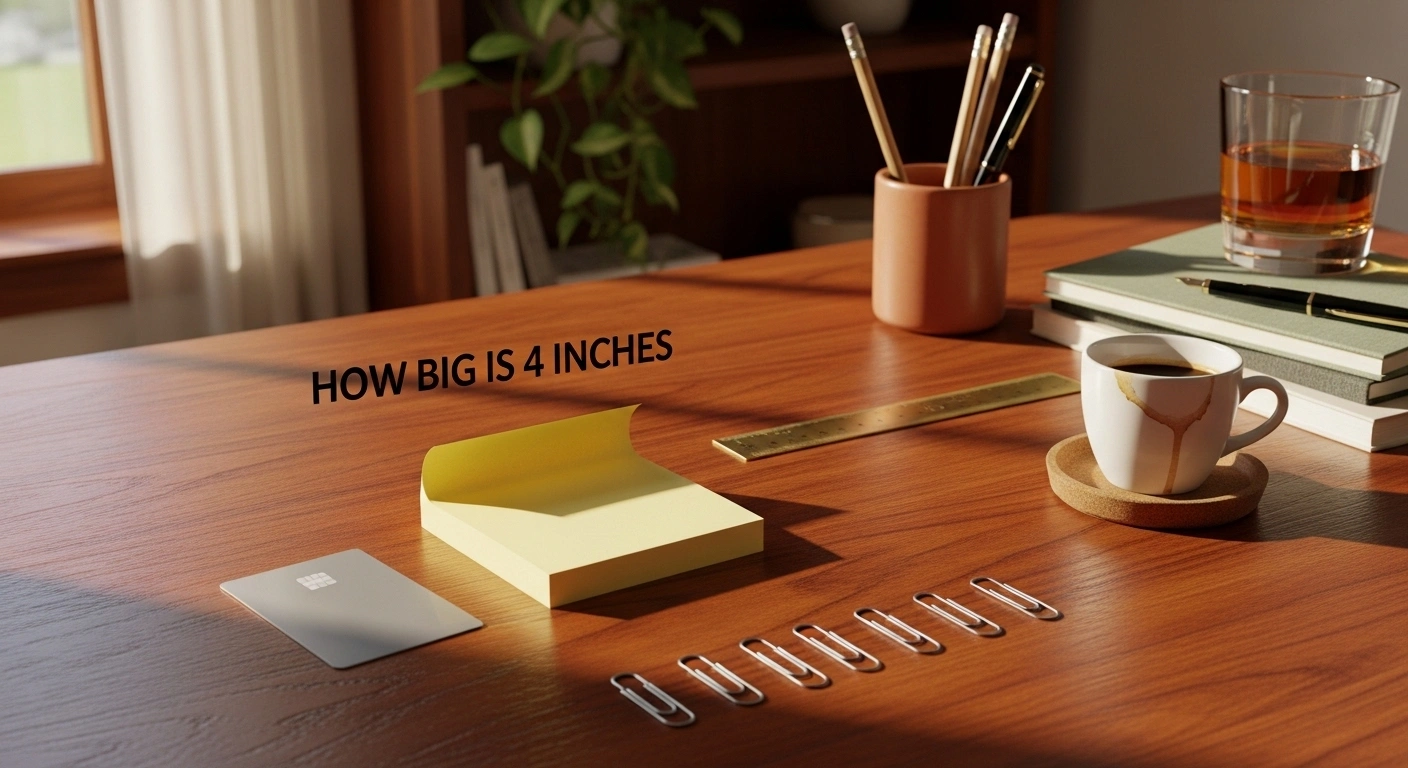

You’re staring at a product listing that says “4 inches,” and you have zero idea whether that’s going to fit your shelf, your pocket, or your project. No ruler in sight. Sound familiar?
Four inches equals exactly 10.16 centimeters — roughly one-third of a standard ruler and about the width of your palm across the knuckles. This guide gives you over a dozen ways to visualize, estimate, and measure 4 inches using objects already within arm’s reach. We’ve spent years covering measurement tools and dimensional guides at BusinessComputingWorld, and this is the most practical reference you’ll find.
4 Inches in Every Unit You’ll Need
Before comparing objects, here’s the conversion math — the part most guides bury at the bottom when you actually need it first.
| Unit | 4 Inches Equals |
|---|---|
| Centimeters | 10.16 cm |
| Millimeters | 101.6 mm |
| Feet | 0.333 ft (exactly ⅓ of a foot) |
| Meters | 0.1016 m |
| Yards | 0.111 yd |
The ⅓-of-a-foot shortcut is the fastest mental trick here. If you can picture a standard 12-inch ruler, divide it into three equal sections. Each section is exactly 4 inches. That mental image stays with you.
Your Body Is a Built-In Ruler for 4 Inches
You don’t need to find a specific object. Your own hand provides two reliable references for estimating 4 inches anywhere, anytime.
Palm Width Across the Knuckles
Place your hand flat on a surface with your fingers together. Measure the width from the outside edge below your pinky to the outside edge below your index finger — excluding your thumb. For most adults, this distance falls between 3.5 and 4 inches.
Here’s what most people miss: hand size varies significantly. According to NASA’s anthropometric data used for spacesuit design, the average adult male hand breadth at the metacarpals is approximately 3.5 inches, while the average female hand breadth sits closer to 3.1 inches. So your palm width is a close estimate, not an exact measurement.
Quick calibration trick: Grab a credit card (3.37 inches wide) and hold it against your knuckles right now. That gap between the card’s edge and the edge of your hand? That’s your personal offset. Remember it.
Index Finger Length
Your index finger, measured from where it meets your palm to the tip, typically runs between 2.9 and 4 inches for adults. If your index finger happens to be close to 4 inches, you carry a reliable measuring stick everywhere.
The real question is: how do you know if your finger is actually 4 inches? Measure it once against a ruler or credit card. Write the number down in your phone’s notes app. Done — you now have a calibrated body ruler for life.
12 Everyday Objects That Show How Big 4 Inches Is
Here’s where this guide gets genuinely useful. We’ve organized these by where you’ll find them — not just listed random items — so you can grab a reference no matter which room you’re in.
At Your Desk
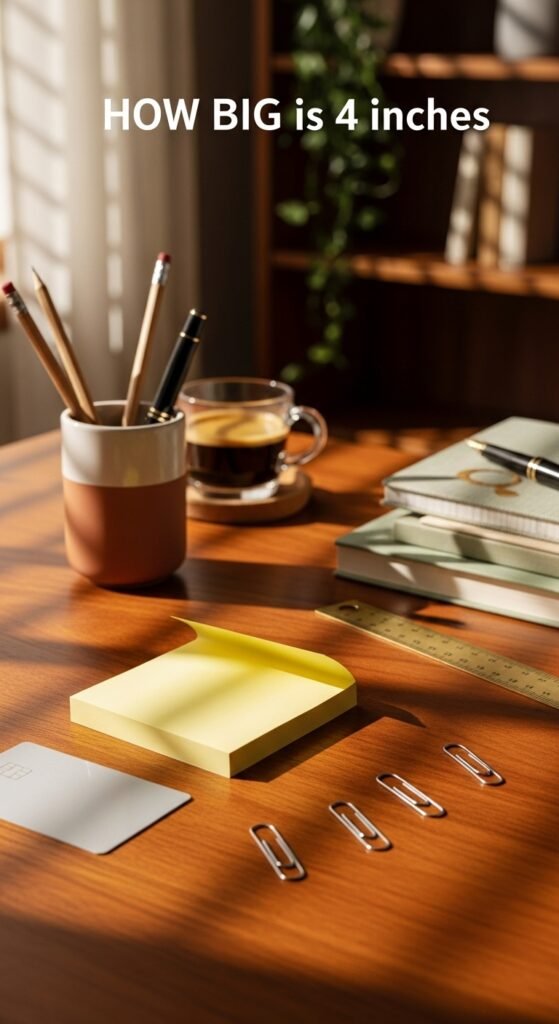
Standard square Post-It Note (4×4 inches): The classic yellow square Post-It measures exactly 4 inches on each side. Not the small 3×3 version — the larger square. Grab one, and you’re holding a perfect 4-inch reference in both directions. 3M, the manufacturer, has kept this dimension consistent since the product’s launch in 1980.
Credit card width (3.37 inches — close reference): A standard ISO/IEC 7810 credit card measures 3.37 inches wide and 2.125 inches tall. It’s not exactly 4 inches, but it’s close enough for quick estimates. The gap between the card’s width and a true 4 inches is roughly the width of your pinky fingernail.
Four standard paperclips end-to-end: A standard #1 paperclip measures about 1 inch long. Line up four of them end-to-end on your desk, and you’ve got a 4-inch measuring strip. This works in a pinch when precision isn’t critical.
In Your Kitchen
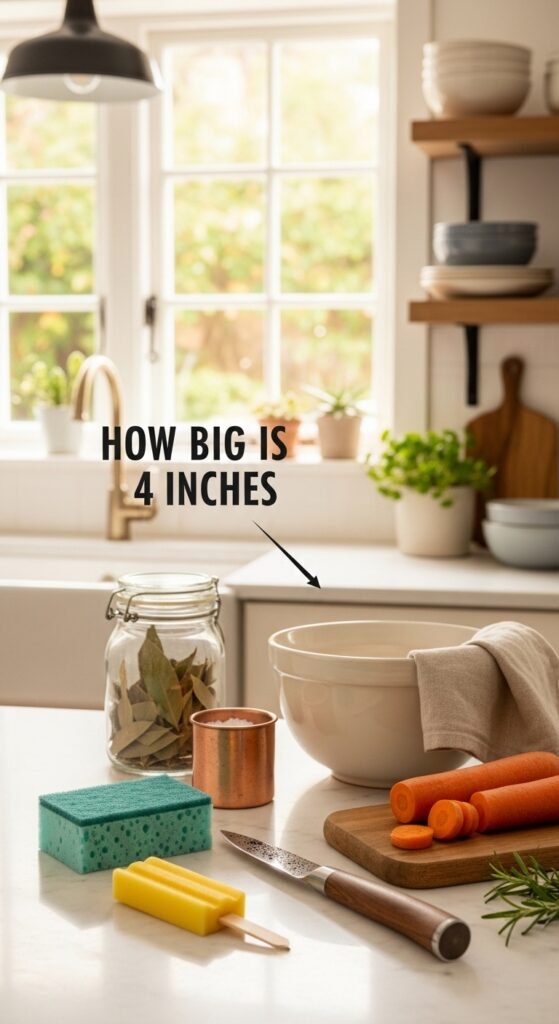
Kitchen sponge: Standard rectangular kitchen sponges — the kind sold by brands like Scotch-Brite and O-Cedar — measure approximately 4 to 4.5 inches long. Next time you reach for one while doing dishes, you’re holding a nearly perfect 4-inch reference.
Popsicle stick: The classic wooden craft stick (also called a tongue depressor in medical settings) measures almost exactly 4.5 inches. It’s slightly over our target, but close enough for estimation, and you’ll find these in nearly every household with kids.
Paring knife blade: Most paring knives sold by manufacturers like Victorinox and Wüsthof have blade lengths between 3.5 and 4 inches. The blade alone — not including the handle — sits right at our measurement.
In Your Toolbox

Stubby screwdriver: Those short, compact screwdrivers designed for tight spaces typically measure about 4 inches from tip to butt. Stanley, Klein Tools, and other major manufacturers all produce models in this standard size.
4-inch PVC pipe diameter: Walk into any hardware store’s plumbing aisle, and you’ll find 4-inch PVC pipes — one of the most common residential drain pipe sizes. The outside diameter of a standard 4-inch PVC pipe is actually 4.5 inches (pipes are measured by inside diameter), but the nominal measurement gives you the right ballpark.
Pocket spirit level: The torpedo-style levels that contractors clip to their belts typically measure around 4 inches long. Compact enough for a pocket, accurate enough for hanging pictures.
On Your Phone or Laptop
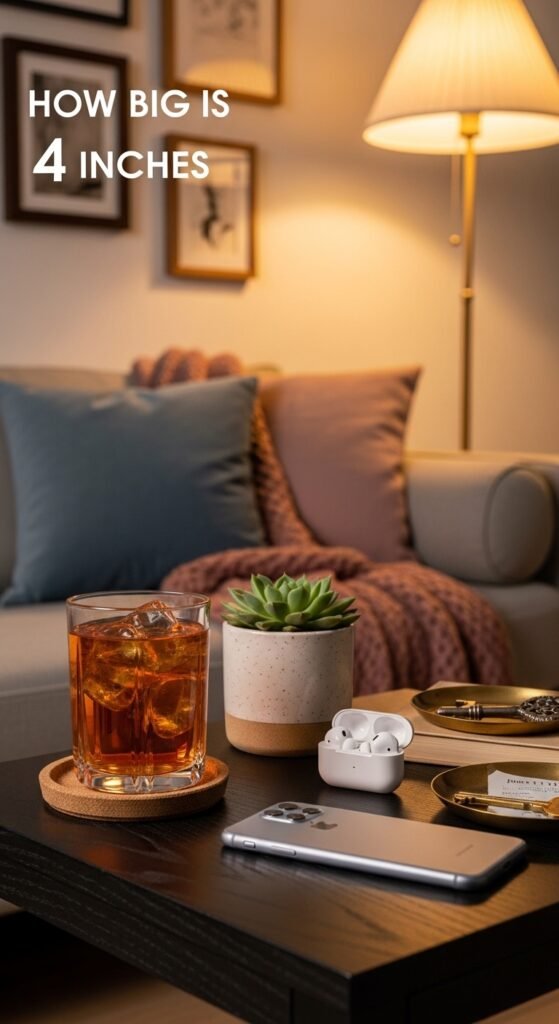
iPhone SE screen (4.7 inches): Apple’s iPhone SE (3rd generation, released 2022) has a 4.7-inch display measured diagonally. The phone’s physical width is approximately 2.65 inches, making the screen diagonal close to — but slightly over — our target measurement. The original iPhone 5 had a screen measuring exactly 4 inches diagonally, though that model is now a relic.
Standard drink coaster: Most drink coasters measure between 3.5 and 4 inches in diameter. If you’re sitting at a desk or coffee table right now, the coaster under your mug is likely a 4-inch reference you never noticed.
Surprising Comparisons
Toilet paper roll width: The standard cardboard tube inside a roll of toilet paper measures approximately 4 inches across (the width of the roll, not the tube’s diameter). Georgia-Pacific and other major manufacturers follow this industry standard.
But here’s what most people miss about 4-inch comparisons: many of these “4-inch objects” are actually approximations. A credit card is 3.37 inches. A playing card is 3.5 inches. A kitchen sponge might be 4.3 inches. The objects cluster around 4 inches without hitting it exactly. That’s perfectly fine for estimation — but if your project requires precision, use an actual measuring tool.
The “Two Quarter Stacks” Method (And Why It’s Wrong)
Several measurement guides suggest stacking U.S. quarter coins to measure 4 inches. Let’s check the math.
A single U.S. quarter has a thickness of 1.75 millimeters (according to the U.S. Mint). To reach 4 inches (101.6 mm), you’d need approximately 58 quarters stacked on top of each other. That’s $14.50 worth of quarters and a comically tall, unstable tower.
What about quarter diameters? A quarter’s diameter is 0.955 inches. Four quarters placed side by side in a row would give you 3.82 inches — close but not quite 4 inches. You’d need about 4.2 quarters, which means adding a dime (0.705-inch diameter) gets you to roughly 4.5 inches. Still not exact.
The takeaway: Coin-based measurement hacks sound clever but rarely deliver precision. Stick with a credit card, Post-It note, or your own calibrated hand.
When 4 Inches Actually Matters: Real-World Scenarios
Understanding this measurement isn’t just a fun exercise. Here’s where getting 4 inches right (or wrong) has real consequences.
Online shopping: Product photos rarely convey true size. A “4-inch decorative figurine” could look enormous in a staged Amazon photo and tiny on your shelf. Holding up a Post-It note while viewing the product image gives you instant scale.
Home improvement: Standard 4-inch PVC pipes are required by building codes for most residential toilet drain lines. Use a 3-inch pipe where a 4-inch is specified, and you’re looking at code violations and potential backups. The International Plumbing Code (IPC) specifies minimum drain pipe sizes for good reason.
Cooking: Recipes that call for cutting vegetables into “4-inch pieces” aren’t being fussy. Uniform sizing ensures even cooking. Four inches of carrot cooks differently than two inches of carrot — the center stays undercooked in the larger piece if your timing is set for the smaller one.
Screen sizes: If you’re shopping for a small display — a dashboard camera, a handheld gaming device, or a secondary monitor — knowing that 4 inches diagonally is roughly the size of an original iPhone helps you judge whether the screen will work for your eyes and hands.
How to Measure 4 Inches Without Any Tools
Here’s a step-by-step method that combines the references above into a reliable system:
- Check your pockets. Credit card? That’s 3.37 inches wide. Add roughly half a pinky-width.
- Check your desk. Square Post-It note? That’s exactly 4 inches per side.
- Check your hand. Palm width across knuckles = approximately 3.5–4 inches.
- Use the dollar bill trick. A U.S. dollar bill is 6.14 inches long. Two-thirds of a dollar bill is approximately 4.09 inches. Fold the bill into thirds — each section is just over 2 inches. Use two sections.
- Use your phone screen. Open a ruler app (several free options exist for both iOS and Android that use your phone’s known screen dimensions to display an accurate on-screen ruler).
The most reliable no-tool method: Use the credit card as your anchor. It’s a precisely manufactured object with ISO-standard dimensions. Everything else is an approximation — but a credit card’s 3.37-inch width gives you a solid baseline that only needs a small mental addition.
Common Misconceptions About 4-Inch Measurements
“4 inches is half a foot.” No — it’s one-third. Half a foot is 6 inches. This mistake leads to significant sizing errors in DIY projects.
“My hand span is 4 inches.” Your hand span (thumb tip to pinky tip, stretched wide) is typically 7–9 inches for adults. Your palm width across the knuckles is the measurement closer to 4 inches. These are very different measurements.
“Inches and centimeters are close enough to swap.” They aren’t. Four inches is 10.16 centimeters. If you accidentally read a 4 cm measurement as 4 inches, your object is actually 2.5 times smaller than expected. This error is common when shopping on international e-commerce sites that mix metric and imperial units.
[CONTENT UPGRADE: Download our printable 4-inch reference card — a credit card-sized cutout you can keep in your wallet as a portable ruler]
FAQ: Quick Answers About 4-Inch Measurements
Q: How big is 4 inches on a ruler?
A: Four inches is the distance from the zero mark to the fourth long line on a standard ruler. It represents exactly one-third of a 12-inch (one-foot) ruler. Each inch is subdivided into 16 smaller lines on most rulers, so the 4-inch mark sits at the 64th smallest division.
Q: Is 4 inches the same as 10 cm?
A: Close but not exact. Four inches equals 10.16 centimeters. The difference of 0.16 cm (about 1.6 millimeters) matters in precision work like engineering or sewing but is negligible for rough estimates.
Q: What common object is exactly 4 inches?
A: A standard 4×4-inch Post-It note is one of the few common objects that measures exactly 4 inches. Most other frequently cited objects — credit cards (3.37″), playing cards (3.5″), kitchen sponges (4–4.5″) — are close approximations rather than exact matches.
Q: How can I measure 4 inches with my fingers?
A: Place your hand flat and measure across your knuckles from the outside of your index finger to the outside of your pinky. For most adults, this distance is between 3.5 and 4 inches. For a more precise body reference, measure your index finger from base to tip — it typically falls between 2.9 and 4 inches depending on hand size.
Q: How big is 4 inches compared to a phone?
A: The original iPhone 5 (released 2012) had a screen measuring exactly 4 inches diagonally. Modern smartphones are significantly larger — the iPhone 15 has a 6.1-inch screen — so 4 inches is roughly two-thirds the screen diagonal of a current-generation phone. Physically, 4 inches is wider than most modern smartphones measured across their narrow dimension.
Q: Is 4 inches big or small?
A: Context determines everything. Four inches is large for a wound, small for a television, standard for a drain pipe, and compact for a smartphone by 2026 standards. As a general spatial reference, 4 inches fits comfortably in your palm — it’s a “handheld” size.
Q: How many 4-inch segments fit in a yard?
A: A yard is 36 inches, so exactly 9 segments of 4 inches fit in one yard. This makes 4 inches a convenient subdivision when working with fabric or other materials sold by the yard.
Your Next Step: Build Your Personal Measurement Toolkit
Stop Googling “how big is 4 inches” every time you need a size reference. Instead, spend 30 seconds right now doing this:
- Grab a ruler or tape measure.
- Measure your palm width across the knuckles. Write the number in your phone.
- Measure your index finger length. Write that down too.
- Note whether your credit card width (3.37″) or a Post-It note (4.0″) is your most reliable everyday reference.
You now own a measurement system that goes everywhere you go. No ruler required.
